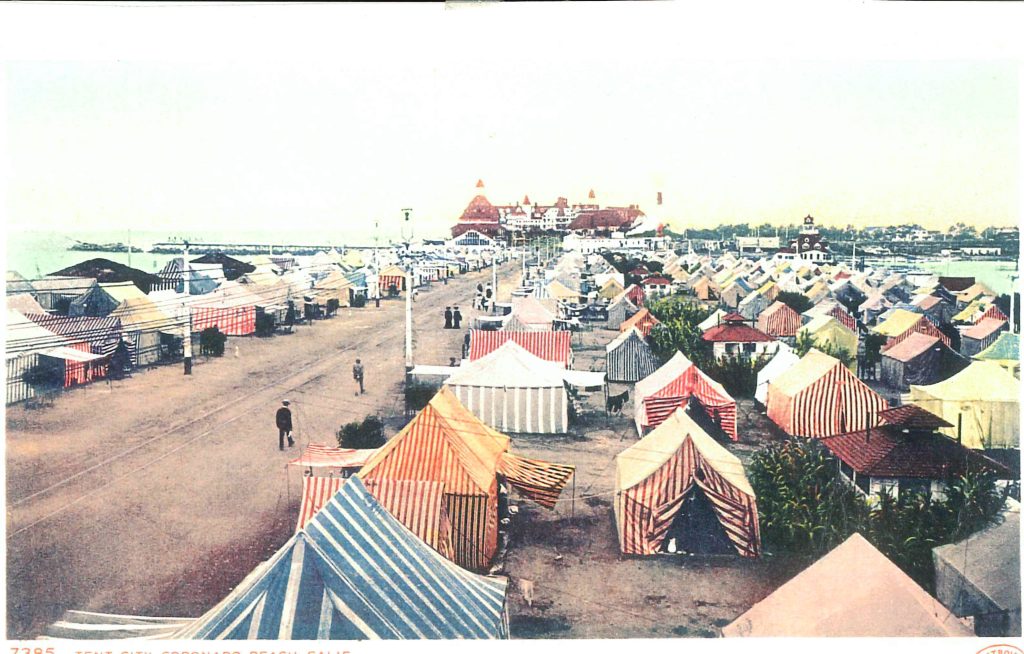



If you take a stroll through Coronado on any sunny afternoon, you will witness a town designed for recreation. From lawn bowlers dressed in white to children splashing in the community pool, our public spaces are the heart of island life. But the parks, beaches, and recreational centers we enjoy today did not appear by accident. They are the result of over a century of community planning, civic dedication, and a shared belief that public spaces belong to everyone.
The story of Coronado’s parks begins with the town’s founding fathers, Elisha Babcock and Hampton Story, who established the Coronado Beach Company in 1886. When they mapped out the island, they envisioned a resort community centered around healthy, outdoor living. This vision was quickly championed by John D. Spreckels, who acquired the Coronado Beach Company in 1890. Spreckels furthered this layout, which originally designated the center of the village as East and West Plaza Parks. In 1909, Spreckels hired architect Harrison Albright to construct a permanent public library building in the middle of West Plaza Park, gifting the completed structure to the people of Coronado.
Following Spreckels’ death, the City proposed renaming Glorietta Boulevard in his honor in 1927. However, local artist Grace Healy proposed that the central park would be a far better commemoration of the man who gave so much to Coronado, leading East Plaza to be officially renamed Spreckels Park. Today, it remains the crown jewel of our park system, hosting the legendary summer concerts and community picnics that define our summers.
As the town grew, so did the community’s passion for sports and the outdoors. Tennis has been a staple of Coronado life since the opening of the Hotel del Coronado, which featured some of the earliest courts in Southern California. The sport eventually expanded into the public sphere, leading to the creation of our beloved Coronado Tennis Center near Glorietta Bay. Similarly, golf found its paradise in 1957 when the Coronado Municipal Golf Course opened. The course was built on filled land along Glorietta Boulevard, which was created when the Port of San Diego dredged the shipping channel after World War II to deposit approximately 120 acres of sand. The legendary opening day foursome in 1957 featured Billy Casper, Gene Littler, Paul Runyan, and head professional Don Collett. When construction for the Coronado Bridge began in 1967, the course had to be re-routed, leading Jack Daray Jr. to redesign the first nine holes into the layout we enjoy today.
Our smaller neighborhood parks also carry stories of Coronado’s early leaders and quirky local lore. The park at Adella and Pomona was established in 1914 after the City purchased the lots from a private homeowner. Originally named Pomona Park, it was humorously nicknamed Bologna Park because of its unique shape, or red slide park due to a beloved playground feature that stood there for decades. In 1954, it was officially renamed Mathewson Park in honor of J.A. Mathewson, nicknamed “Mr. Coronado.” Mathewson established the town’s first retail business, a grocery store known as the Lower Store at Second Street and Orange Avenue, and served as the city clerk for many decades. Similarly, Vetter Park, nestled at the center of Guadalupe, Cajon, and Jacinto, was named in 1984 after Dr. Paul Vetter. Dr. Vetter practiced dentistry on the island for over thirty years and served as Coronado’s mayor from 1968 to 1970.
The waterfront has always been Coronado’s greatest asset, and protecting public access to it was a major victory for residents. Our pristine beaches have been carefully preserved as public trusts. This dedication to waterfront access culminated in the development of the Glorietta Bay park system, as well as the creation of Tidelands Park. Developed in 1988 on the site of a former World War II federal housing project, Tidelands Park is now Coronado’s largest park at 22 acres. For decades, residents also dreamed of a central hub for community gatherings and aquatics. That dream became a reality with the construction of the Coronado Community Center and the adjacent public pool on Strand Way. Overlooking the water, this modern facility serves as a daily meeting place for fitness, youth programs, and family celebrations, perfectly capturing the active, generational spirit of our town.
To guarantee that these cherished spaces remain untouched by future development, the community took a monumental step in 2004. On October 20 of that year, the Historic Resource Commission recommended, and on November 16, the Coronado City Council officially passed Resolution CC 8029. Under project number HR 13-02, this landmark municipal decision granted official historic designation to all of Coronado’s public parks and community open spaces. This historic status legally protects parks like Spreckels Park, Star Park, Centennial Park, Sunset Park, Mathewson Park, Palm Park, Triangle Park, Vetter Park, Bay Circle Park, Bandel Park, and Vista del Barco from being repurposed or lost to urbanization. It is a powerful testament to our community’s values, proving that we treasure our shared green spaces and outdoor heritage just as much as our historic architecture.
Looking back, we can see that our parks, beaches, and recreational centers are much more than just physical assets. They are the social fabric of Coronado. Whether you are playing a round of golf, taking a dip in the community pool, or simply watching the sunset from the beach, you are participating in a legacy of play and preservation that has kept our community feeling like a small, welcoming village for generations.
This historical feature was written by Christine Stokes of the Coronado Historical Association. Thank you for sharing your knowledge and helping us celebrate Parks and Recreation Month!