




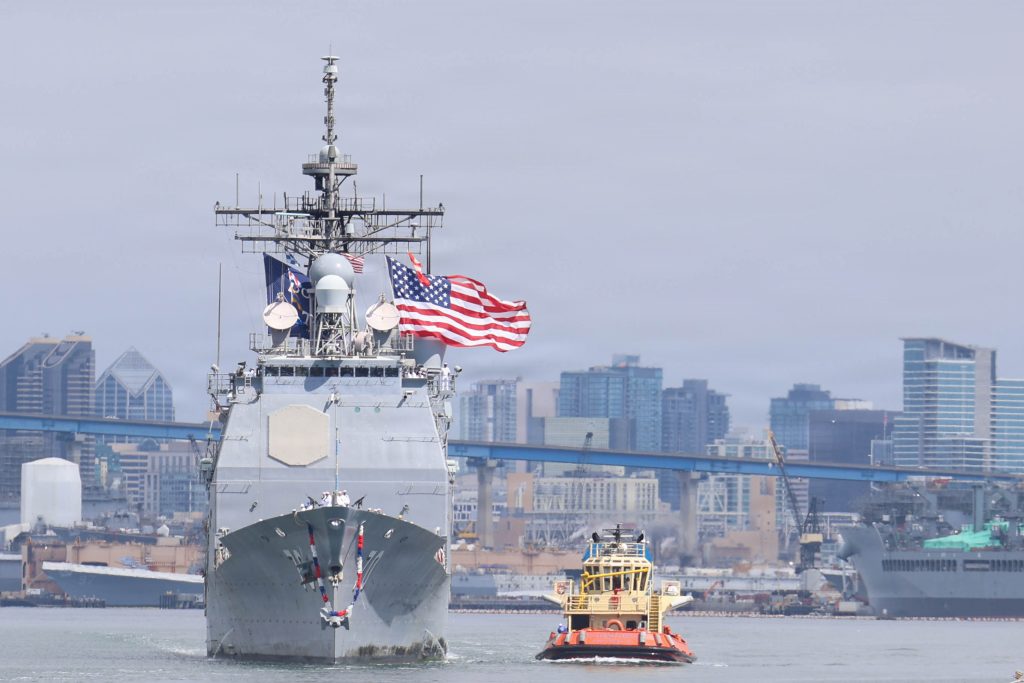
USS Lake Erie returns to San Diego after 11 months at sea
After nearly a year away, the crew of USS Lake Erie is home. The guided-missile cruiser pulled into Naval Base San Diego on June 27, ending an 11-month deployment to the waters off Central and South America.
The ship spent the deployment on counter-narcotics and maritime security missions under U.S. Southern Command’s Operation Southern Spear. Those operations resulted in the seizure or disruption of more than 2,900 pounds of narcotics, according to the Navy.
In one interdiction, the crew — working with an embarked Coast Guard law enforcement team — stopped the M/T Sophia, a stateless tanker sanctioned for illicit oil smuggling.
Lake Erie also served as the air and missile defense commander for the region during the deployment.
“I am immensely proud of this crew and what they have accomplished over the past 11 months,” said Capt. Drew A. Borovies, the ship’s commanding officer. “We are thrilled to be returning to our families, whose steadfast support and sacrifice on the home front made our successes possible.”
The Ticonderoga-class cruiser is named for the Battle of Lake Erie, the decisive U.S. victory that secured the Great Lakes during the War of 1812.
Coronado agrees to $34K settlement over 2025 sewage spills
The City of Coronado has agreed to pay a $34,430 administrative civil liability to resolve alleged water quality violations tied to two sewage spills last year, including one that discharged untreated sewage into San Diego Bay and another that reached the Pacific Ocean at North Beach.
The settlement, issued by the San Diego Regional Water Quality Control Board, stems from two 2025 incidents: a July 1 spill in the Coronado Cays and an Oct. 20 spill near the Parker Pump Station. In both cases, the water board alleged the city failed to prevent unauthorized discharges of untreated sewage, in violation of the federal Clean Water Act, California’s Porter-Cologne Water Quality Control Act and state and regional waste discharge requirements.
City Manager Tina Friend signed the settlement acceptance April 16, and David W. Gibson, executive officer of the San Diego Water Board, signed the order May 28.
The first incident occurred July 1, 2025, when an air release valve failed at the Cays Main Pump Station, causing 1,550 gallons of untreated sewage to enter the city’s stormwater drainage system. The city recovered 277 gallons, but the remaining 1,273 gallons discharged from a coastal stormwater outfall into San Diego Bay within the Coronado Cays community, according to the settlement documents.
The city notified the California Office of Emergency Services and the San Diego County Department of Environmental Health and Quality. As a precaution, DEHQ closed two nearby public areas, including one near a marina and one beach area. Both reopened the following day after water quality samples showed enterococcus bacteria levels met state health standards for recreational use.
The water board found the failed air release valve was listed on the city’s pump station inspection checklist, but said city staff had not been specifically inspecting the valve in the six months before the spill. The board said that deprived the city of the opportunity to identify the malfunction and potentially avoid the spill.
The second incident occurred Oct. 20, 2025, when a force main ruptured near the Parker Pump Station construction site, causing a 4,089-gallon sewage spill. The city recovered about 1,500 gallons by vactor truck and removed or retained another 419 gallons in surrounding soil, but an estimated 2,170 gallons entered the city’s groundwater extraction system, which ultimately discharged to the Pacific Ocean shoreline at North Beach.
The city told the water board it believed heavy equipment moving over the path of the force main may have shifted the pipe alignment, causing the rupture.
DEHQ sampled water at North Beach the afternoon of Oct. 20 and closed the beach the following day after samples showed elevated enterococcus bacteria. The beach reopened Oct. 22 after additional samples showed the water was safe for contact recreation.
The water board noted that North Beach is a popular swimming beach and dog area, and said the beach remained open the day of the spill, putting beachgoers at risk of exposure. While the city responded by stopping the spill, recovering sewage and contacting DEHQ, the board said the city did not proactively post warning signs for beachgoers while awaiting DEHQ’s arrival, even though the city’s spill response plan allowed staff to do so.
The water board calculated a base liability of $14,420 for the two spills, but ultimately sought the maximum statutory liability of $34,430, citing the need for deterrence and the city’s $39.2 million unassigned fund balance in its fiscal year 2025-26 budget.
The settlement allows the city to apply up to $17,215 of the penalty toward a supplemental environmental project, such as the Southern California Bight Regional Monitoring Program. The remainder would be paid to the State Water Resources Control Board Cleanup and Abatement Account.
The water board noted that the city had no history of adjudicated violations.