




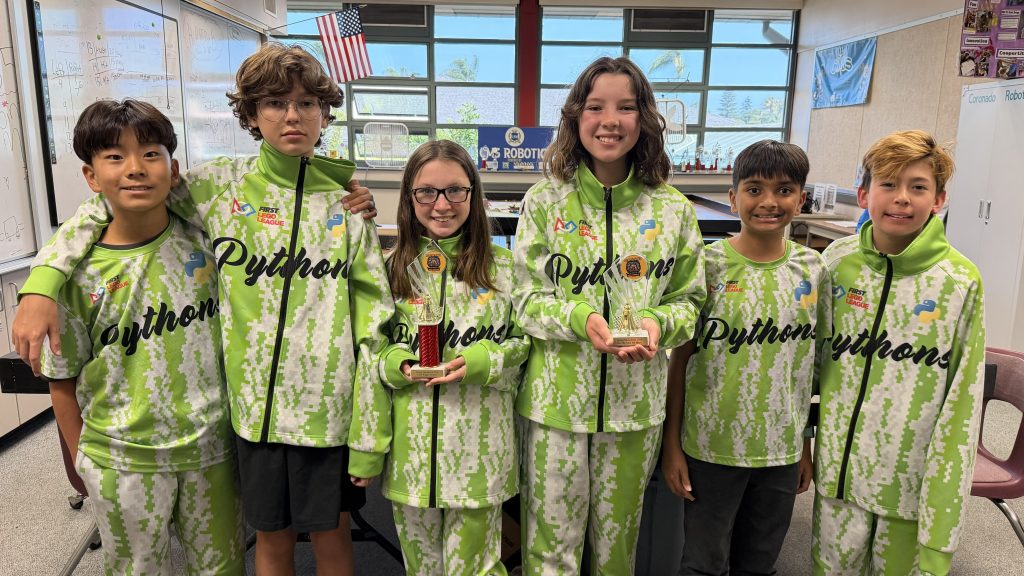
Robotics students from Coronado Unified School District (CUSD) demonstrated exceptional engineering skills, leadership, and composure at the recent FIRST LEGO League (FLL) Spring Showdown 2026, held at Patrick Henry High School. The highly-competitive event brought together 28 teams of students in grades 4–8 to design, build, and program LEGO robots under unique, high-pressure conditions.
The competition included an “On the Spot” challenge. Teams were handed brand-new mission sets they had never seen before, and judges explained the rules in real time directly at the competition tables. With only 1.5 hours on the clock and a strict ban on coach or parent assistance, students had to rely entirely on their own creativity, technical skills, and teamwork to build a functioning robot from scratch.
Adding to the complexity, teams were grouped into two-team alliances, intentionally pairing experienced, veteran teams with younger or newer rookie groups. This structural twist fostered immediate on-site mentorship, collaborative problem-solving, and peer-to-peer learning. Success in the robot game was determined by precision and strategy during intense 2-minute robot runs, where teams scored points by navigating obstacles and activating complex LEGO mechanisms.
CUSD was highly competitive throughout the event, fielding five teams: Representing Coronado Middle School (CMS) were the HackHERs, Pythons, Tiki Tech, and G-Force. Representing Village Elementary were the Engineering Explorers. One of the event’s most impressive performances came from CMS’s rookie team, the Pythons, who earned 1st Place in Core Values and 1st Place in the “On-the-Spot” Robot Challenge, demonstrating outstanding teamwork, creativity, and problem-solving throughout the competition.
A major factor in CUSD’s success was the pipeline of leadership from older students. High schoolers from the Coronado High School (CHS) FIRST Tech Challenge (FTC) and First Robotics Challenge (FRC) programs stepped up as event mentors, guiding the younger FLL teams through the stressful trial.
“Mentoring the Pythons has been a very beneficial experience,” said Porter Aston, a CHS FTC mentor. “Teaching the basics of mechanical design principles strengthened their understanding as well as my own, and it was exciting to see how well the rookie students from CUSD Robotics excelled at competition.”
Beyond the technical robot mechanics, teams were heavily evaluated on the core values of the FIRST program: Discovery, Innovation, Impact, Inclusion, Teamwork, and Fun. Judges specifically looked for positive sportsmanship, respect for volunteers, and mutual support across the multi-school alliances. These behaviors culminate in the coveted Core Values Award — an honor celebrating FIRST’s guiding principles of Gracious Professionalism and Coopertition.
The Spring Showdown proved that success in youth robotics is measured just as much by character and collaboration as it is by engineering. CUSD students returned home not only with sharpened coding and mechanical design skills, but with strengthened confidence, leadership experience, and new friendships across the regional robotics community.
In alignment with its Portrait of a Graduate initiative and in collaboration with the Coronado Schools Foundation, specialized pathways like Robotics have rapidly expanded across the district. “Programs like Robotics align with our goal of preparing students for success in higher education and future careers by providing programs that emphasize innovation, collaboration, and student leadership across all grade levels,” said Superintendent Karl Mueller. “Our Robotics program, under the leadership of Director Roberta Lenert, has grown exponentially across all CUSD schools in the last two years and we are committed to keep the momentum going. We are very proud of our student teams and clubs!”
“One of the most rewarding parts of this season has been watching our students thrive with confidence in a STEM environment while developing the qualities highlighted in CUSD’s Portrait of a Graduate including creativity, resilience, critical thinking, leadership, and collaboration,” said Lenert. “These students are not just building robots; they are building the character, confidence, and skills to become the next generation of innovators, leaders, and problem-solvers who will make a lasting impact on the world.”