




– eCoronado.com Exclusive –
A LAST WALK ON THE DECKS OF
THE FERRYBOAT SAN DIEGO
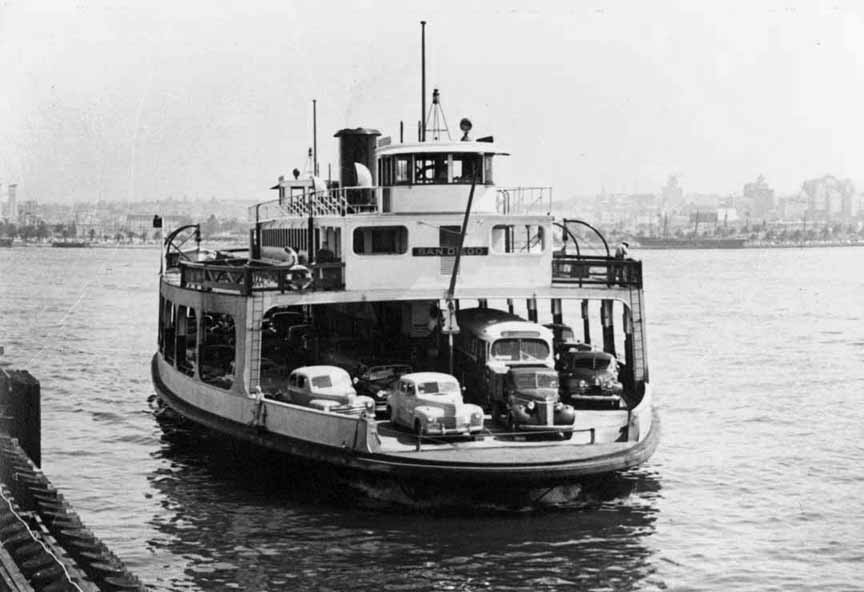
CORONADO As we shared in January, in Part 1 of this saga, the ferryboat SAN DIEGO, one of the final five, car-carrying ferryboats to operate the San Diego-Coronado run (1886-1969) is marked for demolition.
Debbie Riddle and LEE MATHER CO., REALTORS have funded an expedition to the Bay Area to document the final days of the ferryboat SAN DIEGO. Joe Ditler, a Coronado writer and historian, has been asked by Lee Mather Company to travel to the Bay Area and assist in documentation of the ferryboat’s final hours.
The City of Coronado has sent a letter with Ditler outlining a desire to retrieve a few items from the boat. While the ferryboat has been picked clean of most everything of value, there are three navigational poles, some block & tackle from the lifeboat davits, and other ephemera he will attempt to bring back to Coronado.
“Two of the original navigational poles are still in position,” said Ditler. The nav poles jut outward and upward from the two pilothouses. They are about 20 feet long. A third pole is affixed to the upper deck as a spare.
“The ferryboat captains would use the nav poles to line up on the far shore, to hold course during the passage from Coronado to San Diego and back,” said Ditler. “We hope to use them to help decorate the old ferryboat ticket booth that presently sits in Centennial Park.”

Bruce Muirhead lives in the Bay Area but grew up in Coronado. Over the years he has shared many fond memories of the Coronado ferryboats and island history with Ditler. In honor of his uncle, Bruce Muirhead (who died in 2006), the two men are partnering in an effort to document the final days and the last voyage of the ferryboat SAN DIEGO.
One of the major goals of this expedition is to photo document the ferryboat being demolished. Muirhead and Ditler have captured the grim situation with the ferryboat SAN DIEGO in first person prose, combined with video clips and photographs. These will go to the Coronado Public Library as a final chapter on the car-carrying ferryboats that are so fondly remembered by residents of Coronado and San Diego.
The 81-year-old, 208-foot-long SAN DIEGO had been a derelict on the Delta of Northern California for many years (sometimes known under her more recent name, KLONDIKE QUEEN), the result of numerous failed attempts to modify her into something she was never meant to be – a theatre, a restaurant, a museum, a real estate gateway.
The California State Lands Commission has acquired all liens of ownership on the well-traveled vessel in an effort to eliminate a potentially dangerous navigational hazard and eyesore. They will move and demolish the ferryboat in several stages over the next few weeks.
A few days before the final voyage of the ferryboat SAN DIEGO, however, Bruce Muirhead went on board and captured some final glimpses into this old boat and Coronado’s very special Golden Age of Ferryboats through his own emotional walkabout on the boat.
Here Bruce shares his collection of thoughts as he boards the ferryboat SAN DIEGO not for the first time, but probably for the last time:

Ferryboat SAN DIEGO on maiden voyage south to San Diego. Rounding Point Conception
in 1931 with owner’s car strapped to car deck. A close call …
“My mission was simple,” said Bruce. “Get on board that ferryboat before it’s too late, and assess her condition.’ When I got the call from Joe Ditler I knew before he even finished his first sentence that we were about to set out on a great adventure, and I was ready and willing to do whatever I could to help. Especially if it meant I could walk the decks of the old ferryboat SAN DIEGO one more time
“I met Peter Pelkofer and Bryant Sturgess at the Brannan Island boat ramp along Three-Mile Slough. Peter is senior counsel for the California State Lands Commission, and Bryant is their water boundary consultant. We were to visit the ferryboat aboard Bryant’s 21-food speedboat with official sanction from the California State Lands Commission, current (and final) owner of the ferryboat.
“Three-Mile Slough was mirror-smooth, so calm, but I can’t say as much for myself. I was nervous with anticipation. I knew the old boat would look nothing like the ferryboat of my childhood. Still, that anticipation was driving me crazy.
“We boated out of Three Mile-Slough and went south into Horseshoe Bend, which, in conjunction with the Sacramento River, forms Decker Island. Horseshoe Bend has been the final resting place of the ferry SAN DIEGO for several years. Her final voyage was scheduled the following week, when she would get towed to Mare Island for the demolition phase.
“As we came around the bend I recognized that familiar profile, and she just looked a little weathered from the distance. As we got closer, however, she looked more than just weathered. Her exterior sadly reflected neglect, and a number of manmade attempts to utilize her beauty and stateliness for commercial gain.

“The once proud white and green ferryboat agonized through all of this being banished by two cities (Coronado and Antioch) as well as suffering through a small army of squatters and “artists” and a major fire that mostly destroyed her passenger deck (see links to earlier articles about the ferryboat’s rocky past here).
“Debris, broken glass, toilet bowls, sheet metal parts,
insulation hanging down, sheetrock weathering,
but mostly debris scattered everywhere.”
“However, what still stand proudly, as lone survivors of her glory years, are her lifeboat davits, her smokestack, a couple of intake funnels, as well as her two pilothouses – their navigational poles still in place and ready for her last voyage.
“I boarded, stepping on to her car deck with great dismay. I had stepped on to a concrete slab. Where was her sturdy decking that we drove on so many times in the 50s and 60s? Where were those massive bollards used to tie her up as she ended each trip in her slip? I had plenty of questions. Sadly, there were no answers.
“Though Peter had been very clear in his descriptions over the phone, the actual sight was unfathomable. The outline of the ferryboat SAN DIEGO from afar was distinct and harkened to another time. On deck, however, it was a disaster zone, resembling nothing in my memory.
“Debris, broken glass, toilet bowls, sheet metal parts, insulation hanging down, sheetrock weathering, but mostly debris scattered everywhere. It was as if a 30,000 square foot house was going to be remodeled, with demolition complete, but debris not removed.
“I wanted to take pictures, but I could immediately see that there was nothing of value inside her abandoned hollow shell. We had expectations. We wanted to, as Joe Ditler said, take pictures of things, that if you looked at them, would cause you to remember the ferryboat in her glory days. Things that perhaps have not changed all that much.’ Well, it had certainly changed. Most everything was trash.

“I climbed up to her passenger deck in the hope of capturing some silhouettes of her pilothouses and smokestack. This was her charred, burned out deck, a place that had seemed so magical to me as a child. Our folks would turn off the engine on the car and my brother Clarence and I would be up the ladder within seconds, knowing we only had 20 minutes to explore the ship before the sound of car engines starting gave the alert we were pulling into the dock.
“Disappointment ran throughout. The interior of the old SAN DIEGO was hardly recognizable. But then, on closer inspection, I could see the burned and charred areas only thinly disguised her once magnificent, steel superstructure. When revealed, sure enough, there were the portholes you could look through and see the engines down below. Once upon a time, that is.

“And, I imagined that this would have been where that neat, brass, shiny commissioning plate proudly exclaiming MV SAN DIEGO-1931′ was mounted. I was surrounded by debris on this deck as well. The only other artifacts trying to stir my imagination were the interior wooden columns supporting her top deck. Other than that, everything had changed. She was a dead ship.
“As I looked around I spotted her two pair of lifeboat davits with their partially remaining block & tackle. They stood devoid of their lifeboats (all the great iconic images of the boat lifeboats, engine telegraph, brass, signage, ship’s wheel had long ago been stolen). But the davits remained, standing sturdily erect with a backdrop of electricity-generating windmills on the surrounding hills. I found some of the original railing and support posts that had protected her lifeboats from inquisitive travelers and pedestrians.

“I stood and tried mightily to conjure up my imagination, trying to generate some creativity, looking for some arches or stairs to take me back in time, some subject that would help bring her back to life for me, mostly to no avail. Yet, those davits and columns were real. I found myself putting my hands on them, as if to make sure they were still there

“And, there was a wooden ladder, looking original,
probably many a captain having been up and down it.
So up I went.”
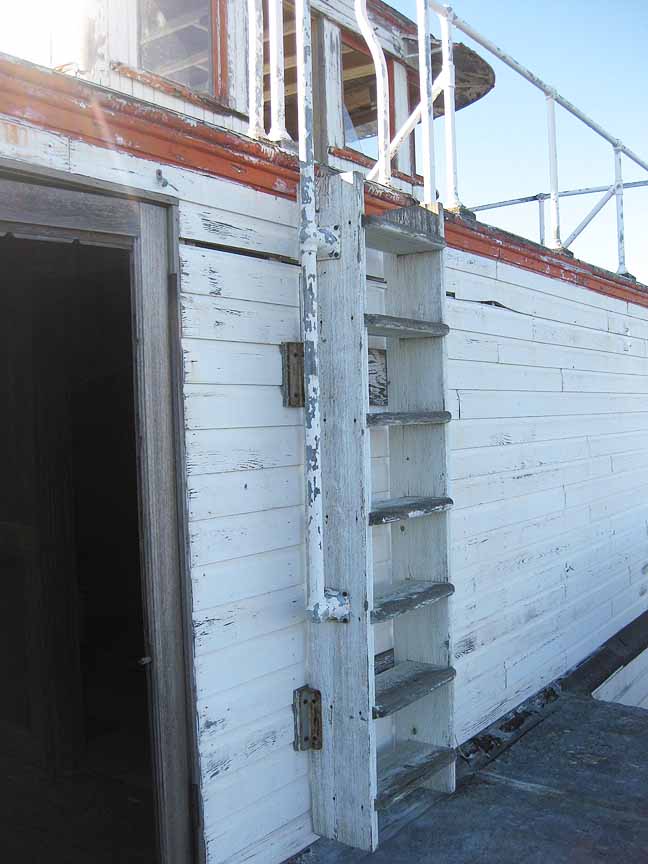
“As I took a final look up to the top deck, I realized that if you squinted your eyes and strained your memory, you could remember the noises and smells of your youth amidst those silhouettes of her pilothouses, smokestack, and funnels. And, there was a wooden ladder, looking original, probably many a captain having been up and down it. So up I went.
“… the bells from the engine room,
the slushing of the water
as propellers went into full reverse,
the cracking wood of pilings,
the deep screeching as the boat’s rub rails
got to know those pilings …”
“As I climbed up the ladder I could immediately see two large funnel stacks lying on the deck, no longer in place. They must have been ventilation funnels for sending air down into the engine room, I thought. Two other, smaller funnels are still in place next to the smokestack.
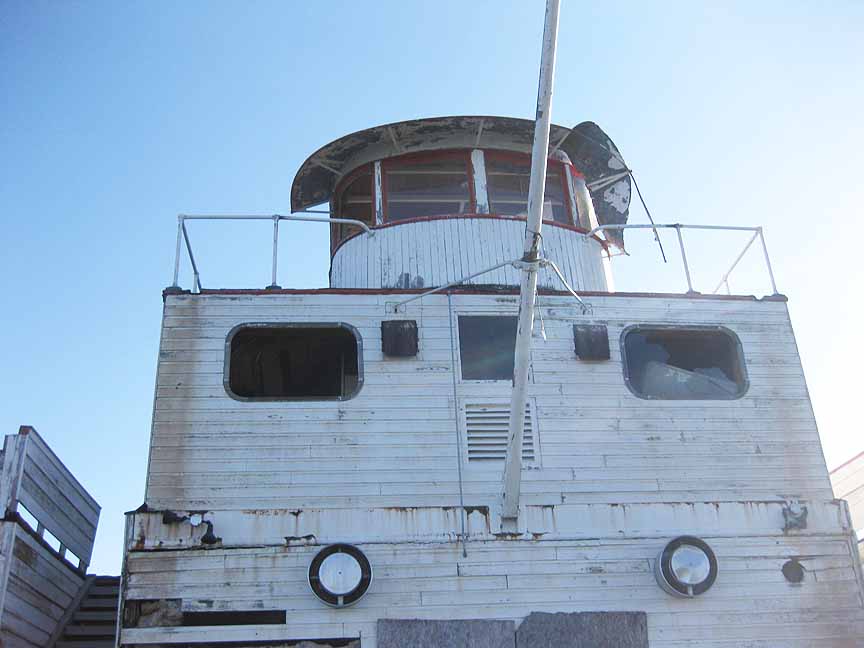
“The pilothouses were a wonderful experience. Here was sacred ground on any boat. Here the captain was responsible for everything and everyone on board. Their safety was in his hands and no one else would be as welcome in these two, small houses as the captain. Being so relatively small they couldn’t hold as much litter as the car and passenger decks.

“Stepping inside of each pilothouse, one could imagine looking out the windows, past a windshield wiper still dangling, lining up the navigation pole to an object on the far shore, reversing those big, diesel engines, and pulling into the slip aided by creosote-soaked pilings. Some gave way, others held. I’ll never forget the motion, the smell, nor the noise of that childhood memory the bells from the engine room answering the helm, the slushing of the water as propellers went into full reverse, the cracking wood of pilings, the deep screeching as the boat’s rub rails got to know those pilings. Who could ever forget such memories? Not me …

“I worked my way back down to the car deck to join Peter and Bryant in the boat. We took one last circle around the old gal, then, back to Brannan Island.
“She’s done. And, she’s now in the throes of the most definitive process she’s been involved in since her days as a ferry ended. Sadly, this process will result in her last voyage. She won’t be able to do it on her own. She’ll have the help of two tugboats to escort her to Mare Island, where she will meet her end and face her executioner – a mysterious assassin with a knacker’s torch.
“As I headed home I pulled over on Highway 160 and took one last photo from afar. The MV SAN DIEGO’s just peeking up over the levee as if to say, I’m not done yet!'”
 -###-
-###-
Editor’s Note: A third installment of the Final Days of the Ferryboat SAN DIEGO will be posted soon on eCoronado.com. We hope you’ll share your comments and memories of the old ferryboats with our readers, and tell others about this ongoing saga to doc