



FERRYBOAT SAN DIEGO FALLS TO
WRECKING BALL AND KNACKER’S TORCH
By Joe Ditler

The ferryboat San Diego is seen here in 1968 with bridge construction going on in the background.
Photo courtesy Coronado Public Library.
VALLEJO This is the final chapter of our expedition to document the last days of the ferryboat San Diego. The end did not come easy for her, or for anyone involved.
In fact, we began to liken it to an execution, as the clock ticked down only to have her fate postponed day by day due to unexpected litigation re hazardous material removal. Eventually we began to joke about what her “final request” might have been, or “final meal,” or that, “The Governor called at midnight and stayed the executioner’s hand yet again.”
Rainstorms blew in and out of the region during this time, and the 81-year-old, 208-foot ferryboat just kept tugging at her chaufed mooring lines with the tide, as if restless to move once more, or perhaps just trying to escape the inevitable.
Every day I would call to see if the authoratative thumb pointed up or down. Flights were booked, and then cancelled again and again. Eventually the boat’s current owner, the California State Lands Commission, weeded through the paperwork and final demolition dates were secured.
It is a sad but dutiful story I bring you now in describing the ferryboat San Diego’s final chapter. Like a favorite aunt who was special to you in your youth, but had grown old and sickly towards the end of her life, maybe it’s better to remember her the way she was. No one will blame you if you don’t want to read this story.
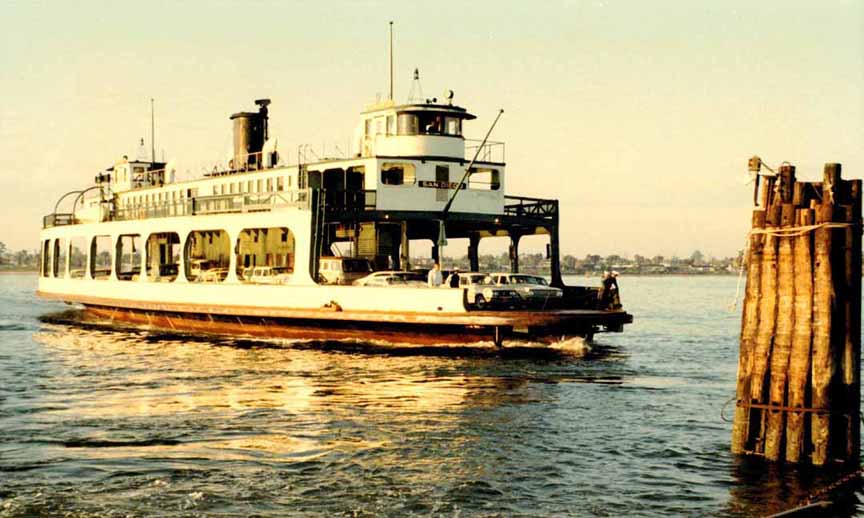 The ferryboat San Diego in operation towards the end of her Coronado career, circa mid-1960s.
Photo courtesy Coronado Public Library.
The old ferryboat San Diego had faithfully served on the Coronado-San Diego run from 1931-1969. She was part of a legacy of horse & buggy-carrying ferryboats (and later automobiles) that began in 1886. The ferryboats were massive then. Today they are small, and only carry pedestrians and bicyclists.
In Chapter One we described the wonderfully romantic history of the Coronado ferryboats in general, and each one’s slow demise over the years. In that story we told you of the ferryboat San Diego, and how she had been declared a hazard to navigation and was now scheduled for demolition. The link is below:
In Chapter Two we took you on board the old boat. Former Coronado resident, Bruce Muirhead, provided still photos and video of the adventure and we were all touched by his emotional exploration of the ferryboat San Diego as he looked for something, anything to remind him of his youth in Coronado, and on this very boat. That link follows:
https://coronadotimes.com/profiles/blogs/end-of-the-ferryboat-san-202012833
Since then, Bruce and I arranged to rendezvous in the San Francisco Bay area to hopefully board the ferryboat San Diego one last time for a specific undertaking. That expedition was two-fold. First, we wanted to capture photos and film of the boat’s final days for eventual archiving in the Coronado Public Library (and use in their upcoming ferryboat exhibit).
 Joe Ditler, left, and Bruce Muirhead on board the ferryboat San Diego at Mare Island Shipyard.
Their consensus? “She ain’t what she used to be.”
The other part of our mission was to see what, if anything, could be removed from the ferryboat and brought back to Coronado. The City of Coronado is considering using these materials to enhance an existing tribute to the Ferryboat Era at Centennial Park, where the old ferryboat ticket booth now stands (the original Ferry Landing at the foot of Orange Avenue).
The expedition to document this story and recover artifacts was funded by Debbie Riddle and LEE MATHER CO., REALTORS, with assistance from the Bruce Muirhead family. I had a letter in hand from the Coronado City Manager introducing me to the old boat’s current owners as the historian heading up the project, and expressing interest in retrieving historic artifacts such as the navigational poles and, “other artifacts significant to the community of Coronado.”
“It had been on fire, adrift,
abandoned, and now aground.”
Since publishing the first two parts of this saga, numerous people have written asking why we couldn’t just bring the ferryboat back to Coronado and, “Do something” with it.
Well, even if we had somewhere to put it, and a few million discretionary dollars to play with, that possibility evaporated a long time ago. The boat had been a liveaboard a derelict – on the Sacramento River, nudged up against Decker Island for many years. It had been on fire, adrift, abandoned, and now aground.
However, the thought that we might have (had we known months earlier of the boat’s intended demise) retrieved the old stack and one of the pilothouses for restoration and use in a children’s playground (for example) was tempting.

So tempting were these illusions of maritime treasure that every time I turned my back, Bruce Muirhead could be found trying to lift one of the 8-foot, 500-pound funnels from the top deck to add to our salvage wish list, or measuring the deck houses to see if they would fit in the trailer he had rented. We were like hungry kids in a candy shop. “Treasure” has that effect on you, especially maritime treasure.
Like a dark, film noir scene, rain pelted my car as I drove out to Mare Island to find the ferryboat and witness her execution. Mare Island was once a thriving shipyard. Now it’s like stepping onto a set from TV’s “Walking Dead.” These once-majestic buildings stand silent, dark and lifeless, with windows broken out or boarded over, and no sign of life except the occasional hungry seagull. This went on block after block as I made my way to Gate Jericho along the wharf. It was a ghost town of enormous proportions.
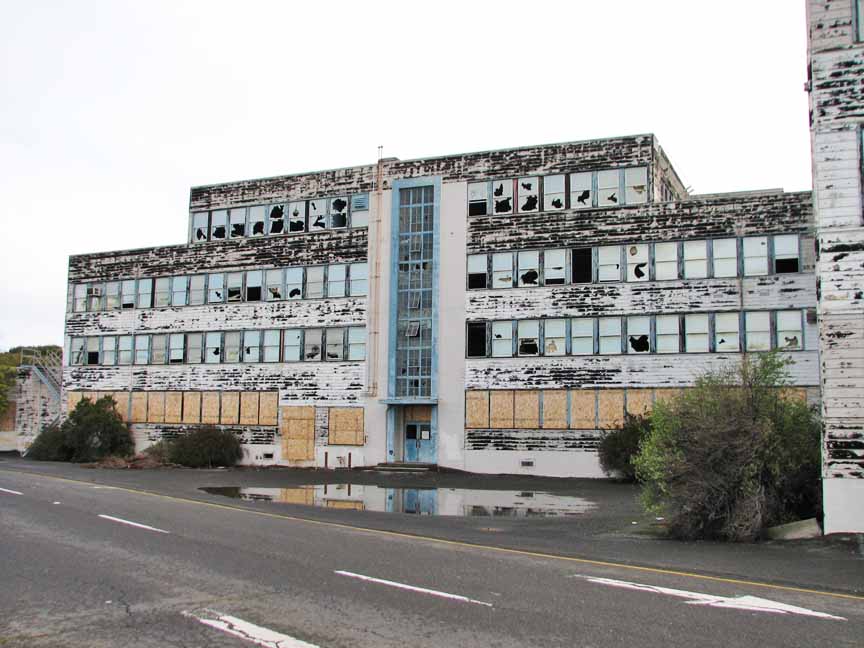


The old Mare Island Train stood idle under a lean-to on my right. The Mare Island Fire Department sat on my left. It had a small, hand-made sign in the window that read, “CLOSED.” It was spooky to the point that I consulted my GPS navigator three times to make sure I was in the right place.
But, there she was, the old ferryboat San Diego, hidden behind the fire station along the wharf. She looked forlorn, but recognizable from the distance, as Bruce described in Part Two, and you couldn’t mistake that boxy, yet familiar silhouette. As Bruce also noted, the closer you got, the worse she looked.
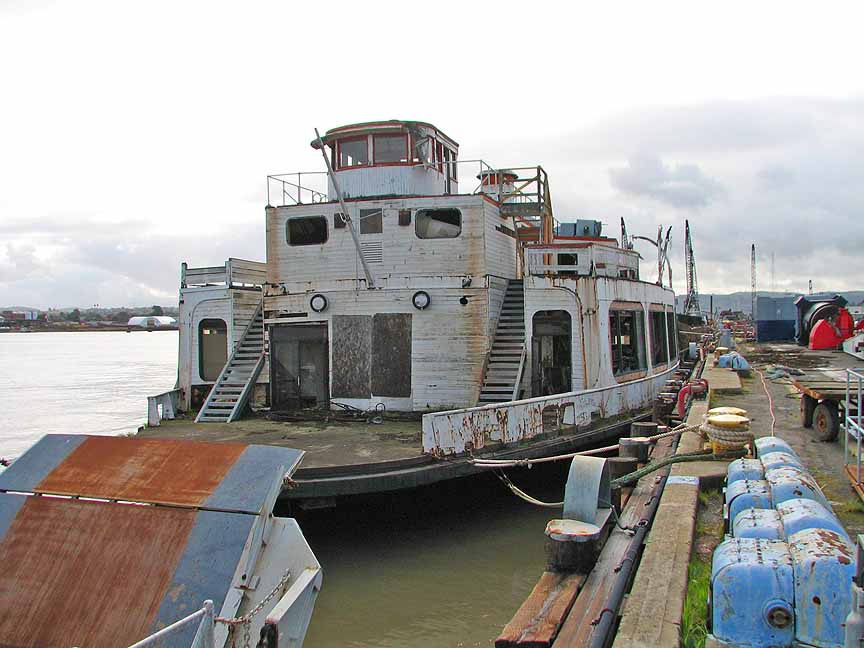
I got there ahead of the work crews and was able to take some photos, collecting my senses after the shock of seeing her this far gone. One of my first PR jobs was representing former ferryboat owner Roger Morgan in his attempt to make this boat into a floating dinner theatre in Glorietta Bay (circa 1984). But I had not seen her myself since 1969.

Bruce arrived with an old Coronado friend I hadn’t seen in 30 years Dick “The Kingfish” Long. The three of us donned our hardhats and gloves and, when the tide moved the boat close enough, we jumped through the broken windows and on to the scattered piles of debris inside.

The ferryboat had an enormous car deck. On top of that was a passenger deck where people could sit and read the newspaper or play cards during their commute. Above that was the Captain’s Deck, where the public was never allowed.

During World War II, waterfront author and artist Jerry MacMullen would often ride on this very passenger deck, sketching people in his notepad war brides, children, servicemen, commuters as one of his favorite pastimes.

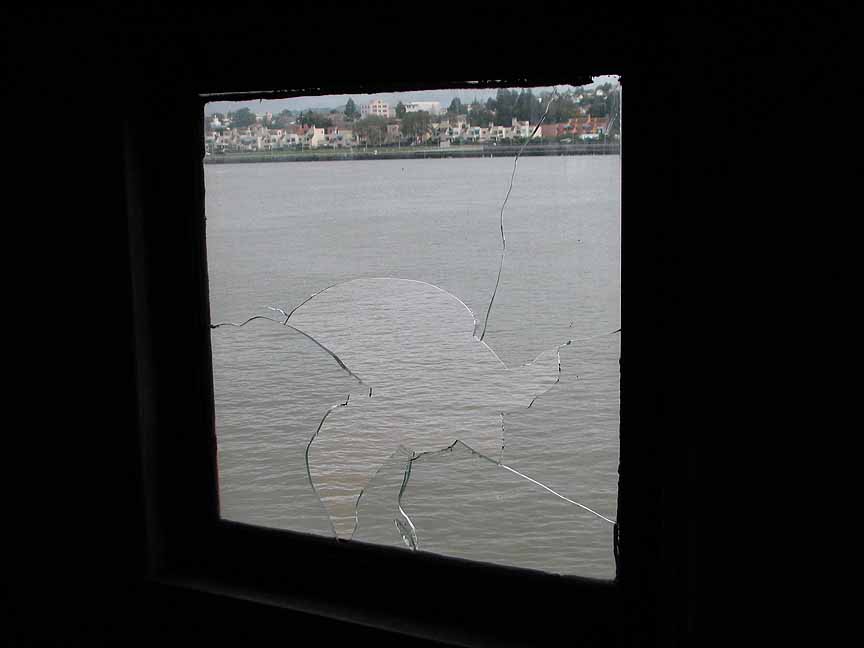
The car deck, as Bruce describes it so well, “looked like someone had demolished a 30,000-square-foot home and just left the rubble lying there.” It was piled high. Cement had been poured over the once-lovely wooden car decks. Glass and poorly framed façades had been constructed all around the boat to keep out the weather. Windows were shattered and the glass pieces strewn atop the rubble.
“
the wrecking ball and knacker’s torch
were just a ceremonial, final gesture.
The reality was that our beloved
ferryboat was already dead.”
A couple of fires had, years earlier, swept through the passenger deck. We did find, however, that the wood had been so strong, and had so many coats of paint over it, that the carved support stanchions were still intact beneath their charred exteriors.
The Captain’s Deck had the smoke stack, four large ventilation funnels, two pilothouses and a general continuance of neglect and abandonment. Jutting from each of the ends were the navigational poles 20-feet of wood that pilots used to make visual references on the far shore when transiting San Diego Bay.
Many imaginations were fueled when people heard this expedition was about to take place. As a waterfront reporter, exploring on old ships (and shipwrecks, which is what this was) is nothing new to me. But in the past, there is almost always something wonderful, some forgotten time machine or piece of history (treasure) to be discovered somewhere on board.
 The proud domain where only captains dared to tread.
In the case of the ferryboat San Diego (now named Klondike Queen), all the iconic items you might imagine could be found, were long-since gone.
Gone were the ship’s large wooden wheels (helms). There no longer was an engine room telegraph. The name boards that once identified her at every compass point had been pilfered. The lifeboats and oars were gone, the bronze porthole covers, the brass whistles and whistle lanyards, the signage. Even the small brass engine room identification plates and christening plaques had been stolen.
 This access port on the foredeck led to the chain locker.
While exploring this floating and much-disguised piece of Coronado history, Bruce and I captured a couple of film bytes we thought you might enjoy. Come with us as we take you aboard the ferryboat San Diego one last time:
The dress code for the day was boots, hardhats and gloves as we climbed through the piles of rubble and began our search for something, anything, representative of the Coronado to San Diego run.