




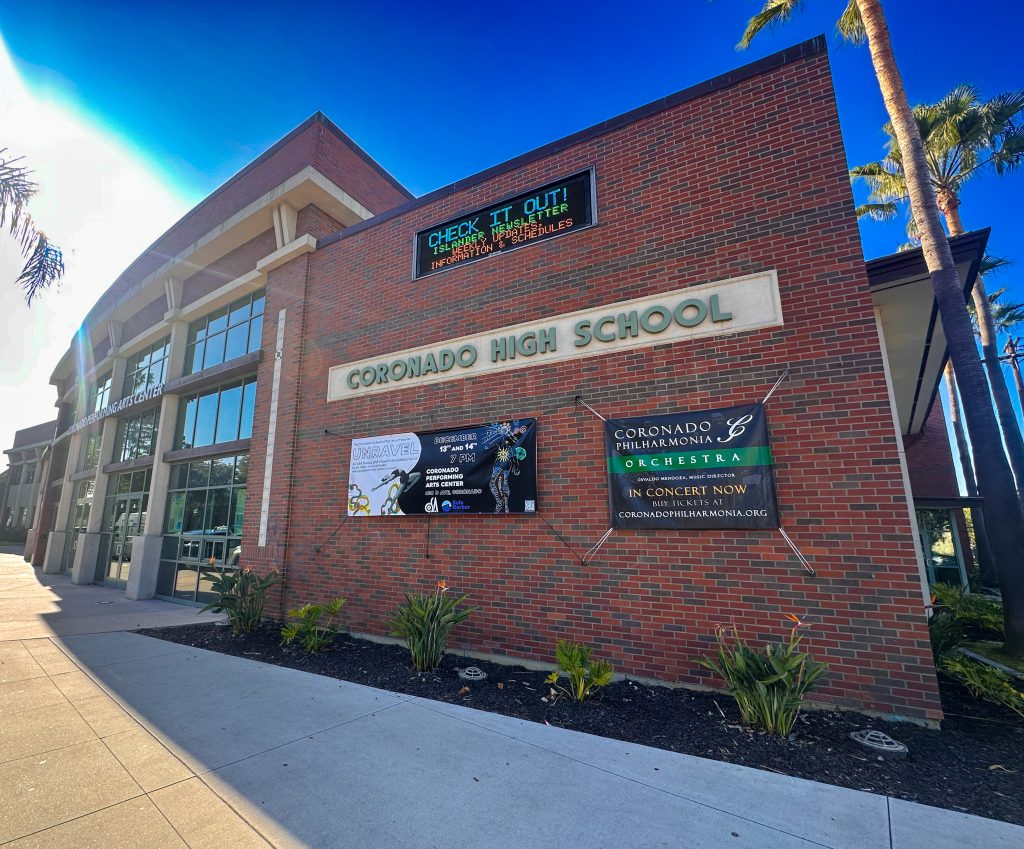
Two Coronado High School students wrote about racism they experienced on campus for the school newspaper, prompting concerns about why racist behaviors often go unreported.
At the meeting for the Coronado Unified School District school board of trustees on October 15, CHS Principal Karin Mellina said she was brought to tears when she read the student articles, which appeared in the CHS newspaper, the Islander Times.
“We are doing great academically, but that doesn’t always mean things feel great for kids,” said Mellina during her CHS report. “And that’s why we are there. We want them to feel safe and happy. So we have to address that.”
The articles — one written by Cailey Song, an Asian American, and another written by Edie Alicandri, a Jewish student — both outlined incidences of racism on campus, often from friends.
“I thought moving to high school would mean kids would mature and learn that racist jokes weren’t funny, but it stayed the same,” wrote Song in the Islander Times. “Growing up in this school and school district taught me to always build a wall around myself, and avoid topics of conversation that would bring up my race because I couldn’t find pride in my identity without mockery.”
Alicandri said her non-Jewish last name made her privy to all kinds of antisemitic remarks around campus.
“It’s not uncommon for me to hear a Holocaust joke in the halls of CHS,” wrote Alicandri. “Something I heard recently was ‘They should have gotten rid of the Jews when they had the chance.'”
Mellina said she was glad the articles were published because she wanted the issue to be illuminated.
“I spoke with these two young ladies at length individually and commended them for being brave and courageous and leaning into this, and thanked them for giving us an opportunity to address some of these things, that, quite frankly I am not completely aware of,” said Mellina.
Often, issues like this go unreported, so administrators aren’t always aware that it’s happening, according to Mellina.
“Sometimes they don’t report it because they are too afraid of retaliation,” said Mellina. “So we have to teach them how to be up-standers. We have to teach them how to deal with situations like this, whether it’s directed at them or not.”
She said that often the incidents happen “friend-to-friend,” which can make it harder to address. She said kids aren’t often equipped with the skills they need to navigate such incidents with success.
The district does offer a mechanism for anonymously submitting reports of bullying using it’s WeTip system.
Superintendent Karl Mueller encouraged students to make reports using WeTip and for parents to inform the district of incidents they hear about. He said the WeTip QR code is posted throughout campuses, and is sent to parents in a newsletter every week.
“How do we encourage people to report, and how do we engage our parent community?” he asked. “At the end of the day, we need all hands on deck here. We need our parents to inform us of the incidences when they occur.”
Trustee Mal Sandie thanked Mellina for highlighting the student voices, and said he was aware of racist comments on campus through conversations with his own son. He underscored the need for training on reporting and helping kids do the right thing to intervene.
Mellina said the articles have already prompted conversations around campus. She said she met with ASB and asked them to read the articles.
“I asked them how many had heard something derogatory or racist. And every hand went up. Then I asked, how many of you feel comfortable stepping in? And not many hands went up,” she said.
But she said the word is getting out. She’s grateful the students wrote the articles and that their words could inspire change.
“I’m just so proud of them, because this alone is going to help us be able to open up, and do some shifting,” she said.
Trustee Alexia Palacios-Peters reinforced the need for students and parents to use WeTip for reporting. She said neither of the two students who wrote the articles reported the behaviors.
“How can we, as a district, do anything if we don’t know it’s happening?” she asked. “So we need to make sure our students understand they can report it, anonymously, and I think that comes down to training and training for parents on how to have these conversations.”
Trustee Palacios-Peters said that even one incident of racism on campus is too many, for her taste.
“I think these articles were probably a shock to some people,” said Palacios-Peters. “And good…because we have work to do.”


I moved to Coronado just before starting 8th grade. During my first week, a popular girl from a well-known Coronado family lost her cell phone and made a comment to me in the hallway: “We don’t steal phones in America. You can go back to Mexico for that.”
At the time, I didn’t think much of it. But as I’ve gotten older, I often reflect on my years at CHS and realize just how isolating it felt to be one of the few minorities. Because most students assumed I was white, I was often privy to racist and deeply offensive comments. I got to hear firsthand what some of my peers really thought about people of color, particularly those who lived off the island.
To hear that these attitudes still exist among students in 2026 is heartbreaking, but unfortunately, not entirely surprising.
I’m now in my mid-30s with a daughter of my own, and when I think back on my experience, I realize just how strongly I feel about never wanting her to experience the same environment I did at CHS. No child should have to feel like they don’t belong simply because of their background or where they come from.
I moved to Coronado just before starting 8th grade. During my first week, a popular girl from a well-known Coronado family lost her cell phone and made a comment to me in the hallway: “We don’t steal phones in America. You can go back to Mexico for that.” That was one of many racist comments I heard when kids realized I transferred from Chula Vista.
At the time, I didn’t think much of it. But as I’ve gotten older, I often reflect on my years at CHS and realize just how isolating it felt to be one of the few minorities. Because most students assumed I was white, I was often privy to racist and deeply offensive comments. I got to hear firsthand what some of my peers really thought about people of color, particularly those who lived off the island.
To hear that these attitudes still exist among students in 2026 is heartbreaking, but unfortunately, not entirely surprising.
I’m now in my mid-30s with a daughter of my own, and when I think back on my experience, I realize just how strongly I feel about never wanting her to experience the same environment I did at CHS. No child should have to feel like they don’t belong simply because of their background or where they come from. Do better Coronado.
Thank you for sharing, this is very meaningful.
This has been a Coronado problem even in the 60’s ‘70’s and ongoing. It’s money and beliefs money makes you better and powerful. Come on let’s not be naive it’s all around us and it’s 2026!
I grew up in Coronado and went to high school in Imperial Beach, Catholic school and we were from all over the South Bay. But once we told our friends we lived in Coronado we were thought of as being uppity and rich. Which we weren’t and they were surprised. To this day at 70 when people ask where I’m from I don’t like saying Coronado because immediately people think I’m rich and a snob.
Granted not everyone in Coronado with money is better than thou! Those who were brought up well and have values are the island’s true gems. But unfortunately there are still those, students as well as adults, who think money will buy them anything status, friends, out of jail cards, and popularity. Once they graduate look out the real world will teach them humility or they will continue the cycle. To those who are prey to the racism and jokes hang in there. The rewards of life, hard work, coping and respecting yourself will make you strong, confident and resilient. This is from someone who lived in Coronado with a mother who was a maid and a father who worked for the city. And was not blonde, white and thin. But had parents who taught me I was just as good if I believed in myself.
It really doesn’t make any difference to write articles or ask the school to help. This is continuing issue. They say they will address but there is never a real consequence. My kids have experienced this and continue to do so. The school district does not care. They protect one another and turn the other way to not upset the bullies and their parents.
I taught tennis camps in Coronado in the mid to late 90s. I had children of extreme wealth, both “natives” of Coronado and Mexican nationals who had properties in the “Taco Towers”, as referred by the children. The racism, the othering, the shit they talked, obviously from overhearing parents, was at least offensive and at most abusive; literal children telling me I wasn’t worthy of their respet because I was from Chula Vista. But on the court… you are who you are. If you practice, it shows. If you play tournaments, it’s up to you to practice, train, and I hope I broke down walls with my kids. I wonder what happened of some of them but it was a lifetime ago. Now they’re probably the ones fighting over housing, property rights, and who belongs on “the Island.”