




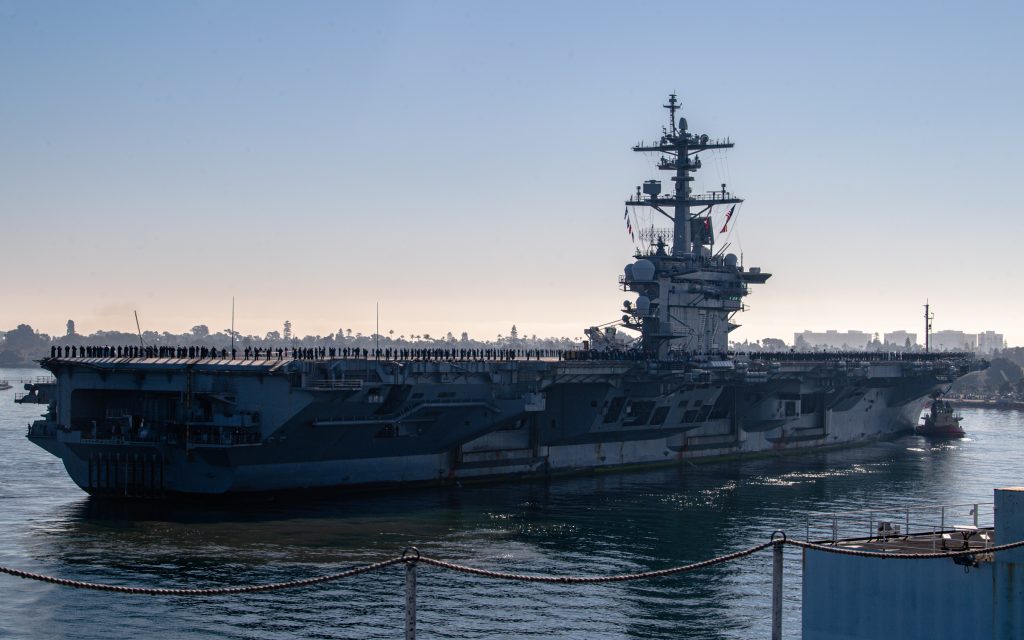
Reports of water contamination, food shortages, and sailors attempting to jump overboard: As the USS Abraham Lincoln stretches toward its ninth month of deployment, families and lawmakers raised alarm.
The Abraham Lincoln will return “soon,” according to Hung Cao, acting secretary of the US Navy.
“There is no question our young men and women have been pushed to their limits — but they have never broken,” Cao said in a statement. “They are rightly tired — but have never been out of the fight.”
The Lincoln departed from Naval Air Station North Island in November 2025 for a deployment first to the Indo Pacific, in the U.S. 7th Fleet area of operations, before moving to the Middle East, where it has operated in the U.S. Central Command area of responsibility.
As of publication, the ship has been deployed for 273 days.
“Unfortunately, the media are trying to paint our warriors as victims,” Cao said in his statement, referencing widespread reports of mental health concerns, food shortages, and deteriorating ship conditions. “Not only is that dishonest but it takes away the focus on the enemy and the threat it poses against our nation, people, and way of life.”
Cao said that a “small number of mental health cases were treated with no loss of life,” that meal plans were adjusted when fresh supplies were not available, and that calls home were limited when operational threats were high.
Even as many rallied around the crew of the Lincoln, others in the military community have dismissed the claims as typical of deployment. Depending on the type of deployment, food rationing and limited communications are expected.
The Navy has grappled publicly with sailors’ mental health in recent years. After three sailors assigned to the USS George Washington died by suicide within a week in 2022, the service launched investigations that ultimately examined not only the deaths but broader quality-of-life problems, including command climate, living conditions, manning and access to mental-health care. Investigators found that mental-health providers aboard the carrier had been overwhelmed by demand, with sailors sometimes waiting more than a month for routine assessments.
But that, some families and advocates for the sailors aboard the Lincoln say, is exactly the point: Should this be accepted as the norm?
US Senator Richard Blumenthal on Aug. 12 sent a letter to Cao and Secretary of War Pete Hegseth demanding information about the conditions aboard USS Abraham Lincoln, echoing mental health concerns, poor ship conditions, disruptions to mail delivery, and other concerns ciruclating.
“These reports warrant immediate attention,” Blumenthal wrote, “but they also raise a broader question:whether the Navy can sustain the operational tempo now being demanded of its carrier force, particularly as this Administration repeatedly commits U.S. forces to conflicts of its own choosing and increasingly relies on aircraft carriers to sustain those operations.”
The Navy’s own readiness model works on seven-month deployments, but a string of ships have been extended beyond that in recent years. In 2016, the Navy extended a deployment of the USS Truman beyond that guidance, calling it “an exception rather than the rule.”
But that’s not what the data shows.
USNI, which maintains its own database of operational carrier deployments, reported this year that carrier strike groups deploying from the East Coast have averaged almost nine months since December 2021, and flatly described extensions beyond the seven-month plan as having “become the norm.”
CNN independently analyzed carrier deployment data this month and found that the median length of U.S.-based carrier deployments has steadily increased since 2020. It found that most deployments between 2018 and 2022 were at or near the 210-day target, while deployments have routinely overshot it since October 2023. Three carrier deployments beginning in 2024 exceeded 250 days; two beginning in 2025 exceeded 270 days.
Some examples:
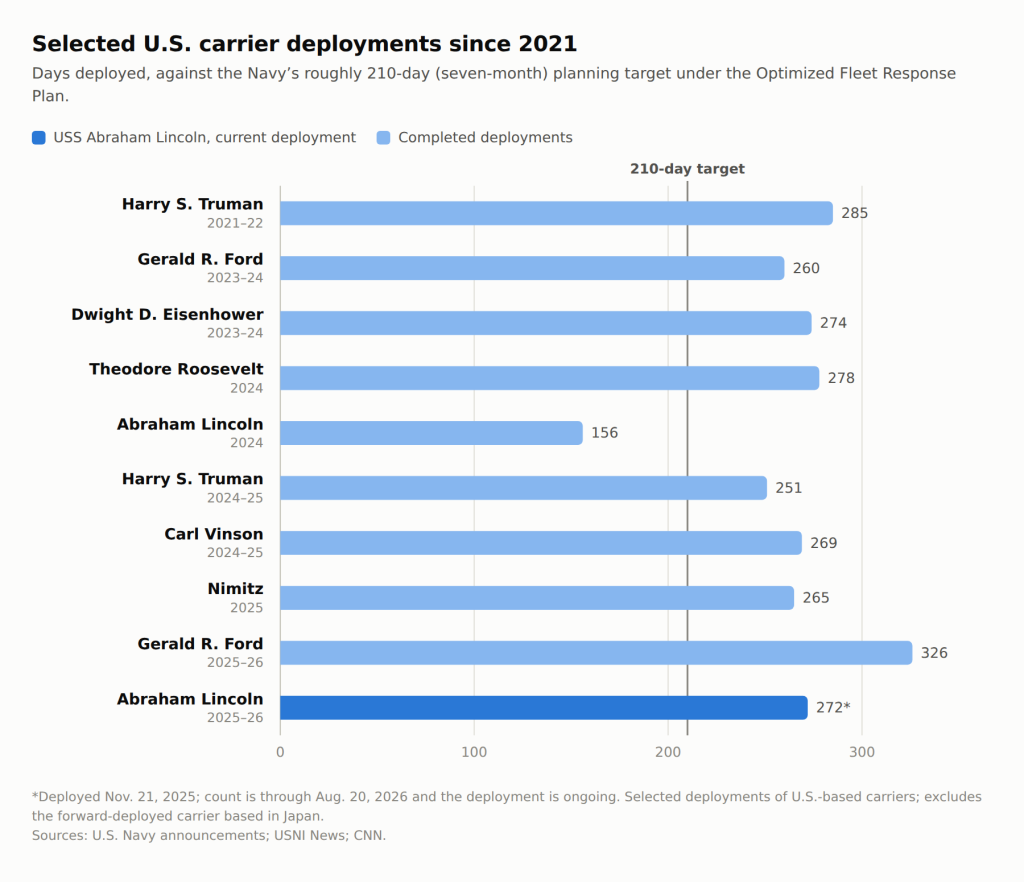 Long deployments are not singular to carriers. The USS Winston S. Churchill, a destroyer homeported in Mayport, Fla., spent nearly 11 months deployed with the Ford strike group, departing June 21, 2025 and returning May 17, 2026. The Navy’s own return announcement calls the strike group’s deployment “historic”; the carrier itself was gone 326 days.
And the USS Fort Lauderdale, a San Antonio-class amphibious transport dock, returned from a 334-day deployment in July.
Longer deployments, with decreasing time in between
Another consideration is how long ships remain in port before deploying again. The Navy’s Optimized Fleet Response Plan is built around a 36-month cycle for carriers and surface ships that includes a roughly seven-month deployment, along with maintenance, training and a sustainment period during which ships can be called on again.
But again, that is not always the case.
In San Diego, the USS Stockdale deployed in July 2024 and spent seven months deployed.
Just 49 days after returning, the destroyer departed again for U.S. Northern Command operations along the southern border. Then, in September, the USS Stockdale left San Diego again for operations in the Caribbean.
It returned in April 2026 after another seven-month underway. The sea time was separate, but the compressed turnaround illustrates another measure of operational tempo: not simply how long a single deployment lasts, but how much time sailors actually spend at home between periods at sea.
Attack submarines show a similar strain. While they have not seen the same clear increase in deployment length (recent deployments still generally run about six to seven months), that does not necessarily mean submarine crews are spending less time away from home.
The Navy is struggling to keep enough attack submarines operational, with about 33 percent of the SSN fleet currently in or awaiting maintenance, well above the service’s 20 percent goal. With fewer boats available to meet persistent operational requirements, the submarines that are ready can face a demanding cycle of deployments, training and other underways.
In other words, a six-month deployment may look relatively normal on paper while masking how frequently a crew is actually at sea — a distinction that deployment-length statistics alone do not capture.
This month, President Donald Trump ordered the construction of a fifth public shipyard specifically to increase submarine and aircraft carrier repair capacity, saying backlogs have clogged operations.
Trump’s increase in naval strength is the largest since the Reagan administration, the White House says.
For operational security purposes, the Navy does not release ship movement details, including the projected homecoming date for the USS Abraham Lincoln. However, CENTCOM has reported that the USS George Washington, another aircraft carrier, arrived in the Middle East Aug. 19 to relieve its counterpart.
There’s a familiar refrain in military life: “You knew what you were signing up for.” But as deployments stretch longer and time at home grows less predictable, some military spouses and service members have pushed back on that idea online, arguing that today’s operational tempo is not what they expected when they joined or married into the military.
CENTCOM did not immediately respond to requests for comment on this story. The public affairs office for Naval Air Station North Island declined to comment.
Megan Kitt is married to an active duty service member.