




Written by Bill Lyons

Short-term rental investors confront a dual threat: cooling returns and tightening regulations that squeeze profitability while raising loan qualification hurdles. Platforms like Airbnb have democratized vacation rental investing, but they’ve also triggered state and local crackdowns on tax compliance, licensing, and occupancy caps.
For investors already holding properties or considering new purchases, miscalculating revenue in this environment, or ignoring regulatory shifts, can turn an expected return into negative cash flow or loan default. Market research has moved from helpful to essential.
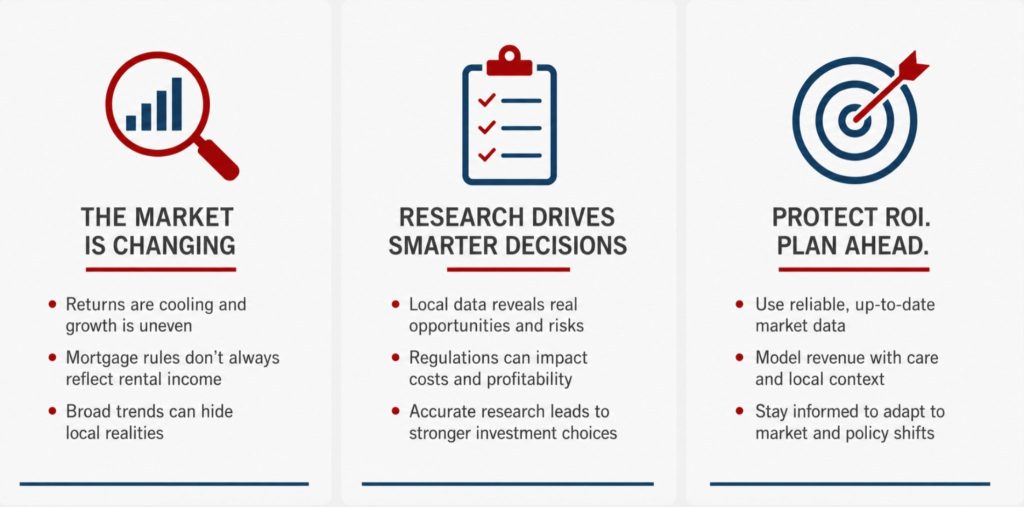
Why 2026 ROI Isn’t What It Was
The annual STR outlook research published by AirDNA is one of the most useful top-level data sources demonstrating the overall health of the short-term rental market. The report shows that while market fundamentals continue to improve, performance can vary significantly by location, reinforcing the importance of thorough market research before investing.
Likewise, AirDNA reports that the short-term rental premium has climbed to its highest level since 2022, reflecting improving market fundamentals.
Coupled with property prices showing little to no growth in many regions and mortgage rates remaining stable for the moment, the temptation to start or expand an STR portfolio may be strong. However, the broad view doesn’t account for geographic variance.
Region-Specific Challenges
AirDNA’s granular data on the STR market in different parts of the country, as well as the regulatory outlook, which is changing in many states, means investor market research must be thorough. In some cases, the data points to both challenges and opportunities, with an investor’s own position as the defining factor.
For instance, local market conditions can differ significantly, even among popular vacation destinations. While some markets continue to benefit from strong traveler demand, others are experiencing shifting pricing dynamics, changing inventory levels, or increased competition from new listings. These regional differences can create both opportunities and challenges for investors, making local market research essential before making a purchase.
Likewise, the imposition of stricter regulations in certain jurisdictions creates additional costs and administrative obstacles to overcome for investors. In California, Senate Bill 346 was signed into law on October 13, 2025, and took effect on January 1, 2026, to strengthen enforcement of short-term rental licensing and tax requirements. According to the bill’s sponsor, an estimated 25% to 75% of short-term rentals in some jurisdictions may not be properly licensed or remitting applicable taxes. The law is not self-executing; cities and counties must adopt their own ordinances before its reporting requirements apply locally. This legislation enables local governments that adopt such ordinances to require booking platforms to provide information needed to improve compliance and tax collection.
Similar increases in scrutiny for the STR market are taking place in other jurisdictions. In Austin, for example, booking platforms have been required to remit hotel occupancy taxes since April 1, 2025, and unlicensed short-term rental listings have been subject to delisting since July 1, 2026. That’s why thorough market research is a must for all investors, as tougher local rules can erode ROI.
Making Accurate Revenue Calculations
Because traditional mortgage products often disallow projected STR income as proof of affordability, real estate investors rely heavily on Debt Service Coverage Ratio (DSCR) loans and private transition loans. In that context, it’s common for non-QM lenders to require proof of short-term rental market performance for the specific location and property in question before they will greenlight a loan.
According to Griffin Funding, a mortgage and home loan lender, investors must use a combination of data sources to calculate their expected ROI on a rental purchase, especially if they intend to buy an STR in a state where rules on ownership and taxation expectations are getting stricter at the moment. AirDNA projects average daily rates (ADR) will increase by approximately 1.5% in 2026, while occupancy is expected to ease modestly in 2026, making location-specific research essential when modeling expected rental income. Even if investors qualify for a DSCR loan on expected income, if that calculation is not accurate because it uses data that’s too broad or not up to date, the risks of having their ROI squeezed or even going into arrears are higher.
How to Avoid Revenue Modeling Miscalculations
The STR market over the last five years has been a rollercoaster, spiking post-COVID-19 before cooling in subsequent years. According to AirDNA, 2026 is expected to be the best year to invest in short-term rentals since 2021, with listing supply growth projected to slow to approximately 4.6%, down from a post-pandemic peak of roughly 20%, helping improve market fundamentals. Investors can take heart in these trends, while alternative lending products continue to make it possible for more people to enter the market if they’re comfortable with the risks involved.
Most importantly, rigorous market research remains crucial because differences in regulations, occupancy rates, ADR, and other metrics can make or break the ROI of an STR investment. There’s ample data available for regional markets, so there’s no excuse for inaccuracy or an excess of optimism.
This story was produced by Griffin Funding and reviewed and distributed by Stacker.
Author: Bill Lyons

Bill Lyons is the Founder, CEO & President of Griffin Funding. Founded in 2013, Griffin Funding is a national boutique mortgage lender focusing on delivering 5-star service to its clients. Mr. Lyons has 25 years of experience in the mortgage business. Lyons is seen as an industry leader and expert in real estate finance. Lyons has been featured in Forbes, Inc., Wall Street Journal, HousingWire, and more. As a member of the Mortgage Bankers Association, Lyons is able to keep up with important changes in the industry to deliver the most value to Griffin’s clients. Under Lyons’ leadership, Griffin Funding has made the Inc. 5000 fastest-growing companies list five times in its 12 years in business. Follow his updates on LinkedIn.