




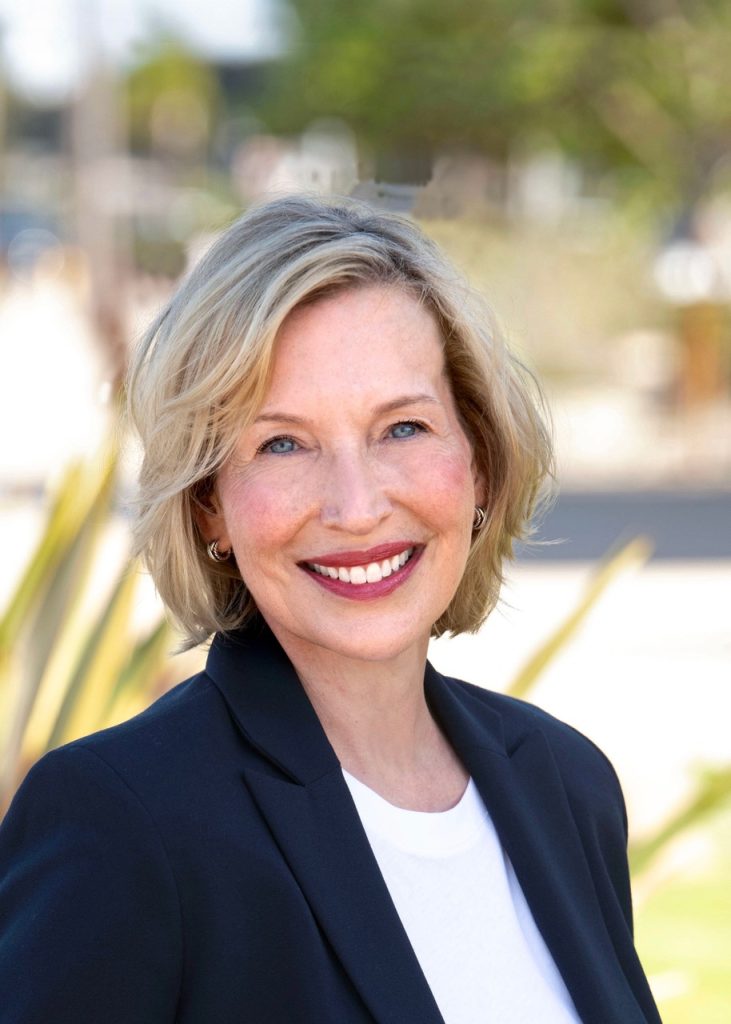
 Rebecca King barely knew her neighbors in Coronado the first time she found herself addressing a room of them.
“I’m sorry,” she said, standing up in the middle of a town hall meeting and addressing the city’s director of golf and recreation services, “but that’s just not true.”
King, a lawyer, contested the way an ordinance was being interpreted to support a fee increase for tennis court rentals. The ordinance on the books at the time set rental fees at $5 for two hours for residents. The director at the time interpreted it as $5 per person.
“I said first of all, you don’t get to interpret this — it’s clear on its face,” King said. “If something is clear on its face, in the four corners of the document, there is no interpretation. It is what it says it is. And if it were to be interpreted, it wouldn’t be by him.”
She didn’t stop there. She filed a public records request for the revenue and cost data behind the fee increase. Under California law, the city cannot charge more for a service than it takes to operate. Beyond that, the fee would be considered a tax, which requires voter approval.
Then, she pointed out that the sitting City Council had not voted on the increase. The city held the rates at $5 per court.
It wasn’t about tennis, King said. It was about government accountability and transparency, one of the key facets of her platform as she campaigns for a seat on the Coronado City Council.
Her platform also includes finding a permanent fix for the Tijuana River sewage crisis; addressing public safety, particularly through fast-tracking modern fire stations and e-bike regulations; and infrastructure moves such as replacing the city’s aging water and wastewater pipes.
King practiced law in Norfolk, Va., before working for the Commonwealth’s Attorney’s office and then the Norfolk City Attorney’s office. Her husband spent nearly seven years as a U.S. Navy surface warfare officer before becoming a physician. A Navy fellowship brought the family to Coronado for the first time in 2007, and they returned for good in 2018.
Transparency and accountability
The tennis fee dispute is the example King reaches for, but she said the problem extends to multiple city contracts.
King is critical of Coronado’s penchant for hiring subcontractors to handle city services in a way that, she says, erodes transparency.
Years after first sparring over tennis fees, the city again considered raising them. By then, Coronado had begun to contract the operations of its courts to Impact Activities, a private company. When up to a 300 percent fee increase was proposed, many players — King included — balked at them.
King once again filed a public records request for revenue and operation figures. But since Impact Activities is a private company, its financials are private. She stood before the council holding a piece of paper so heavily redacted, it was essentially a single, black rectangle.
“I’m just not the tennis candidate,” King said, chuckling. “This is a pattern with the city: If a private company receives a contract, they do not have to disclose how city money is being spent.”
King would like all such arrangements to include a clause that requires companies to disclose their financial information if they would like the contract.
She wants every city request for proposals to require that bidders’ financial records tied to the contract be made public — a standard she’d apply to the infrastructure projects at the center of her own platform, including the pipe replacement and new fire stations.
“Without transparency in all the contracts, how do we as a city hold all our contractors accountable?” King said. “Just because you don’t have to disclose something doesn’t mean that you shouldn’t.”
A collaborative approach to the Tijuana sewage crisis
King said Coronado needs to stop treating the ongoing sewage from Tijuana that is polluting the area’s beaches and air as a problem it can solve alone.
She wants to work with other cities, nonprofits, and other interested parties to become a broader voice for advocacy.
“If we’re sending a council member and a mayor from Coronado (to advocate),” she said, “that’s about 10 to 11 thousand registered voters. But if we go as a part of a larger coalition within San Diego County, with the cities and NGOs that are pushing for solutions, that represents a much larger voting bloc.”
King argues the city was slow to declare an emergency over the crisis and wants more public, plain-language testing data, pointing to UC San Diego researcher Kim Prather’s work on sewage-contaminated sea spray as a model worth expanding. She said she would like more research done in the Coronado Cays, especially near Silver Strand Elementary.
“I’m not willing to sacrifice health,” King said. “Get the data, put it out there, let people know.”
She wants San Diego County to extend the air filtration units it provides to Imperial Beach residents to Coronado Cays residents as well.
Public safety and infrastructure
King wants the city to fast-track fire station construction to meet the recommendations of Coronado’s Community Risk Assessment, arguing the city needs modern facilities to recruit and retain firefighters and police. She would also like to replace the city’s aging water lines.
She’s also pushing to amend Coronado’s e-bike ordinance, modeling changes on Carlsbad and Danville: after an egregiously dangerous incident, police could impound a rider’s e-bike, and the rider would have to complete a mandatory safety course before getting it back. A minor’s parent would face the same requirement.
“People are terrified of hitting someone on an e-bike, especially a child, and I don’t think we should wait for that to happen,” King said.
She’s careful to note the policy isn’t a knock on Coronado’s police, who she says are understaffed and limited by state law.
King’s father was a career civil servant, and she said politics was a regular topic at her family’s dinner table growing up. In Coronado, she’s served on the then-Design Review Commission, CUSD’s Guiding Coalition, and the CoSA Foundation Board. She’s an active member of the Coronado Woman’s Club and a former volunteer for the Naval Officer Spouses’ Club.
“I’ve always been civically engaged,” she said. “I’ve certainly gone and given my two cents as a member of the public at city council meetings — I thought it was time to step up and serve, to put my money where my mouth is.”


King wants contract-linked financial records made public. Would her proposed disclosure clause also apply to subcontractors hired by the winning bidder?
King’s proposal to require that “financial records tied to the contract be made public” raises a practical question about scope. Would the clause require itemized costs and payments for the Coronado contract while allowing unrelated business records to stay private? Defining that boundary in the bid documents would help both residents and bidders know what to expect.
Not only is Rebecca smart, dynamic and caring, she is fully dedicated to our beloved Coronado, having raised her children here while her husbnad was serving in the Navy, and choosing to return here once he retired to full-time medical practice. She and her family are dedicated to service, and I can’t think of a better person to represent us.