




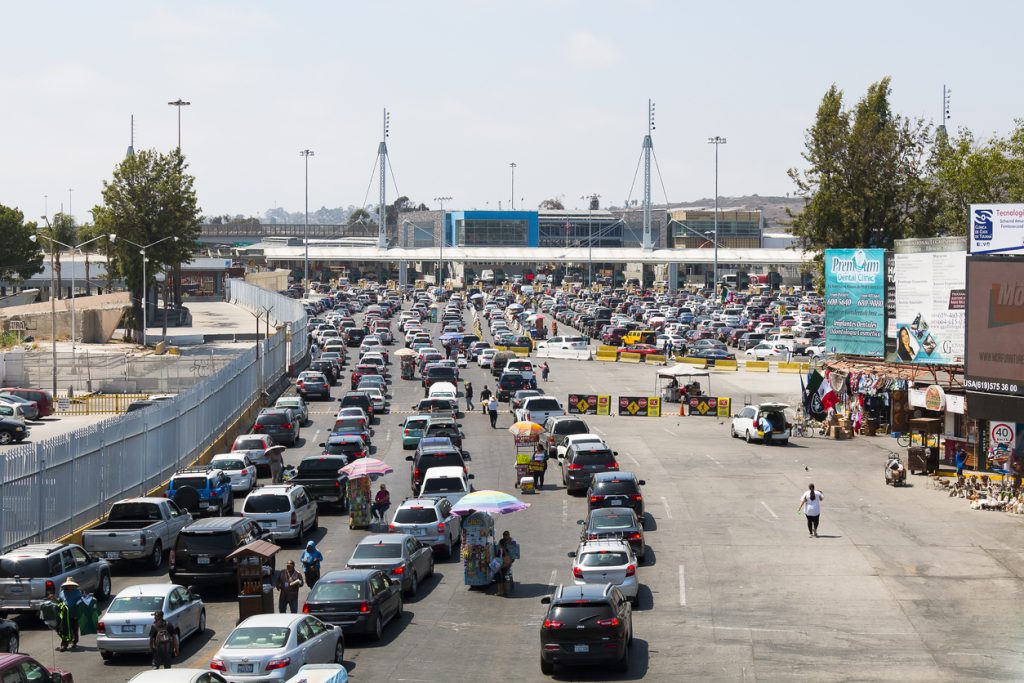
A new border crossing is in the works, but it was approved with a caveat: that SANDAG form a working group on the Tijuana River sewage crisis.
The board adopted that condition in July 2024. Two years later, when Coronado Mayor John Duncan asked what had happened to it, nobody could answer. As far as anyone at the San Diego Association of Governments (SANDAG) knew, it had never been formed.
The board moved ahead with funding for a new Otay Mesa Border Crossing anyway. On July 10 it authorized another $184.2 million for the crossing — the second construction package, covering the northbound passenger lanes — drawing on federal and state grant money already secured for the project. Three members voted no.
The entire project carries a projected cost of $1.3 billion.
The July 10 vote followed more than an hour of debate that had little to do with construction contracts. Board members from across the county described a public health crisis decades in the making, and split over whether approving the crossing meant surrendering the region’s only real leverage over Mexico.
“Mexico needs this port more than we need it. They need trade with us more than we need trade with them,” said Poway City Councilmember Christopher Pikus, who voted against it. County Supervisor Paloma Aguirre, who seconded the motion to approve, compared the agency’s environmental efforts to putting band-aids on someone bleeding out.
Duncan, the first board member to speak on the July 10 item, said the staff report in front of him detailed the project’s environmental mitigation at length but said nothing about the sewage conditions attached to the 2024 approval.
“It appears to me that we’ve had zero progress in regard to something that we attached to one of the votes approving this project,” he said.
SANDAG CEO Mario Orso responded that the agency has been pressing Mexican officials at the federal, state and municipal levels to route project revenue into Tijuana’s own infrastructure, and has proposed a lockbox structure modeled on the one governing State Route 11 funds on the U.S. side. He said the Mexican federal government controls the concession on its side and has not decided.
State Route 11 is the toll road SANDAG and the California Department of Transportation (Caltrans) built to feed the new crossing. The state law authorizing it, the Otay Mesa East Toll Facility Act, requires that money collected on the corridor be spent on the corridor. Orso wants Mexico to adopt the same arrangement, so that its share of toll revenue would be bound to Tijuana infrastructure rather than absorbed into the federal budget.
That same restriction is why SANDAG cannot spend its own toll money on sewage. A bill this session would have amended the act to let the revenue also fund environmental mitigation and restoration in the Tijuana River Valley. It died.
Duncan said he was familiar with all of this, and it wasn’t the point.
“The problem I have that I’ve highlighted with this agreement is the massive increase in commerce, the massive increase in the need for sewage treatment, and no binding agreements whatsoever to address any of that on any level,” he said. “There is no actual commitment that’s been agreed to to do anything about this. It’s going to create a lot of money and a lot of revenue for Mexico and a lot of money and revenue for the United States, and nothing — literally zero — for handling this environmental crisis is included.”
Duncan argued that Mexico takes action when pressed.
“Sometimes the complexity causes nothing to happen,” he said. “I’ll give you one example that I think is incredibly simple.”
Duncan pointed to the San Antonio de los Buenos treatment plant, six miles south of the border, which he said Mexico’s federal government built “partially at the insistence of this board, indirectly” about three years ago. Mexico broke ground in January 2024, and the rebuilt plant came online in April 2025 with a design capacity of 18 million gallons a day.
It isn’t enough. “It’s treating 50% of the sewage, or less, that goes to that facility,” Duncan said. “The rest of it comes straight out of the canyon wall onto the beach and into the ocean. There’s video. It’s factual. They admit it.”
The plant has been running at capacity since the rebuild. The problem is the volume arriving at it: flows above 18 million gallons a day are mixed with the treated effluent and discharged onto the beach.
“How hard would it have been — maybe I’m naive — to just get like 5% of Mexico’s revenue on this project to go to building a second plant?” he said. “They did it. We watched it be built. It wasn’t that hard.”
More trade, more sewage
Duncan’s objection rests on a prediction: that a crossing built to move more goods and people will generate more sewage in a city whose treatment system already cannot handle what it has.
His evidence is USMCA, the trade agreement that replaced NAFTA in 2020. Its implementing legislation directed the Environmental Protection Agency to address polluted transboundary flows in the Tijuana River watershed and appropriated $300 million for border wastewater infrastructure, money secured by the San Diego congressional delegation and paid out over four years.
In Duncan’s reading, that appropriation is an admission. Congress attached sewage money to a trade bill, he argues, because it understood that expanding trade with Mexico would expand the sewage problem.
“The USMCA massively increased trade between Mexico and the United States,” he told the board. “They knew that was going to happen. Well, they also knew it was going to increase sewage, and that we already had a crisis. How do we know that? Because they put in the USMCA $300 million as an attempt to start to address the crisis.”
Even then, he said, the money took years to reach the International Boundary and Water Commission.
Otay Mesa East, by his argument, is the same bargain without the second half: a project sold on the commerce it will generate, carrying no money and no binding commitment for the wastewater that commerce produces.
No analysis of the crossing’s likely effect on wastewater volumes was presented to the board.
The agreement Duncan cites is itself in play. The three countries met July 1, nine days before the board took up the funding, and the United States declined to renew USMCA in its current form. The deal remains in force while the parties negotiate. Members of the San Diego congressional delegation have urged the U.S. Trade Representative to preserve its Tijuana River provisions.
A public health emergency, not just an environmental one
County Supervisor Paloma Aguirre, who seconded the motion to approve the funding, used her time to reframe how the board talks about the problem.
“I want to be very clear: this is not just an environmental crisis,” Aguirre said. “This is a public health emergency. Full stop.”
Aguirre said beach closures have cost South Bay businesses thousands and in some cases millions in lost revenue, and that tens of thousands of families breathe toxic gases daily. Her larger argument was that the funded fix will not be enough.
The arithmetic bears that out. The South Bay International Wastewater Treatment Plant on the U.S. side is being rebuilt and expanded from 25 million gallons a day to 50, at a cost of roughly $350 million. The rebuilt San Antonio de los Buenos plant on the Mexican side handles 18 million. Combined, that is about 68 million gallons a day of treatment capacity.
Tijuana currently generates roughly 67 million gallons of wastewater a day, a figure projected to reach about 92 million by 2050 as the city grows from about 1.8 million residents in 2020 to 2.4 million. More than three-quarters of its sewer network requires urgent rehabilitation and more than half its pump stations need short-term repair, according to a San Diego Regional Chamber of Commerce report published in March. Even with both plants fully expanded, the region would be short by roughly 24 million gallons a day.
The working group Duncan said was never formed had, by the chair’s account, been folded into the Borders Committee. Its July 24 agenda included a panel on SANDAG’s resiliency plan, with presentations on a Scripps Institution of Oceanography heat-mapping tool and a Cal EPA plastic pollution fund.
Aguirre was unimpressed. “No offense to the working group or to the presentations planned for it, like plastic pollution reduction and heat maps,” she said. “I mean, it’s like we’re offering band-aids for somebody who’s bleeding out because their artery has been cut.”
Her preferred remedy is legislative. The bill that would have let SANDAG spend its toll money on sewage? It was hers. Aguirre said she requested it as an Imperial Beach councilmember and Sen. Steve Padilla carried it, and that it was watered down and died before the SANDAG board ever took its initial action on the project.
“Depending on an entirely different nation for solutions, we’re going to be here another 20 years,” Aguirre said. “And yes, people will die if they haven’t died already.”
The case for withholding funding
The sharpest position of the morning came not from a border city but from Poway, roughly 40 miles inland.
Poway City Councilmember Christopher Pikus said the pollution has been one of his hot-button issues since he first heard about it in the early 1990s. Thirty-five years later, he said, all he has seen out of Mexico are requests and memoranda without teeth.
If the crossing is the region’s leverage, he told the board, he was prepared to spend it. “I’m willing to vote no, even as a protest, and even if this is going to go down 18 to one.”
He acknowledged a no vote could delay the project a year. “Maybe that will get their attention,” he said. “Mexico seems to be uninterested in all the sewage they dump upon our nation because there’s no consequences for them doing so.”
That framing found sympathy well beyond the South Bay. Encinitas Mayor Bruce Ehlers said he remained genuinely undecided minutes before the vote, worried the board was surrendering its only leverage.
“I feel like I’m giving up our leverage to get this fixed and move it along and keep Mexico motivated,” he said, noting that SANDAG will ultimately donate the completed facility to the federal government. “Once it opens up, then you relieve the economic pressure.”
Imperial Beach Councilmember Jack Fisher described spending the Fourth of July on the shore in Imperial Beach among perhaps 10,000 people, of whom he counted just a handful of children in the water.
“Mexico always wants to show up when there’s agreements to be signed that benefits them,” Fisher said. “I’m sorry, they’re not a great partner for us. They have not been. They will not be, because there’s no implications that make it so they have to be. They will not do it willingly. They need to be compelled.”
The counterargument
Not everyone accepted the leverage logic. Chula Vista City Councilmember Carolina Chavez, who made the motion to approve the funding, said the crisis is devastating to her city but that the project predates it by more than two decades.
“I don’t believe in stopping progress of a project that has been since 2000 in the making,” she said, citing 100,000 daily border crossings, workforce, students and tourism, and arguing the crossing will cut three-hour wait times and the emissions that come with them.
Orso pushed back on the premise that approval costs the board leverage — arguing the opposite. The action, he said, lets SANDAG use state and federal grant money already in hand to build out the northbound passenger facility, which accounts for roughly 64 percent of projected toll revenue, without committing future revenues or taking on bond obligations.
“What that action really does is it unlocks 60 percent of the revenue of the project without having a major funding commitment or a payback commitment,” he said. “So it frees some of our restrictions and it allows us to have bigger conversations at the state and the federal level.”
He also warned that halting work would mean paying delay costs, sending contractors home and returning money the agency received at no cost.
What the board actually adopted
Discussion nearly ended early. Santee Mayor John Minto raised a point of order that the conversation had tiptoed toward a violation of the Brown Act, a government transparency law that prohibits deliberation on a matter not publicly announced on an agenda.
Duncan objected: “The agenda (item) has environmental mitigation in it; certainly talking about it isn’t a violation,” he said. Legal counsel advised the comments were sufficiently tangential to be permitted. The chair let it continue, saying every South County member around the table wanted to speak.
What emerged was direction to staff rather than binding conditions: a report back within 90 days recapping the Tijuana River Valley situation with a forward look, and instruction that the CEO use whatever leverage is available in discussions with all parties. La Mesa City Councilmember Lauren Cazares asked that a full SANDAG meeting be dedicated to the pollution crisis; the chair said one is already planned for the fall.
Duncan ultimately voted in favor of the funding, but said it was the last time.
“I will vote for it today, but going forward, I’m not going to be able to vote yes on anything related to this project in the state that we are in now.”
He returned to the leverage argument, also rejected a suggestion from another member that responsibility is shared across both countries and global consumption patterns.
“Factually, 100 percent of the sewage we’re talking about comes from Mexico,” Duncan said. “The United States is investing a billion dollars in trying to treat it. 100% of the sewage we’re talking about is Mexican sewage. That’s a fact.”


The April 2019 Gate 2 Port of Entry Study is an interesting read as the IBWC guarantees no sewage will cross the border because of this project or its sister project the Viaduct Road project. That promise was not kept by Mexico as the Viaduct road project dump over 80 billion gallons of sewage into the United States. The IBWC and Mexico fail to enforce and meet its promises
I say close all ports of entry for San Diego, County only until the Sewage is no more!!! You NO GO there & it won’t END UP HERE.
Shameful that Paloma Aguirre is taking credit for the toll tax when in fact it was Imperial Beach City Council Members; Mitch McKay and Jack Fisher who legislated to get the toll tax on the table.
A Right step in the Wrong direction!
Let’s be honest. Mexico will never be serious about fixing their sewage problem until the right cartel is paid off and the right pockets are lined.
Understand that negotiating with the Mexican govt is like negotiating with the Iranian Govt. They care nothing for the wellbeing of their own ppl, they siphon off funds as a norm and they only respond to power. The Mayor of Rosarito was once asked: “what are you doing about your sewage problem?” She responded: “we don’t have a sewage problem, you have a sewage problem.” – Shut the border every day the beach is closed – this will get their attention.
Hurrah for what Coronado Mayor John Duncan had to say at a SANDAG meeting about Mexico’s Los Buenos PARTIAL SEWAGE TREATMENT PLANT.
“The plant has been running at capacity since the rebuild. The problem is the volume arriving at it: flows above 18 million gallons a day are mixed with the treated effluent and discharged onto the beach. ”
Mayor Duncan’s paragraph largely describes the South Bay Treatment Plant in the U.S. too. The S.B.T.P. has been running at capacity since 1998 and since a recent rebuild/expansion. One problem has been the volume arriving at the plant. Flows above the plant’s daily capacity are mixed with the treated effluent and discharged “onto the beach.”
The difference between the two partial sewage treatment plants is that the U.S. South Bay Treatment Plant sewage waters go through the South Bay Ocean Outfall before they land on U.S. beaches. Both raw sewage and partially treated sewage are released from the S.B.O.O. into a known counter-current that carries the sewage waters to U.S. beaches.
The two-step fix to open South Bay Beaches is in control of the U.S. Do what was recommended in the Arcadis Report commissioned under Trump 1.0.
1. Rebuild the pipe from the sewage treatment plant that connects the S.B.T.P. to the Point Loma Ocean Outfall. Send the S.B.T.P. sewage waters to the Point Loma Ocean Outfall.
2. Shut down the South Bay Ocean Outfall. 10 miles of beaches will then be safe to swim on non rain-runoff days, as they were before 1998.
The construction estimate time and budget estimate is 2 years, $98 million. The 2 year clock to achieve open beaches starts when construction begins. Hurry up, please.
President Trump is known for saying that other countries take advantage of the U.S. Actions in Baja in the 90s to maneuver the U.S. into volunteering (!) to import Tijuana sewage is a brazen example of that. The U.S. fell for it for sure when California quietly passed a law a few years ago to increase sewage imports from Mexico. That CA bill shut down the Treat Tijuana sewage in Mexico plans analysed by the Arcadis Corporation under Trump 1.0. It sounds like the SANDAG meeting was dealing with another example of Mexico taking advantage of the U.S.
President Trump has the gumption to put a stop to that. Tell him about the border crossing topic and why ending the public health disaster in the Tijuana River Valley must come first.
.
Insist Tijuana sewage be pumped South of Tijuana as had been done for 40 years. The new large sewage pumps recommended by the Arcadis Consultants worked for 4 months and border waters ran clear. Suddenly those pumps were stopped and sewage was sent north. Public health impacts in the Tijuana Valley have gone downhill since then.
I am glad to read that Mayor Duncan, Paloma Aguirre and other SANDAG representatives of good will are now standing their ground in negotiations with Baha representatives.
Judy Collins, Ocean swimmer, Coronado
Organize, Conquer
It’s simple. SANDAG, the cities, county and state have morons running things. Mexico does too. In order to fix this problem, cut off all funding, clawback funds appropriated, seize/lock Mexican government funds held in the US, shut all border crossings to vehicular and pedestrian traffic until non-morons can verify the work has been completed to a first class, first world quality. After that, we may reopen the border if they have also taken down the cartels.
Hi Megan, Jack fisher is the councilmember from Imperial Beach, not Christopher Pikus