




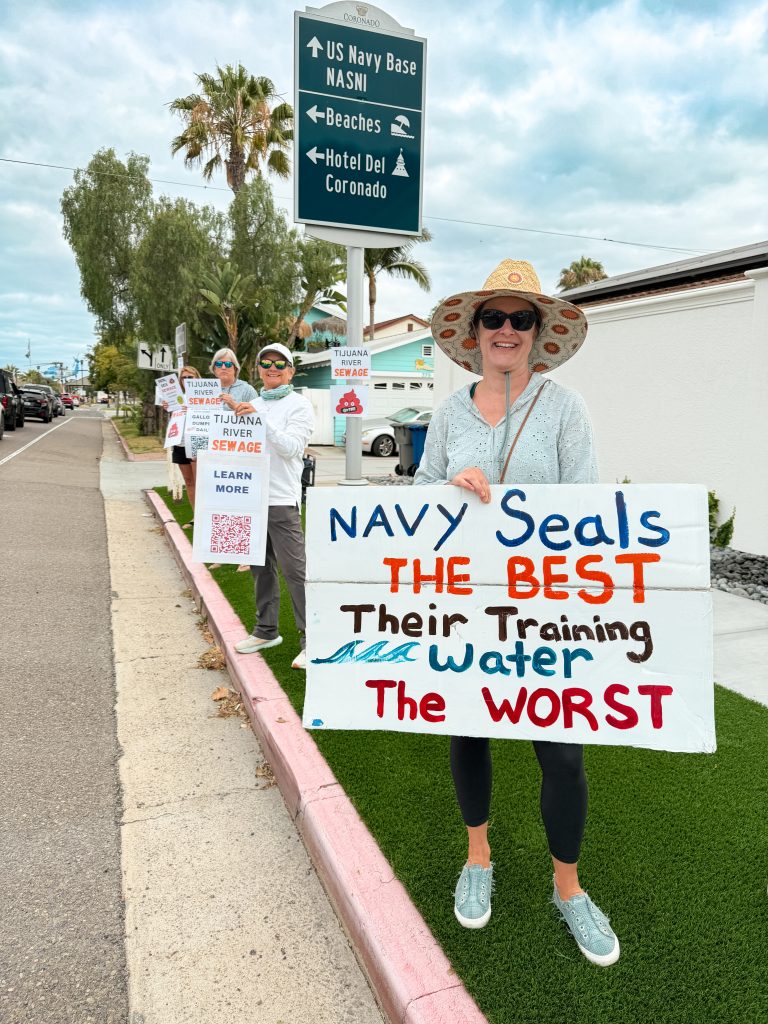
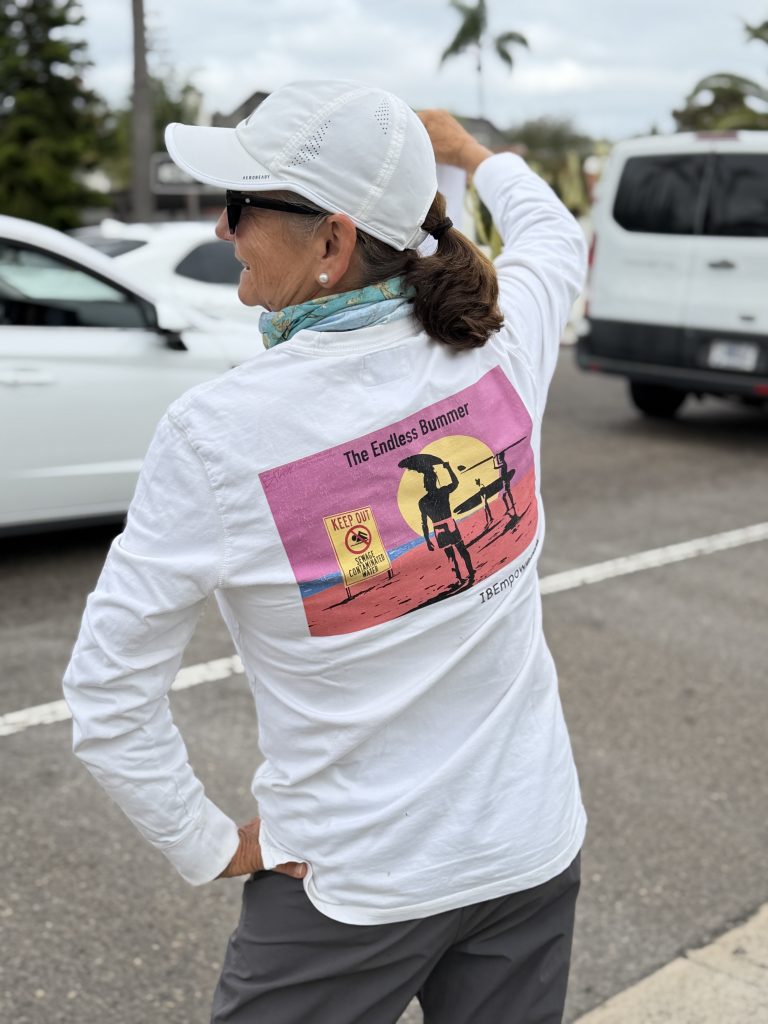
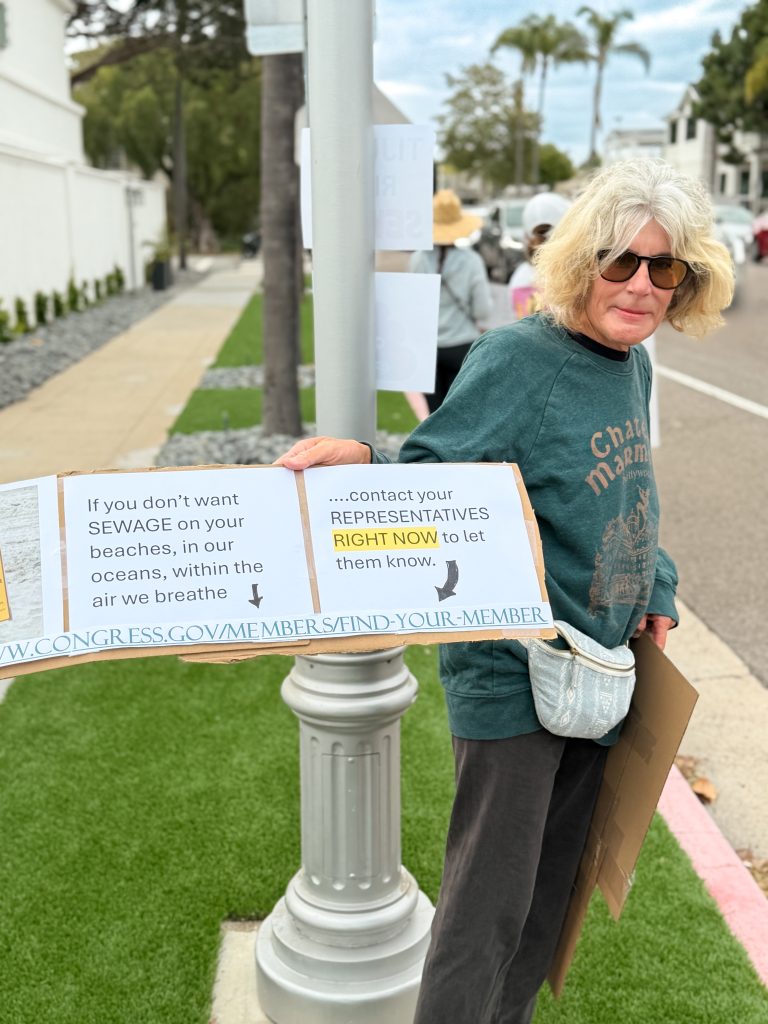
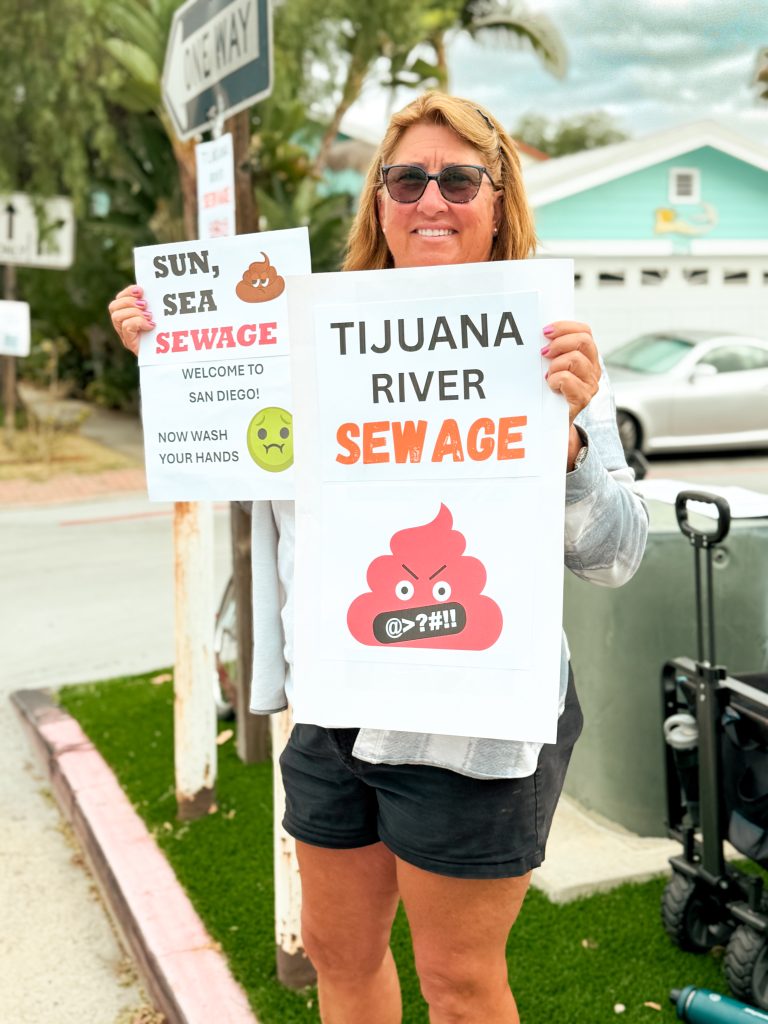
 While the flags waved high at NASCAR, residents raised signs in the air to alert racing fans to the cross-border sewage crisis affecting local beaches.
With an estimated 125,000 visitors coming to the island for NASCAR, it seemed like a great way to raise awareness to the issue, said Leslie Crawford, who organized the protest with friends Marvel Harrison and Amber Riddell. Protesters held signs with QR codes linking to air and water quality reports from Emerald Keepers and a substack with links and resources.
“The three of us were swimming at the community center pool on Monday, and it took me 20 minutes to get there because of all of the NASCAR trucks,” said Crawford. “I thought, let’s use this event to raise awareness. A lot of people have no idea!”
So far this year, Coronado beaches have been closed more than 100 days. Just last month, the repeated collapse of a Tijuana wastewater line resulted in “excessive” flows to the main wastewater treatment plant. Coronado beaches turned murky with what appeared to be brown and yellow sewage foam and were subsequently closed.
Coronado beaches close as sewage treatment plant hit with ‘excessive’ flows
But many people aren’t aware of the issue.
“Locals don’t get in, and tourists don’t know,” said Amber Riddell, whose husband grew up going to the beach in Coronado. “This is a bi-partisan issue. Everyone needs clean water.”
She said many locals who grew up surfing in Coronado had to stop visiting local beaches because they were getting intestinal and ear infections. Then there are the stories of people getting flesh-eating bacteria.
Flesh Eating Bacterial Infection Extinguishes the Dreams of a Former Border Patrol Agent
But the polluted beaches aren’t just a problem for locals. Basic Underwater Demolition/SEAL (BUD/S) candidates who come from all over the country are exposed to the contamination.
Marvel Harrison, an Imperial Beach resident who has been involved in raising awareness for the sewage crisis, says the toxic gas — called hydrogen sulfide, which often smells like rotten eggs — is a big concern.
“People keep talking about the bad smell, but it’s more than a bad smell. It’s a toxic gas,” she said. “Hydrogen sulfide was the first chemical warfare gas used in World War I.”
She said the residents of South Bay have been suffering for years from exposure to the toxic gas. It’s problematic for day-to-day living because it affects everyone, regardless if they go in the water or not.
“I can choose not to go into the water, and that’s heartbreaking,” said Harrison. “But I can’t choose not to breathe. This should be a huge source of shame for the state of California.”
But she says this is a crisis that can be corrected.
“We’ve been treating sewage for 100 years,” she said. “So why aren’t we doing it? And stop blaming Mexico. Yes, it’s coming from Mexico, but now it’s our problem. It’s our beaches and our air.”
She said U.S.-owned manufacturing companies in Tijuana are driving rapid population growth in the region — which is quickly outpacing any improvements in infrastructure. According to the Global Migration Center, these companies are attracting more than 80,000 new residents to Tijuana each year.
 This means more sewage in a system that’s already crumbling.
“We have more than 700 manufacturing companies in Tijuana, and 80% of them are U.S.-owned,” she said. “While these manufacturing companies aren’t responsible for the infrastructure that’s been broken for decades, they are the cause of the crisis.”
Harrison believes that U.S. politicians need to push hard on the American-owned factories, because they have the potential to help fix the problem.
And then, there are all the chemicals. According to scientific research, more than 175 toxic chemicals are found in water samples collected from the Tijuana River Valley — many from manufacturing.
“Maybe even more important is the dumping of all the ‘forever chemicals’ and carcinogens and the life-long toxicities in the ground water systems,” she said. “All the fentanyl and all the meth…it’s been measured.”
Harrison says she’s glad that EPA Administrator Lee Zeldin visited the region, as he is the highest-profile politician that’s ever come to assess the situation. But more needs to be done.
“I think that there are lots of the right things being said, but until the air is clean, the water is clean, the marine life is protected, our Navy SEALs and Border Patrol are protected, I’m not buying it,” she said.
Crawford said that the feedback from those driving to NASCAR was very positive. And she feels like they are accomplishing their goal: keeping the sewage crisis at the top of mind.
“I’m sick of this,” said Crawford. “I felt kind of powerless up to this point. But maybe there is something we can do.”


We want to hold signs. The whole community needs to do this to raise awareness. Let’s do it this summer. In front of the Del on the beaches. I’m sick of it being hidden! It’s disgusting!
We want to hold signs. The whole community needs to joy this hard to raise awareness. Let’s do it this summer. In front of the Del on the beaches. I’m sick of it being hidden! It’s disgusting!
An important story, well done!!
Such a great and important story. Thank you!!