




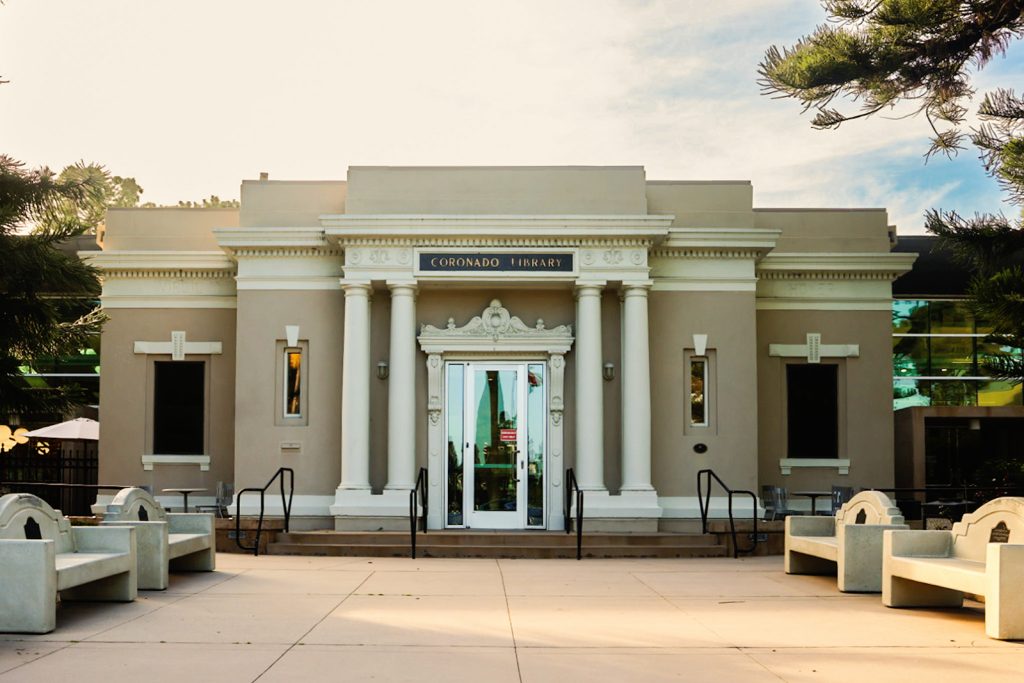
Every time it rains in Coronado, library staff hustle. They haul out trash cans, moving them from drip to drip. Artwork, archival materials, and books are all at risk. One leak is repaired, but the water is relentless and finds its way to another entry. The staff moves the trash cans to the new leak, ready to catch the rain.
The Coronado City Council has approved a plan to fix the library’s aging, leaky roof — though full relief may still be years away, with construction slated to begin in 2028.
“I never, ever want to see Beth Skelly up on a ladder again,” said Coronado City Councilmember Amy Steward, referencing the library’s administrative coordinator’s efforts to preserve the collection at the Coronado Public Library.
After more than an hour of deliberation, the Coronado City Council on April 7 unanimously approved a long-overdue overhaul of the library’s roof and HVAC system. It also voted to commission a $100,000 solar feasibility study before committing to what could be a transformative energy investment for the city.
The project carries an estimated total cost of $8 million and has been years in the making. The library’s 14 rooftop mechanical units were installed in 2004 and 2005, and the roof itself has reached the end of its warranty life. Water ponding, leaks, and drainage failures have become increasingly common.
Meanwhile, frequent patrons of the library report unpredictable temperatures. Sometimes they sweat; sometimes they wrap beach towels around themselves to stay warm.
The roof
Principal technician Jackie Ludwig led the presentation, walking the council through a recommendation to replace the existing thermoplastic polyolefin (TPO) roof with a polyvinyl chloride (PVC) system. While PVC runs roughly 15 to 30 percent more expensive than TPO, the material offers a lifespan of 25 to 35 years compared to TPO’s 15 to 20. The price premium in real terms, Ludwig noted, works out to only a 5 to 6 percent increase on the total $2 million roof installation. All three consultants on the project unanimously backed PVC.
As part of the roof work, the historic Spreckels Reading Room skylight — which staff has been repeatedly patching — will be replaced, along with updated fall protection barriers and corroded flashings.
The HVAC
Three mechanical system options were on the table, ranging from a $5.8 million in-kind replacement to an $8.5 million overhaul that would have required cutting concrete slabs and installing columns throughout the library’s interior. The columns, however, would have be obstructive and impeded accessibility.
The council approved the $5.8 million option as the most straightforward approach: Replace all 14 existing rooftop units with equivalent-capacity equipment, while adding one new dedicated unit for the archival collections as an improvement.
The Solar Question
The most contentious portion of the evening centered on solar, where council members clearly wanted to act, but disagreed on how far to go.
Staff presented two options: a modest, 5,000-square-foot array that would offset roughly three percent of the library’s annual energy use with minimal structural and electrical impact, or a full rooftop array estimated to offset approximately 90 percent of energy usage. However, that would require major SDG&E infrastructure upgrades, structural reinforcement, and significant additional study.
Complicating the picture was a late-arriving voice from the public comment period. Stuart Smith, a Coronado native and former solar developer, urged the council to pounce on a current 40 percent investment tax credit under federal law (30 percent base plus a 10 percent domestic manufacturing bonus) if a project is completed by Dec. 31, 2027. Cities can lock in eligibility by paying 5 percent upfront by July 3 of this year, which Smith acknowledged was tight, but still, he argued that the economics “absolutely scream” in support of full coverage.
Councilmember Steward was persuaded.
“I think we have an opportunity here to look at these,” she said, describing the library’s proximity to other city buildings as a prime location for a potential city-wide micro-grid. “It would be foolish not to, at this juncture, when we’ve been saying we’re going to put solar on buildings.”
Councilmember Mark Fleming, however, was skeptical that Coronado could meet such a tight deadline. He also worried about delaying a project that the community needs now.
“When we start adding two, three, four, five, six months, potentially, to this project, what additional risk are we putting to the facility, the artwork, the books, and the programs?” he asked.
Councilmember Carrie Downey said she personally has been trying to get solar panels onto a city building for 24 years and supported, at minimum, the $100,000 feasibility study.
The council as a whole was amenable to solar, and approved the feasibility study, adding direction to staff that it be completed as fast as possible.
In the meantime, design will move forward for the roof and HVAC replacement. Design is expected to take 14 months; bidding and awarding contracts, another six; and construction 16 months (18 to 20 with solar).