




Written by Alexis Curtis
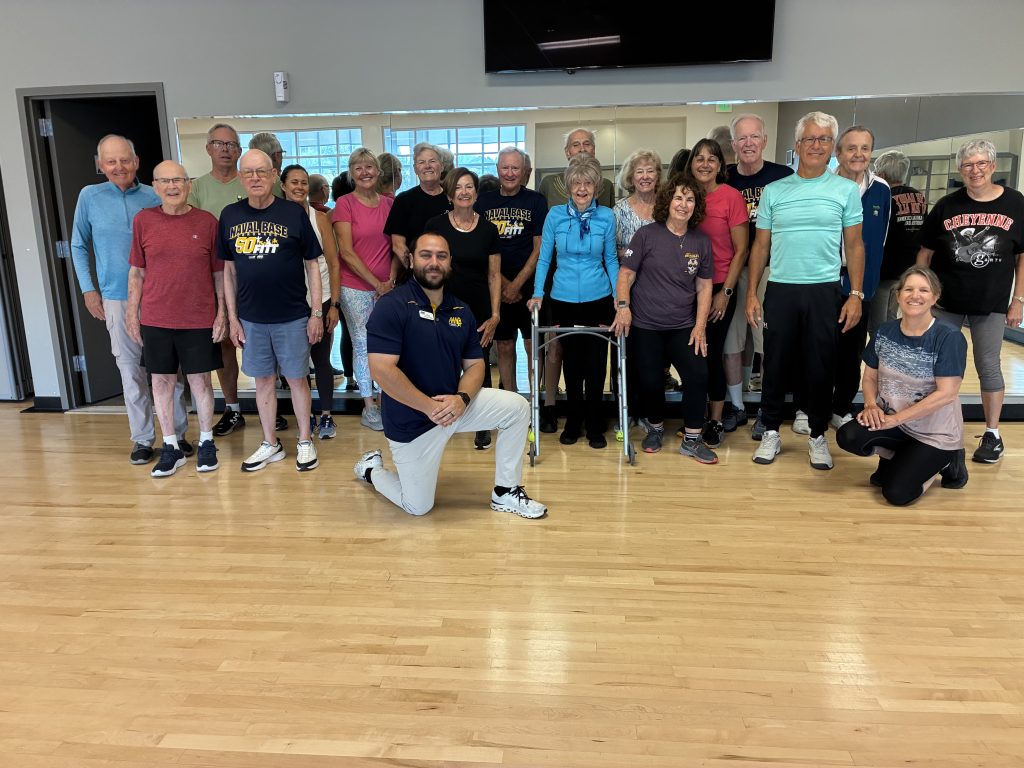
Chuck joined back when the class was still called Senior Stretch.
“That’s why I went,” he said. “I was so stiff.”
The day he signed up, the name changed to Senior Fit. He found out what the difference meant after his first session, when he made it out to the front desk and leaned on the counter to catch his breath. Somebody asked how it went.
“I said, ‘they should call it cruelty to old people.’”
The name never changed, but the joke stuck. Now when he checks in on class mornings, the staff send him off with, “You’re on your way to see your abuser.”
The instructor is Erick Lopez, who has led the class for about three and a half years at the VADM Martin Fitness Center on North Island. Lopez has also worked as a personal trainer for roughly twelve. Ask him what a senior fitness class is actually for and the answer is practical.
“Getting older, there are some challenges,” he said. “So this class is just to strengthen our bodies, to keep our bodies healthy as we age, and to help with those activities of daily living, and to keep that independence.”
Activities of daily living is trainer shorthand for the ordinary business that determines how well the years after 70 go. Getting out of a low chair. Carrying groceries in from the car. Reaching a high shelf. Catching yourself when the sidewalk turns out to be uneven.
Those things get harder for a reason. Adults start losing muscle in their thirties and keep losing it, and the pace picks up after 60. Harvard Health puts the typical rate at one to two percent a year beginning around age 35, rising to roughly three percent a year after 60, which adds up to four to six pounds of muscle per decade in people who do no strength training. Strength declines faster than muscle mass does, which is partly why someone can look about the same at 75 as they did at 65 and still find the stairs harder to climb.
The consequences turn up in the fall statistics. The Centers for Disease Control and Prevention report that more than 14 million adults 65 and older, about one in four, fall every year, and that falling once doubles the odds of falling again.
The encouraging news is that muscle responds to training at essentially any age, and the official recommendations are more modest than most people assume. The CDC advises adults 65 and older to get 150 minutes of moderate activity a week, strengthen their muscles on at least two days, and work on balance regularly. The World Health Organization recommends balance and strength training three or more days a week, specifically to keep people functional and on their feet.
 Most older adults don’t get there. In one study of more than 1,300 people, most participants averaged plenty of physical activity a week, but only 11 percent met the full guidelines. Strength and balance were the pieces most often left out, and those two things are most of what Senior Fit is.
Lopez also teaches a warrior strength class for a younger crowd, and he doesn’t treat the two as separate species of exercise.
“Movements are all the same,” he said. “It’s about how you put those movements together that really makes a difference in your workout.”
In Senior Fit he builds around three areas of the body. “I try to focus on mainly the hips, the torso, and the shoulders,” he said. “That’s where a lot of our movement is generated and transfers through.” What he’s after is a well-linked kinetic chain, hips and trunk and shoulders operating as one connected system, which is what it takes to lift a suitcase into a trunk or turn to look behind you while backing out of a parking space.
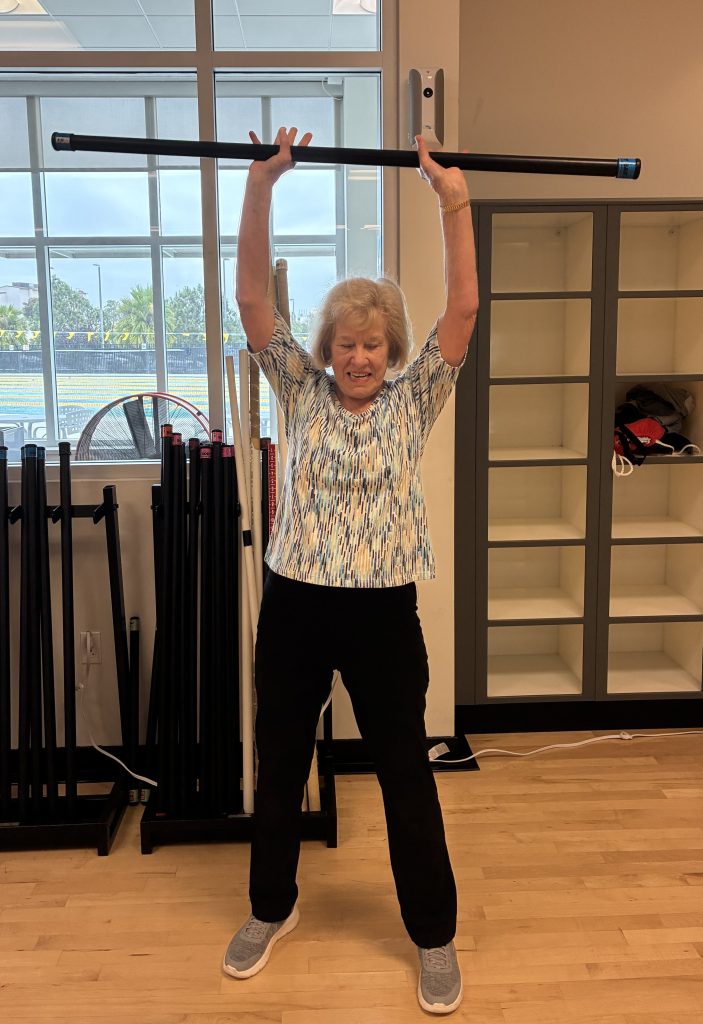
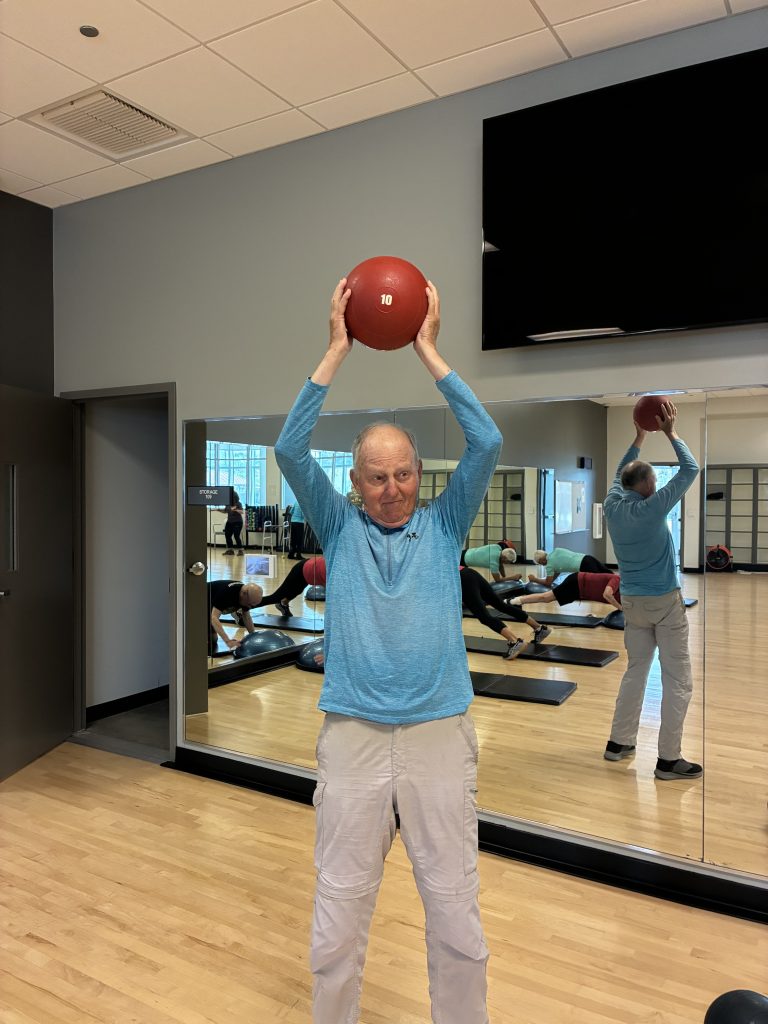
The format is almost always a circuit, though the emphasis changes. Some days are built for endurance. Some are built for strength. Some include a power element, the slams and other explosive work that the group seems to enjoy more than it lets on.
“It gives me an organized exercise routine twice a week, and that’s important at my age,” said George, who is in his 80s and has been coming to Senior Fit longer than anyone. “I’ve been doing this since I retired from the Navy in 1990. … I’ve been coming all this time, at the old old gym, and then the old gym, and now this gym.”
The oldest person in the room right now is 96. The only qualification to participate is being a senior, and participants can determine at what age they qualify.
“It’s open to everyone,” Lopez said. “There are all levels of fitness in this class, and I think it’s just great for anyone that wants to come and challenge, or maybe get ideas for what they’re already doing in their workout routine, and just kind of challenge what they’re doing, and maybe add in some new elements to their own routine.”
Getting the class to that point took some adjusting. When Lopez started, he wrote the workouts out on paper, the way he would for any client, using the terms he’d always used.
“I used to write out the workouts on a piece of paper,” he said, naming exercises like row and shoulder press. “No one really knew what those words meant.”
So he changed how he taught it. The early sessions leaned on body weight and resistance bands, and he started taking the group out of the room.
“Every week I would go out to the gym floor, and we would look at machines,” he said. Some weeks the class met out there. The point was to show people that what happens in the room isn’t a separate world from the rest of the building. “Just to see that what we’re doing in this class isn’t too far off from what’s being trained out in the gym. It’s just put together a little bit differently.”
Three and a half years in, he can pick out the longtime members from the newcomers, though not by how much weight anyone is moving. It comes down to pacing.
“The new people in the class, ‘how many reps should I do in this allotted time? Should I go a lot, or should I go slow?'” he said. “I think the people who’ve been coming to this class kind of have an idea of how many reps to do. When I say today’s an endurance, long-duration day, they kind of understand, okay, today’s a little bit lighter, more reps. Or today’s strength, it’s going to be a little bit more intense, the movements, so the duration is going to be shorter.”
Knowing what your body has available on a given morning is a skill, and it travels well outside the gym.
Rogers turned 90 in April and has been coming for five or six years. He still skis.
“You’ve got to keep active,” he said. “One thing is balance as you get older, but you can work on that. You can improve it, always.”
He is clear-eyed about which parts of getting older respond to effort and which don’t. “You can’t keep the color of your hair the same,” he said. “Or even the hair.”
Asked what he’s gotten out of the class, he mentioned staying active and meeting people, in that order. “It’s a great group. Really friendly, and all working hard at our own rate. I enjoy it.”
Chuck is 96, and he arrived with a specific complaint. “I needed to loosen up my joints,” he said. It has worked, and his review of the results was two words: very good. But when he was asked about the best part of coming, he talked about something else entirely.
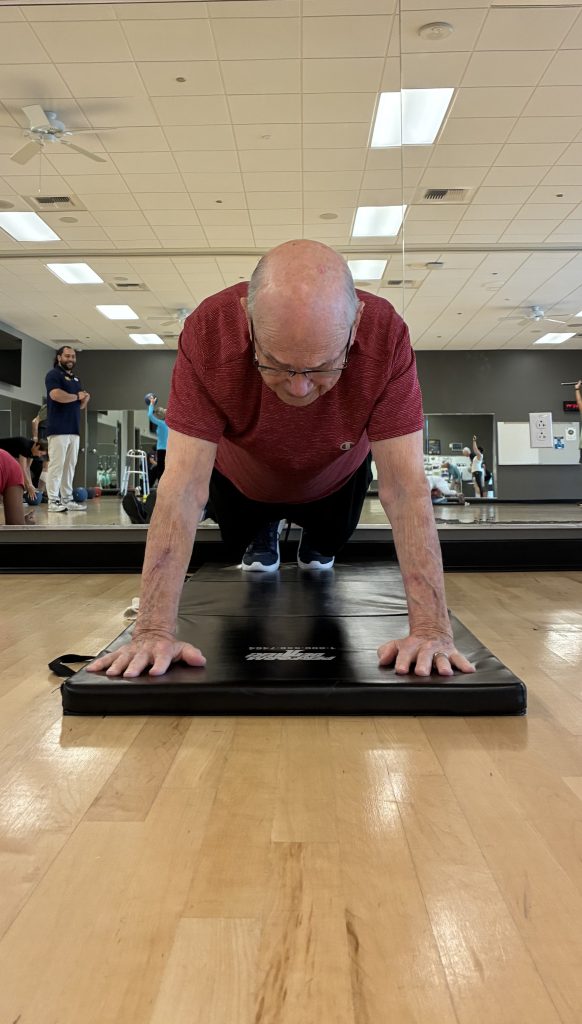
“The socializing,” he said. “I try to be more fit. But I really look forward to the socializing.”
Kitty, who turns 75 soon, has been coming since not long after the gym opened, and she has watched the class fill up.
“It’s gone from just a couple of people to sometimes 27,” she said. “I think we’ve actually had 30 at times.” Summer brings part-time residents, the zonies, as she calls the Arizona contingent, and the numbers thin out again when they head home.
Her answer about the biggest benefit matched Chuck’s. “Social,” she said. “It is social, and it keeps you connected. That’s why I do it.”
She thinks it does something for her head, too. Lopez changes the workout constantly, and she counts that as a feature rather than an inconvenience.
“He does different things all the time, so you have to actually think about what you’re doing,” she said. “It keeps the brain active.”
Kitty has been in enough classes to know the difference between an instructor who runs a room and one who watches it. “He knows what old people’s limitations are, and he tries to help with those. And he watches us, unlike some people who will just let you do it alone.” She said he connects with people in a way she hasn’t found in every younger trainer.
Asked whether there was anything else he wanted to say about the class, Lopez went back to something Chuck had said.
“I like how Chuck mentioned the social aspect of it,” he said. “I like how this class is community-based.”
Then he described something that doesn’t appear anywhere on a workout card. He schedules the socializing.
“I do reserve five minutes before the class starts, just so everyone can walk around and talk,” he said. “And even after the class, I stay maybe 10 to 15 minutes after, just so everyone can stay … and have a place to hang out.”
That’s twenty minutes a session set aside for nothing but company. Researchers have spent the past several years documenting what isolation does to the health of older adults, and the U.S. Surgeon General issued an advisory on the subject in 2023. A class that reserves time for people to stand around talking is doing more than it looks like it’s doing.
“That’s just what I enjoy most about this class,” Lopez said. “Everyone who comes here, we have fun, and that’s how I always try to make it every time. I mix it up, so you know to expect a circuit, but it’s just different every time.”
Chuck’s proposed name never did catch on. He’ll be there next class anyway, leaning on the counter afterward, and the front desk will have something to say about it.
What: Senior Fit
Where: VADM Martin Fitness Center on North Island Navy Base
1507 Rogers Rd, Coronado
When: 8 a.m. Tuesdays and Thursdays
Need to know: Base access required
Entry to the VADM Martin Fitness Center on Naval Air Station North Island is free for active duty military, reservists, retirees, and their eligible dependents. Authorized guests or visitors without a military ID card typically require a small guest fee (around $3) when accompanied by an eligible sponsor. Once checked in, all equipment use and classes are included.


This article talked me into checking out the class, but it is missing a few helpful details. What is the address of the fitness center? North Island is a big place if you’re just driving around looking at random buildings. Is there a charge for the class? Do students need to bring their own weights, mats, etc?
Thank you for the comment. I’ve added the address of the fitness center and some additional details about entrance to the fitness center. There is no charge for the class, nor do you need to bring your own equipment.
Erick is my Son and I just love to read all the good things he is doing over the years . He is a wonderful Person and I’m not surprised by all the good comments about him . He really enjoy his job and has a lot of pacience for all the good people around him. Thanks for this post 🙏🏼❤️
Love your comment so much! I take the class and he is amazing!