




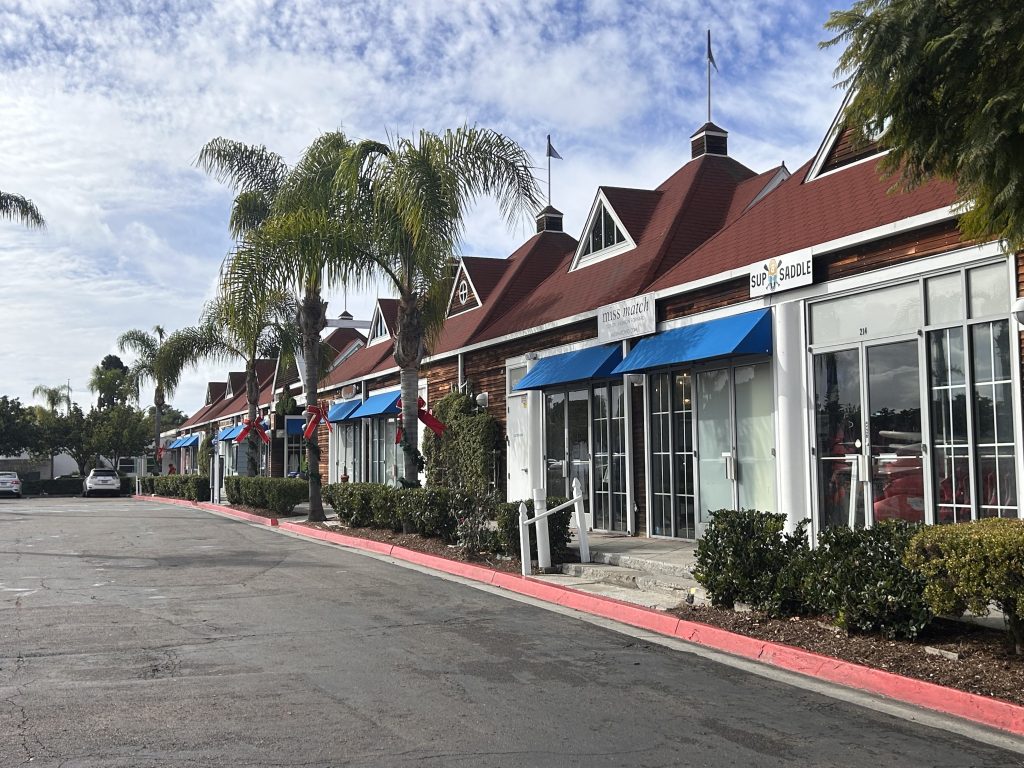
With just over a week left on its lease, the operator of the Coronado Ferry Landing appears to have settled its differences with its landlord and could end up running the waterfront retail center for another 35 years.
The San Diego Board of Port Commissioners will vote June 23 on an option-to-lease agreement with longtime operator Port Coronado Associates (PCA).
The proposal moves up construction on the Ferry Landing’s redevelopment by a full year, to 2027, and cuts the construction timeline from 36 months to 24.
If approved, PCA would have 12 months to meet a list of preconditions before signing a 35-year lease or losing its right to lease the property.
The deal also folds in structural and utility work on the ferry pier itself, which wasn’t part of the original scope, and calls for hiring an “activation consultant” to program public spaces with seasonal events.
The proposed agreement comes after eight months of debate in public and closed session.
In October, the Port announced it would not renew its lease with PCA, which has operated the waterfront property since the 1980s, and would instead take over operation of the 13-acre site itself, a decision Coronado leaders called opaque and unilateral.
The move stalled a $20 million planned redevelopment of the property and left food and retail tenants unsure of their futures.
By November, Port staff were pointing to roughly $17.5 million in deferred maintenance as justification, though PCA said these concerns had never been disclosed. By December, the Board had reversed course again, voting unanimously to send the matter back to closed-session negotiations after PCA submitted a revised proposal addressing those maintenance concerns.
Tuesday’s vote could mark the end of the saga and catalyze the Ferry Landing’s long-awaited renovation.
“Coronado has waited long enough, and it was important to get this issue resolved to yield the type of Coronado Ferry Landing that the city deserves,” said Frank Urtasun, Coronado’s representative on the Board of Port Commissioners. “I think under this plan, we will get that.”
Urtasun thanked Coronado’s leaders, particularly Mayor John Duncan, for pushing for transparency in and resolution of the matter.
The Ferry Landing sits on land that is part of a public trust overseen by the Port of San Diego under the California Public Trust Doctrine, which requires that waterfront land be used for purposes that benefit the public.
The Port cannot sell public trust land, and it often enters into long-term leases with private companies that promise to invest capital into development or improvement. Under this model, the Port retains ownership and regulatory control of the land, but private companies finance and operate businesses on it under lease terms that allow them to recover their investment over time.
Since then, according to a staff report, PCA has resolved approximately 95 deferred maintenance items on the property. The staff report also says the new terms are designed to keep the renovation on schedule.
PCA’s renovation plan now carries a $13.9 million price tag for landside and pier improvements, plus a separate requirement to spend no less than $5.3 million on future subtenant improvement projects — bringing the total investment close to the $20 million PCA had originally proposed back in 2022.
Under the proposed deal structure, PCA must meet a number of conditions for redevelopment of the Ferry Landing in the next 12 months, including securing project financing, obtaining permits, submitting working drawings, posting payment and performance bonds, beginning early demolition and parking work, and lining up signed letters of intent for at least 25 percent of the center’s leasable space.
The current lease, set to expire June 30, 2026, would stay in force during that option period so long as PCA keeps up its obligations. If PCA fails to meet the preconditions, the option lapses, and the company would be required to hand the property back to the Port in good order, at no cost to the Port.
During the 35-year lease, PCA’s rent would be tied to a percentage of the center’s sales, with a minimum payment of $600,000 to start. That floor climbs in four steps over the life of the lease, more than doubling at the first jump alone, before reaching nearly $2 million by the end of the 35-year term.
By comparison, PCA paid the Port approximately $1.09 million in rent in fiscal year 2025, when the center generated nearly $29.4 million in gross sales.
The agreement also includes a penalty clause: if PCA hasn’t finished the renovation by July 1, 2029, rent automatically increases by $250,000 on a per diem basis until the work is done or the lease is terminated. The staff report does not clarify exactly how that penalty would be calculated.
The new lease leans heavily into the maintenance disputes that defined the fall. PCA would be required to spend at least 5 percent of its average annual gross income every five years on upkeep and repair, and to commission independent condition assessments of the property at lease years 10, 20, and 30 — addressing whatever those assessments turn up. Mid-term reviews would also benchmark subtenant occupancy and sales performance against expectations.
The Board of Port Commissioners will vote on the proposal during its open session meeting at 1 p.m. on June 23.