




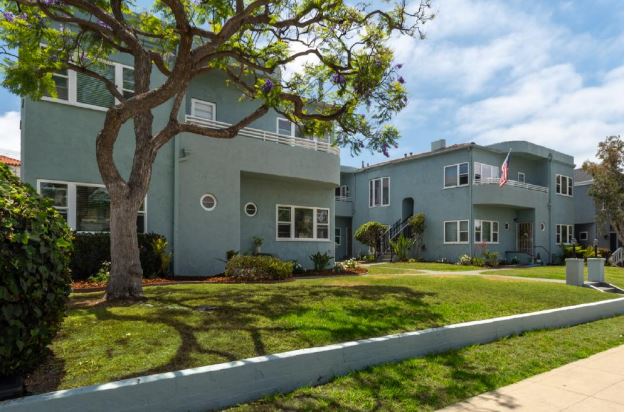
The Coronado City Council voted unanimously to move forward the purchase of an eight-unit apartment property on D Avenue, positioning the city to eventually convert the units into affordable housing.
The complex will cost just under $6 million, and the city will finance the purchase using $1.8 million from its affordable housing in-lieu fund, with the remainder as an intra-fund loan from the city’s general fund, which will be repaid over time by future housing in-lieu fees.
The units are currently rented at market rate, so the units will be phased into affordable housing over time. Each two-bedroom, one-bathroom unit is approximately 900 square feet.
Although the council voted unanimously on Dec. 2 to move forward with the purchase, discussion centered — as it often does with affordable housing — on the tension between state mandates and council authority.
“This is imposed on us by the state of California, and we as a city are doing the best that we can to be in compliance with what’s being handed down from our elected leaders in Sacramento,” said Councilmember Mark Fleming during deliberations. He said that in the past, he purchased a home that wasn’t his ideal house, and wasn’t in his ideal neighborhood, but hoped one day he could achieve the house that was his ideal.
“We are using taxpayer dollars to subsidize the cost of housing for people who can’t afford to live in Coronado, so that they can live in Coronado,” Fleming said.
Steward, after noting that she wouldn’t be able to afford her house at its current value today, proposed the intra-fund loan in light of Fleming’s point. That way, taxpayer dollars taken from the city’s general fund to facilitate the purchase would eventually be repaid by housing in-lieu fees, which are paid by developers. The rest of the council was supportive of the financing structure.
Steward voiced the most support for the purchase, saying that she hoped it could enable first responders and teachers to live in the community in which they work.
Councilmember Kelly Purvis called the opportunity a “diamond in the rough,” noting its approximately $750,000-per-unit purchase price.
“The rules are the rules,” she said, “and we have to do the best we can to meet the mandate of the state with affordable housing.”
Mayor John Duncan emphasized that while the city is spending money to produce affordable housing, it is also acquiring an asset that will generate rent: some of it subsidized to keep the units affordable, but revenue nonetheless.
“It’s important to note that we own the property, because the property is valuable, and its (value) is going to keep going up, whether it has dips or not,” he said.
Councilmember Carrie Downey recused herself from the vote due to owning nearby property.
California’s mandates for affordable housing
The state does not explicitly require that cities themselves produce affordable housing, but its mandates do require measured progress toward reaching affordable housing targets.
Every eight years, a new Regional Housing Needs Allocation (RHNA) begins, during which cities must pass a new Housing Element approved by the California Department of Housing and Community Development (HCD).
In the current cycle, Coronado was allocated 912 units, which city leaders balked at, saying it was disproportionately high considering the city’s size and built-out nature. After a period of noncompliance and a failed lawsuit, Coronado begrudgingly passed its current plan in October 2023.
However, the state does require that cities make progress toward reaching affordable housing goals, a relatively recent shift in enforcement brought about by a series of legislative changes made beginning in 2017.
Simply put, state law requires that cities show they are making progress toward their affordable housing targets, but the law does not specify how that progress must be made. In built-out, expensive cities like Coronado, enticing development of affordable housing units on the private market is often difficult.
As a result, some cities choose to purchase property and provide affordable housing themselves.
This is where the affordable housing in-lieu fee comes in. In Coronado (and many other cities), if a developer wants to build a housing complex, there are two choices: provide affordable housing, or pay a fee.
Housing in-lieu fees are put into a fund the city can use to purchase affordable housing. This, too, is often misunderstood, because the fees themselves are not required by state law, but for many cities, they provide a route toward compliance with the HCD.
Coronado increased its in-lieu fees earlier this year for the first time since 1993. Previously, it was $7,000 per unit; now, it is $25 per square foot, and it will increase in phases until it reaches $55 per square foot in July 2029.
The process involved robust public discussion and pushback from developers who said the fee increase was too steep, too sudden, and might stall development of additional housing in Coronado.
Others questioned if, rather than making housing more affordable, it might instead increase Coronado’s already pricey real estate or discourage multifamily units, since single-family projects are not subject to the fee. The council opted to phase in the fee, but still approved the increase.
The conversation about in-lieu fees sounded similar to that about purchasing the D Avenue property. We have to provide affordable housing, city leaders say, time and again. If the city does not, nobody will.


I’m so much interesting. Can somebody call me or let me know where we can apply for for this affordable housing