




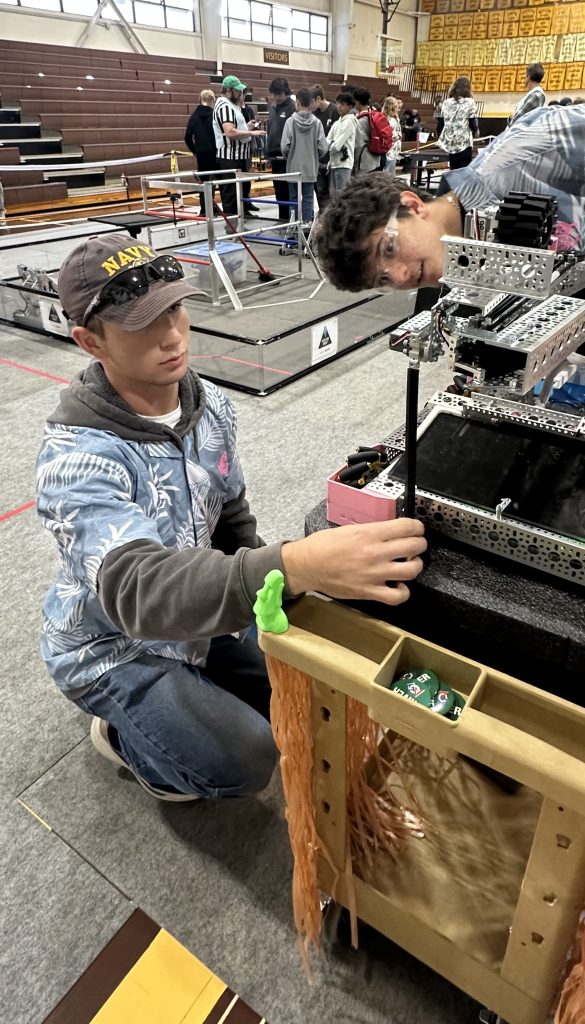
In alignment with its Portrait of a Graduate strategic vision, Coronado Unified School District (CUSD) has expanded robotics programming and is in the planning stages of implementing a coordinated computer science curriculum across all school sites.
“Graduating students who are ‘Technologically Competent and Adaptive’ is one of the goals outlined in our Portrait of a Graduate,” shared Senior Director of Learning Dr. Megan Battle.
Of course, expanding robotics and computer science experiences for students comes at significant cost that is beyond the scope of the district’s general fund.
“We’re incredibly fortunate to have two strong partners in the Coronado Schools Foundation (CSF) and the Department of Defense Education Activity (DoDEA) who make this growth possible,” shared Dr. Battle. “Without their financial support we wouldn’t be able to offer the robust STEM programs we have and are preparing for at all four of our schools.”
“Offering robotics opportunities districtwide has been a long-standing goal, and we’re thrilled to now offer robotics clubs at the elementary level,” continued Dr. Battle. “We are also fortunate to have Roberta Lenert overseeing K–12 robotics. Her leadership ensures strong vertical alignment and a clear pathway for students as they advance through grade levels.”
Roberta Lenert, CUSD’s Director of Robotics, founded the Coronado Robotics program at Coronado Middle School and has been the driving force behind the growth of the robotics teams at the secondary level.
The district’s focus on both robotics and computer science directly supports its broader STEM goals. By spring of 2026, Silver Strand and Village Elementary schools will begin to incorporate computer science instruction directly into the core curriculum.
“Our vision through the CS+ DoDEA grant is to implement the California Computer Science Standards starting with our youngest learners by integrating these skills into the core curriculum,” explained Sarah Yakutis, CUSD’s Teacher on Special Assignment and administrator for the grant.
“The goal is to increase participation in advanced computer science courses, such as AP Computer Science, by the time students reach high school.”
For students eager to go beyond the classroom, CUSD is offering robotics clubs as extracurricular opportunities. “We’re excited to have two outstanding coaches, JD Laaperi at Silver Strand and Courtney Sakai at Village, leading our elementary programs,” said Lenert.
At the secondary level, Coronado Middle School students will continue to grow its competition team program. CMS will have five competition teams this year, and they will compete in the First Lego League series.
At Coronado High School, students will also have expanded options to participate in robotics, including both competitive and exploratory opportunities at the club level.
As the director overseeing robotics at all levels, Roberta Lenert has set a bold vision for the district. “Our goal for the district is to build programs that provide a safe and supportive learning environment where students can take risks, learn from failure, and iterate their ideas – turning mistakes into opportunities for innovation. We are excited to build this pathway from elementary through high school, growing students’ abilities and passion along the way,” shared Lenert.
Funding is the critical piece to realizing the district’s STEM pathway goals.
CSF funds a broad range of STEM activities, including the district’s Innovation Labs and robotics programs, as well as classes and labs in coding, computer science, game design, and environmental and biomedical science.
Additionally, DoDEA awarded CUSD a $1.25 million Project Computer Science (CS+) grant to expand and improve computer science study in grades kindergarten through 12th grade.