




Written by Dawn Richards
“The only thing better than singing is more singing.”
~ Ella Fitzgerald
While Ella Fitzgerald couldn’t have known about the Sit a Spell and Play a Tune public art piano, she would undoubtedly approve of the Community Sing-Along happening at 1 pm on Friday, August 15, at the Coronado Public Library. Sponsored by the Library and Cultural Arts Commission, this free event will take place at the piano’s home outside the Library next to the coffee cart. Singers of all ages and abilities are welcome – no talent required.
Friday’s event will feature popular songs from multiple decades that everyone seems to know and love. Lyric sheets will be provided to all singers and wannabe singers, and in a twist from previous years, musicians are invited to bring along their own instruments. Whether guitarists, violinists, or even ukulele strummers (who made a welcomed surprise appearance last year), all are invited to join the jam.
For those who claim they can’t sing, enjoy the experience by simply listening. However, consider that a recent Canadian study revealed that a paltry 1.5% of the population experiences a condition known as “congenital amusia,” which makes it challenging for them to distinguish between pitches and tones. But if you’re part of the other 98.5% of the population, you can definitely learn to sing, and there’s no better place to practice than this Friday’s event.
In addition to having fun, expect to benefit from singing’s ability to boost lung capacity, release endorphins, and lower stress levels, along with the additional benefits that accrue with group singing. According to researchers, it builds bonds and creates a sense of belonging, boosting self-esteem and the feeling of being part of something larger than oneself.
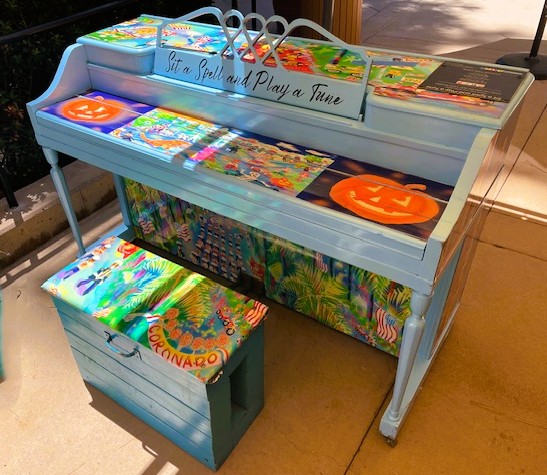
It turns out that public art pianos, too, create a strong sense of community, bringing people together while also exposing them to art. Cities around the world are installing these “smile generators” in public spaces as a way to transform neighborhoods and highlight neighbors’ similarities over their differences, while also adding the vibrancy of art that decorates the instruments.
Stories from near and far illustrate how the pianos foster a feeling of spontaneous delight and inclusion. Both children and adults have experienced their first time playing, often leading to a new hobby. Those who have played for years in their own homes have discovered the joy of playing in public. And those who simply enjoy listening to the music frequently find themselves talking to strangers, who are suddenly no longer strangers but now familiar faces. Additionally, it’s a creative outlet for those who love to play but either can’t afford their own or have no room for one.
According to Steve Woolrich, who celebrated his 50th birthday in 2010 by donating Canada’s first outdoor piano, “When people come together in an upbeat and open way they realize that they have much in common. We also learn that the best streets in our cities are the ones where people care about what goes on there — where people take a shared ownership and responsibility. Street pianos help create that vibe.”
Woolrich was inspired by the first known street piano in Sheffield, England, where a new piano’s owner was confounded by the steep staircase leading to his home. Forced to wait a few days for help, he left a sign on the instrument inviting passersby to sit down and play. So popular was the piano with the community that it became a permanent fixture. Since then, painted public pianos have been adopted in numerous cities.
So, channel your inner diva, invite your friends and family, and be a part of something big. See you there!