



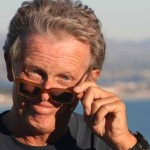
Joseph P. Rizza
“Friend of all the World”
1915-2012
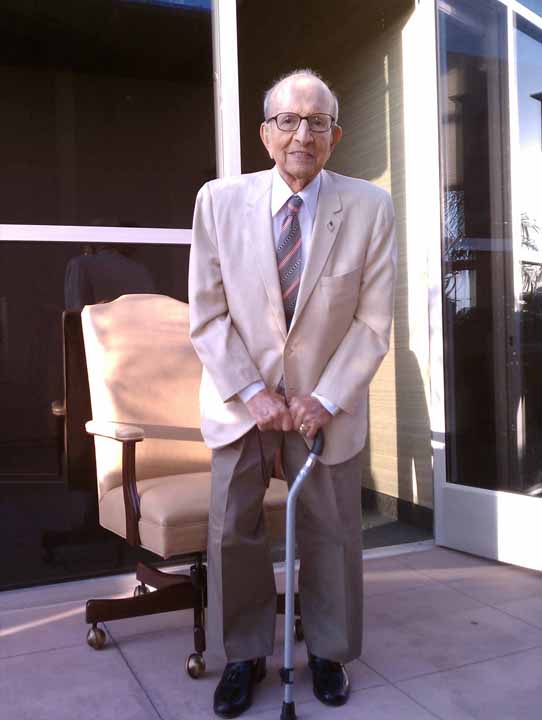
Coronado’s first “Citizen of the Year,” Joe Rizza. Photo by Joe Ditler.
CORONADO In the wake of WWII and at the height of the Cold War, Joe Rizza ended a brilliant career at sea in the Merchant Marine and US Navy that few, if any, could lay claim. And yet, he wasn’t done. He went on to build another sterling career for himself as a major player in US foreign policy ashore, and as an educator with far-reaching results. As an expert in international political military policies, Joe played a dominant role in US foreign policy as advisor to the highest office in the land, the President of the United States.
Rear Admiral Rizza had a reputation worldwide for his unbiased and objective work, and the integrity, honesty, and credibility he consistently brought to the table. During his wartime service he was the epitome of leadership, ethical comportment, and complete grace under fire.
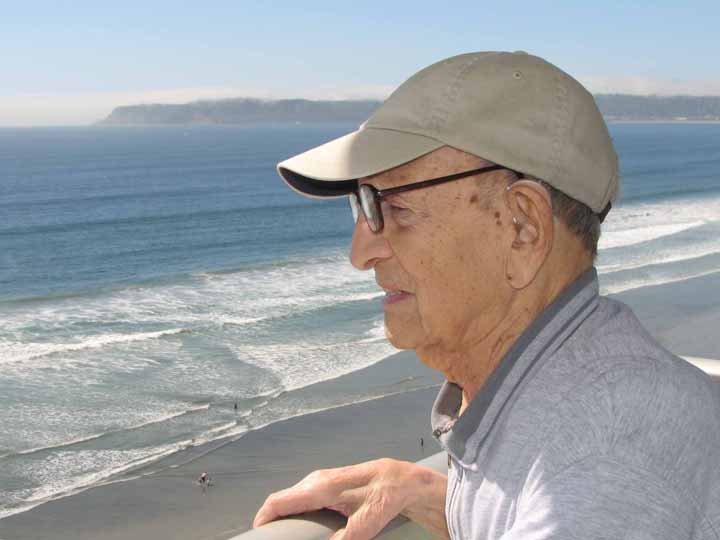
From the balcony of his Coronado Shores condo, Joe spent many hours gazing out over the Pacific, the only real home he ever knew during his long career as a Merchant Marine officer and a US
Naval officer. Photo by Joe Ditler.
Joe Rizza died October 5th, at Coronado Hospital, from congestive heart failure. He was 97. Until the end, Joe remained an active presence at both Coronado Roundtable and Coronado Rotary – two organizations he was very proud of.
Admiral Rizza retired in 1983 after 50 years of a distinguished professional life encompassing three related careers US Merchant Marine officer (1934-42), US Naval Officer (1942-72), and President and champion of the California Maritime Academy (1972-83) in Vallejo, California. He left the service at the rank of Rear Admiral, U.S. Maritime Service (Ret.); and Captain U.S. Navy (Ret.).
Joseph P. Rizza was born in Johnstown, Pennsylvania on January 30, 1915. As one of two sons and a daughter of Italian emigrants, the Rizza boys had to work hard to get their shot at education and a career. At 18 Joe worked six days a week in steel mills for long hours and little pay, while awaiting acceptance to the Pennsylvania Maritime Academy (1934-36).

The Pennsylvania Maritime Academy training vessel – the 1897 Spanish-American War
gunboat, USS Annapolis. Joe Rizza was scared to death of heights. When it became obvious
he must either conquer his fear or be dropped from the Academy, he would sneak out at night,
and under cover of darkness he slowly conquered his demons, one ratline at a time, until he
became proficient enough to skylark aloft. That lone effort served to stiffen his resolve
throughout war and life, no matter how steep the challenge or how dangerous the situation.
Joe graduated with distinction from the Academy, and later the University of Washington, where he was selected Phi Beta Kappa and was graduated cum laude in Political Science (1951). He earned a Master’s Degree in Political Science from the Boston University Graduate School in 1958 while pulling double duty in the evenings and on weekends on the faculty at the Naval War College in Newport, Rhode Island.
After graduating from the Maritime Academy Joe sailed with the U.S. Lines Steam Ship Company out of New York, rotating between the Trans-Atlantic passenger liners and around-the-world flag cargo liners for six years. He rose to become the youngest Coast Guard-licensed Master Mariner in the company.

This small booklet remained in Joe Rizza’s possession his entire life. In it are the details of his early Merchant Marine life – departing port, destination, captain’s name, dates of departure and return, and ship name. During this time (1937-1942) Joe was a spectator to the twilight years of Colonial Rule throughout Asia and Europe. Photo by Joe Ditler.
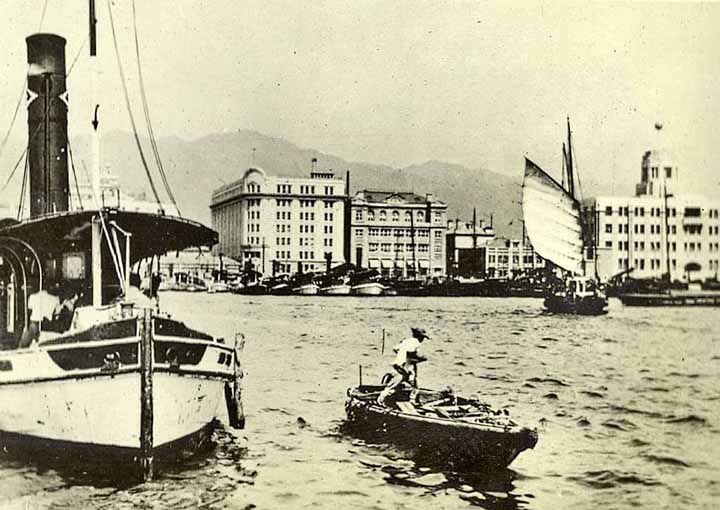
Hong Kong, 1934, where Joe Rizza visited aboard the cadet training ship, USS Annapolis.
Photo by Joe Rizza.
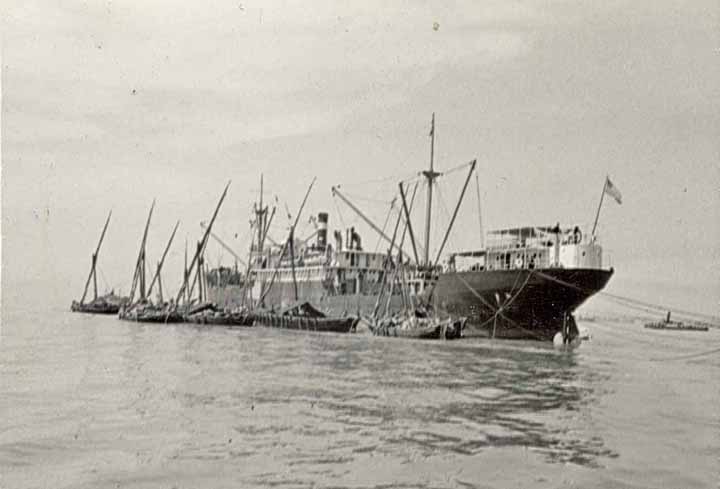
In Rangoon, in 1936, Joe’s ship was greeted in the harbor by Chinese junks that offloaded cargo alongside. Photo by Joe Rizza.
At the onset of WWII Joe was called to active duty in the United States Navy and participated in major amphibious assaults of the Pacific Theatre. For the next 31 years he made the Navy his life and his career.
After a brief assignment as a nautical scientist with the Naval Hydrographic office in Washington DC, Joe served in the newly commissioned USS Leedstown, a 500-foot attack transport as navigator and operations officer. From this commission Joe participated in major amphibious assaults in the Marshall and Solomon Islands Campaigns.

A young Joe Rizza in 1936, aboard the West Cusseta, posing at the rail
and proudly wearing his brother Sal’s West Point jacket.
In 1944, Joe found himself executive officer of another new commission, the attack transport USS Banner. Here he partook in additional, crucial amphibious assaults throughout New Guinea, the Philippines, and Okinawa. A narrow miss by a Kamikazi attack haunted his dreams and plagued Joe with severe back pains for the rest of his life.
He later served as executive officer on the destroyers USS O’Brien and the USS Lloyd Thomas, and commanded the destroyer escort USS Spangler in the Pacific Fleet’s ASW Force. Captain Rizza commanded the destroyer USS Gregory as well, participating in two, six-month deployments with the Seventh Fleet in the Western Pacific.

The USS Banner was nearly destroyed by a Japanese Kamikaze plane near Okinawa. The captain wasn’t well and Joe Rizza, the executive officer, took over. Through his binoculars he could see the pilot’s face. Joe kept yelling, “Keep those guns firing.” At the last possible second the wing was blown off the plane by the Banner’s gun crew and it dipped into the ocean sparing many lives.
Captain Rizza served on the faculty of the Naval War College as an instructor and Chairman of the Strategy and Tactics Department before returning to sea in command of Destroyer Escort Squadron Three, an Anti-Submarine Warfare squadron in the Pacific Fleet.
In 1960 he served in Seoul, Korea where he assumed command of the U.S. Naval Advisory Group, Republic of Korea Navy for three years, and played a central role in building that country’s Navy.
Following Korea, Rizza assumed command of the attack transport USS Mountrail in the Atlantic Fleet Amphibious Force, where his ship was commended for winning the Battle Efficiency Competition and excellence awards in all departments. Most of his ship commands were singled out for similar honors.

Joe and his first wife and love of his life, silent film star,
Marie Antoinette Follin (stage name Dona Clara), at the Casbah in 1947.
From 1964-66 Captain Rizza served on the Joint Chiefs of Staff as a Far East Politico-Military Planner in the Plans and Policy Directorate. He was awarded the Joint Service Commendation Medal for outstanding performance in this assignment.
During this period, and based on his vast experience in dealing with other countries and their leaders, Joe wrote five classified foreign policy papers for the Joint Chiefs of Staff, which played no small role in influencing foreign policy and Presidential decisions.
These papers were: “The Future of the Ryukyus,” which caused great worldly concern regarding the future of Japan and Okinawa; “The Future of the Trust Territories of the Pacific Islands,” which became U.S. Policy for island nations creating the option of joining the United States or seeking sovereignty in Post WWII; “A Multilateral Organization for the Far East;” “U.S. Politico-Military Position Papers on the Republic of Korea;” and “The Status of Forces Agreement” for the Republic of Korea and GRC (Government of the Republic of China).”
Captain Rizza commanded Destroyer Squadron 24 from 1966-68. During this tour he served two deployments as Screen Commander in the Sixth Fleet and the Mediterranean attack carrier striking force, which consisted of 12 destroyers.

Joe Rizza and his wife Marie entertain an old Hollywood friend of Marie’s, Lana Turner.
At this time Joe was invited to attend a gathering hosted by Princess Grace of Monaco. Joe had been on intense operations for three days and nights, but wasn’t about to miss a chance to meet the former actress and member of European Royalty. They became fast friends and the Princess put her personal limosene at Joe’s service during his stay in Monoco.
Such celebrity/political encounters were not uncommon in his position. Before World War II he met a powerful German politician named Adolf Hitler. Rizza dined with King Ibn Saud of Saudi Arabia in his desert palace. He interviewed General Franco, President of Spain, broke bread with Mobuto, ruler of Zaire in the Congo, studied under Henry Kissinger, lunched with Africa’s Idi Amin, and interacted with most of the Presidents of the United States during his professional career.
In 1968 Joe Rizza was hand-selected by Admiral Zumwalt to be his Chief of Staff, Commander U.S. Naval Forces Vietnam/Chief, Naval Advisory Group, MACV, overseeing all allied navies participating in the Vietnam War.
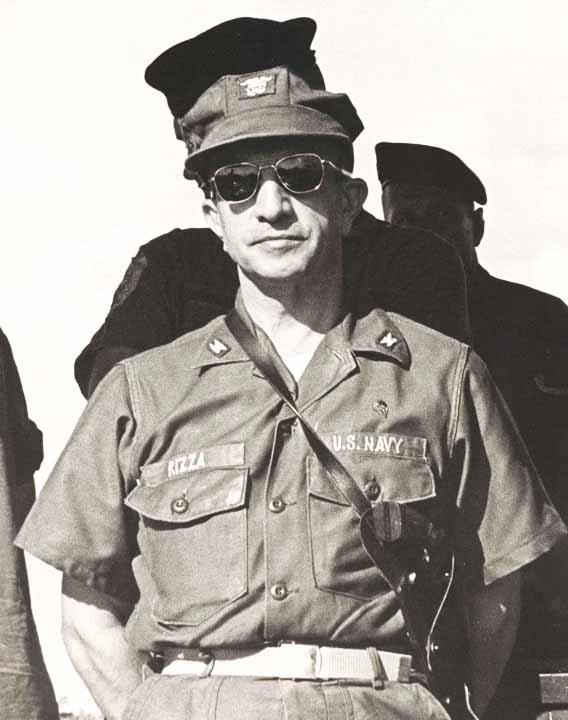
Captain Joe Rizza, while serving as Chief of Staff for Admiral Elmo Zumwalt
in Vietnam (1968). Joe was in charge of overseeing all allied navies during
the war, and participated in the planning of numerous offenses against the enemy.
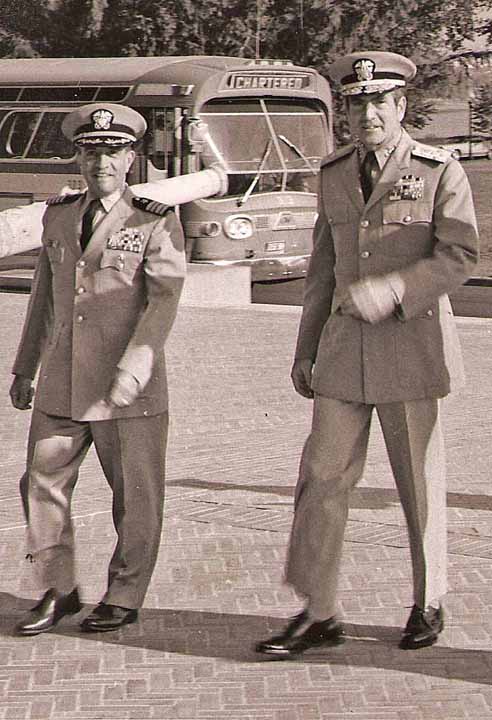
Joe Rizza, left, and Admiral Zumwalt tour the War College together.
For Joe, the Merchant Marine and the US Navy provided him with opportunities no other field could come close to. His career took him to almost every country in the world, taught him to speak French, Russian, and Italian, and found him in meetings and social surroundings with the great Heads of State and foremost political leaders of his era.
Admiral Rizza accepted an invitation by then-Governor Ronald Reagan in 1972 to take over as President of the beleaguered California Maritime Academy in Vallejo, California. While there he achieved a complete reformation and permutation of the Academy into the 21st Century. Always on the cutting edge, Rizza opened the school’s doors to women and saw the first female applicants graduate from the Academy.

Governor Ronald Reagan enlisted Joe Rizza to restore credibility and bring leadership to a struggling California Maritime Museum. President Ronald Reagan praised his success and leadership years later for making Cal Maritime an educational institution respected worldwide.
The three-year course of study at the Academy was expanded to four years, and the California Maritime Academy became an accredited institution of higher education, subsequently joining the prestigious California State University System.
When he retired in 1984 the auditorium at the California Maritime Academy was named the “Joseph P. Rizza Auditorium,” with a large painting of him placed on the wall in the foyer, presented by the Class of 1983-84 Student Council. For his role at the Academy, Elizabeth Dole, Secretary of the Department of Transportation, presented Joe Rizza with the highest civilian award in government, “for exceptional public service.”
Over his long career Joe belonged to numerous organizations: Council of American Master Mariners; Rotary International (President Vallejo Club 81-82); Vallejo Chamber of Commerce (Director 80-83); Propeller Club of the US (Golden Gate, President Emeritus – San Diego); Navy League San Diego County (Director); Coronado Roundtable (President Emeritus); World Affairs Council-San Diego (Director); San Diego Civil Service Commission (President ’85-91); and Propellor Club Port of San Diego (President Emeritus).
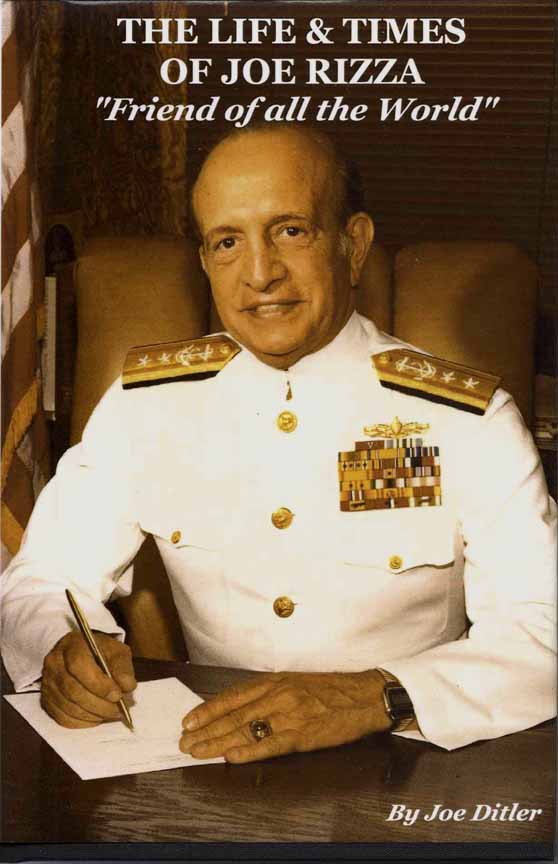
Joe’s biography was published a year before his death, “The Life & Times of Joe Rizza:
Friend of All the World.” The book is available to read online, free, at www.blurb.com/books/2471487.<