




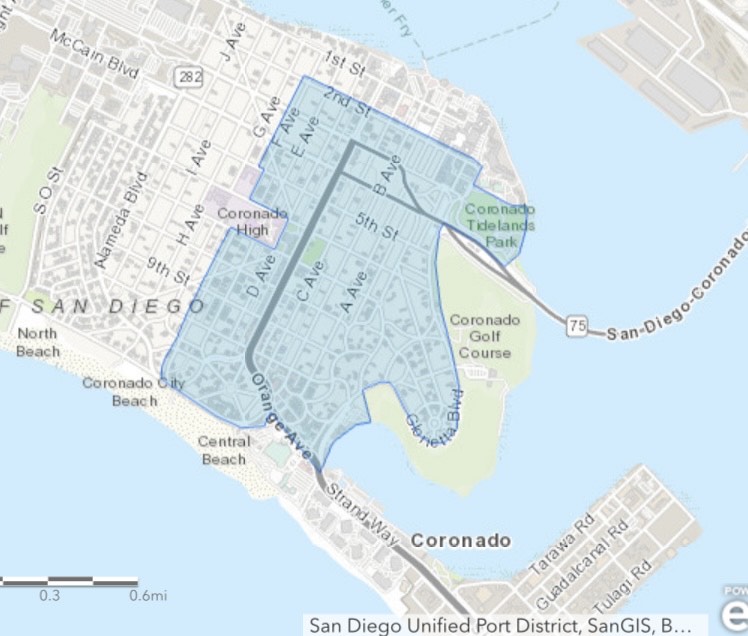
Three Coronado residents have contracted the West Nile Virus, which is transmitted to humans by a bite of an infected mosquito. To protect the public and keep mosquitos from spreading the virus, the County of San Diego will spray a portion of Coronado with pesticide mist treatments by truck this week.
The area being treated includes from 2nd Street in the north to Ocean Boulevard in the south, F Avenue in the west, and Glorietta Boulevard to the east.
“County Vector Control truck treatments use AquaDuet — a pesticide that mimics natural insecticides found in chrysanthemum flowers, is approved by the Environmental Protection Agency, and does not pose a risk to people and pets as applied,” according to a county spokesperson.
The treatments are scheduled to take place from 1 a.m. to 6 a.m. on Friday, Sept. 25 and from 1 a.m. to 6 a.m. on Saturday, Sept. 26. Additional treatments may also be applied the following week, depending on conditions.
The treatments are schedule to be applied in the early morning hours when most people are not outside.
“It is practically invisible and dissipates in under 30 minutes,” according to the county. “Beekeepers and those with insects and fish kept outdoors are encouraged to cover their habitats during treatments.”
The County’s surveillance of mosquito activity found elevated numbers of mosquitoes in Coronado, some of which were positive for west nile virus. There are currently 11 reported human cases of west nile virus in San Diego County this year, three of which were Coronado residents. This is the most local west nile virus infection since 2016.
Conditions of the three Coronado residents with west nile virus are not available.
While the West Nile virus can be deadly, most of the time there are no symptoms at all. Sometimes, the infected person experiences headache, fever, nausea, fatigue, a skin rash, or swollen glands.
In rare cases, it can cause severe illness or death, according to the San Diego County Vector Control. In October 2024, an elderly resident in San Diego County with a compromised immune system died of West Nile Virus encephalitis, which is a sudden inflammation of the brain tissue.
The Vector Control program says that the best way to guard against West Nile virus is to prevent, protect, and report. The program recommends taking the following actions:
- Dump or drain anything that holds water, like plant saucers, clogged gutters, buckets, toys, old tires and wheelbarrows.
- Cover rain barrel openings or use mosquito dunks.
- Request free mosquito-eating fish for ponds, fountains, or unused swimming pools.
- Protect yourself from bites by wearing long sleeves and pants outdoors.
- Use repellents with DEET, picaridin, oil of lemon eucalputus, or IR3535.
- Make sure window and door screens are in good shape.
- Report increased mosquito activity or unmaintained swimming pools or dead birds (crows, ravens, jays, hawks, owls) to County Vector Control at 858-694-2888 or email [email protected].
Learn more about the West Nile virus and updates on mosquitoes, visit SDFighttheBite.com.


Very informative, thank you!