




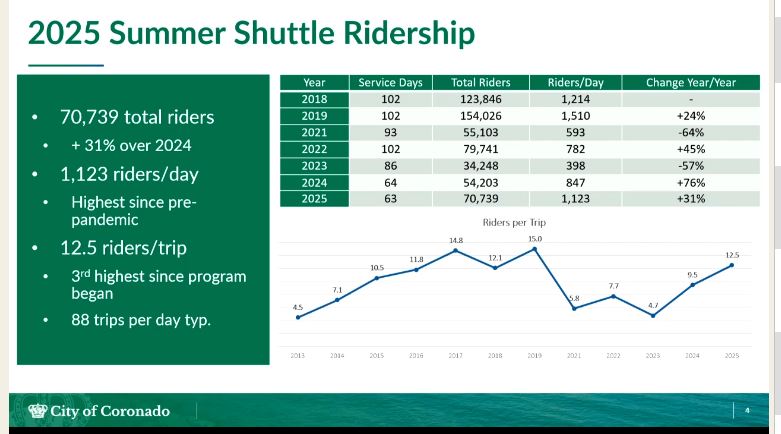
Ridership for the Coronado’s annual free summer shuttle service rebounded in 2025 after years of decline during and following the pandemic.
Last summer saw an average of 1,123 riders per day — the highest since the COVID-19 pandemic, and the third highest in the program’s history despite operating on an abbreviated schedule with reduced hours. It cost about $141,994 total to operate, including the cost of bus wraps, at a cost of $2.01 per rider.
Despite the resurgence, the future of the shuttle remains uncertain.
The free summer shuttle operates on a fixed route using conventional, full-sized buses. After years of declining ridership and mounting expenses, the City Council decided to give the program one last try in 2025 to see if the struggling program could flourish.
That decision paid off, and the City Council asked staff to prepare several options for discussion about a potential 2026 shuttle.
At the same time, Coronado’s leaders are soliciting quotes that would allow the city to continue the Island Express, it’s on-demand electric mini shuttle program after a popular but expensive pilot program in 2024. During past discussions, the City Council has questioned whether offering two transit options is redundant.
Unlike the routed service of the summer shuttle, the Island Express is an on-demand, door-to-door service. It was free during its pilot, but will likely charge a fee if resurrected. The future of the Island Express will hinge on cost. After the city receives proposals, the council will consider its options.
Meanwhile, the council is still grappling with its free summer shuttle. Not only did ridership increase in 2025, but also, the city may be able to run the shuttle for less next year. Starting in January, San Diego Metropolitan Transit System (MTS) will replace the Route 904 buses with propane-powered minibuses, which cost less to operate and consume less fuel.
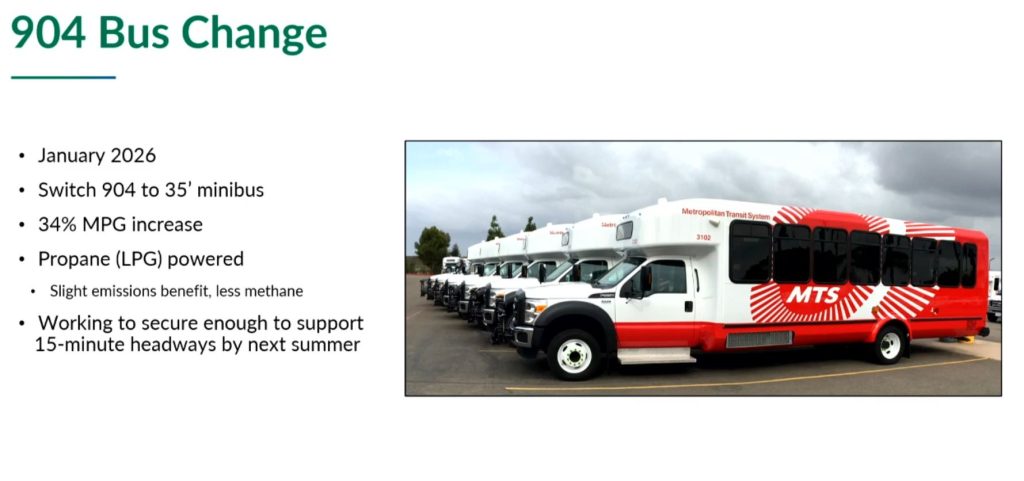
MTS’s decision to swap the buses is recent, so city staff does not yet know how the change would impact the summer shuttle program, which uses the same route but at a greater frequency and is operated by MTS but paid for by the city of Coronado.
“I thought the likelihood of us continuing this service beyond (last) summer was slim,” Councilmember Mark Fleming said, “but with the advent of the smaller shuttles, that gives us another thing to consider.”
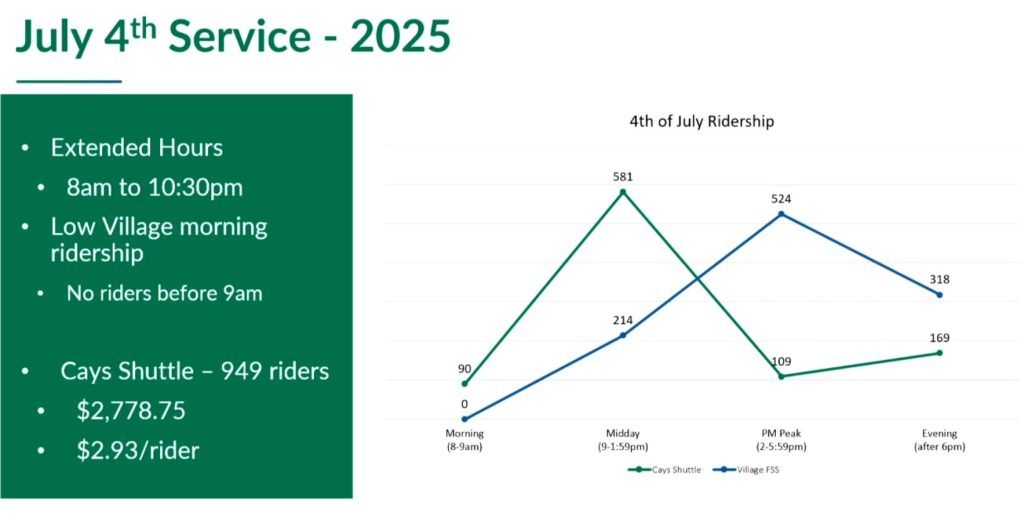
City Councilmember Amy Steward said that she favors the small, electric shuttles used by the Island Express. She suggested a hybrid program, in which the city operates the larger summer shuttle on the Fourth of July — its most popular day — including service to the Coronado Cays all day.
“I can’t think of a better community that should be a golf cart community than Coronado,” Steward said.
Another facet of the matter emerged when Councilmember Carrie Downey raised concerns that a high-frequency shuttle route could reclassify part of Coronado as a major transit corridor, triggering new state zoning laws.
This matters because Senate Bill 79, which passed earlier this year, allows multifamily housing within a half-mile of major transit stops regardless of local zoning. The goal of the law is to increase housing and decrease car dependency, but some critics say it discourages cities from expanding its public transportation.
Meanwhile, Assembly Bill 2553, adopted in 2024, broadened the definition of a “major transit stop” to include locations where service frequency is 20 minutes or less.
Downey noted that the summer shuttle arrives every 15 minutes, although it is a temporary service. Still, Coronado has grappled with state housing mandates before.
“We did what you do in mass transit: We tried to make it more convenient, more affordable,” Downey said at the Nov. 11 meeting, “and it might bite us in the butt.”
While Coronado likely does not meet the threshold for a major transit stop as currently defined, Mayor John Duncan agreed that changing state standards could bring unexpected impacts.
Ultimately, the rise in ridership and potential cost savings led the council to direct staff to explore options for a 2026 shuttle, including Steward’s suggestion for a hybrid program. Additionally, Councilmember Kelly Purvis requested more information about how the minibuses would impact the program’s greenhouse gas emissions.
The City Council is expected to weigh those options and decide on the program’s future in the spring.


My hope is that whatever services are offered in the Village are offered to the Cays. We all pay the same taxes, we should all receive the same services.
SB 79 requires rail or a dedicated bus lane, not a summer-only bus that shares lanes with cars. But the fear that it would require new housing (during a housing crisis) shows how uninformed and selfish Coronado’s elected leaders are. They’re just reflecting the same traits of their constituents.
Coronado NIMBYs gonna NIMBY.
I have lived in The Shores for over thirty years. The summer shuttles are Wonderful! They eliminate the need to drive my car amongst heavy traffic and fight for parking. I’m certain they add to the attraction of Coronado by dispelling the perception of heavy traffic and fighting for parking. Consider the increased revenues of our local restaurants and shops as a result.
Michael Lutz
Why not let the independent rideshare folks handle this?