




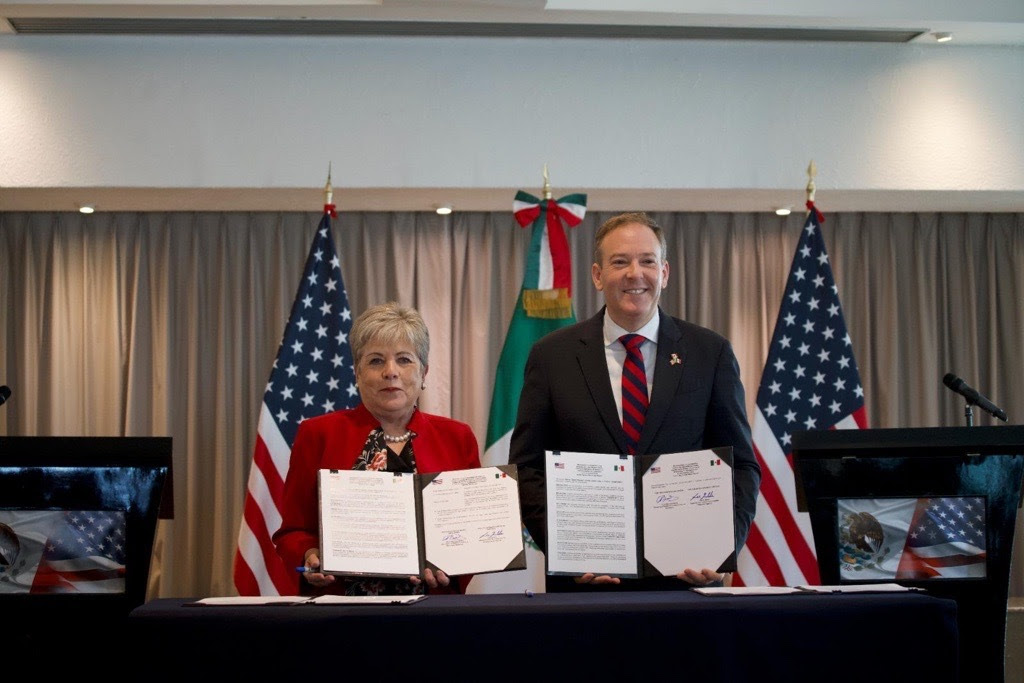
The United States and Mexico on July 24 signed a memorandum of understanding that will expedite projects addressing the Tijuana sewage crisis and plan for long-term infrastructure needs related to the decades-old problem.
Under the agreement, the US will complete its expansion of the South Bay International Wastewater Treatment Plant by the end of 2027.
The project, which launched in October 2024, was initially expected to take up to five years and will increase the plant’s treatment capacity from 25 to 50 million gallons per day (MGD). An interim expansion to 35 MGD is expected by Aug. 28.
Meanwhile, Mexico will complete all of the projects it committed to in Minute 328 by the end of 2027 or sooner, with several now slated for completion this year. It will release $93 million in previously committed, but not allocated, funding for these projects.
“There are times when announcements get made and there’s no substance,” said US Environmental Protection Agency Administrator Lee Zeldin moments before signing the memorandum of understanding. “But here we are today with great pride to be able to stand before the people of Mexico and the United States who care so much about this issue to be able to finally tell you about all the details of us finally delivering this urgent, long-overdue, permanent, 100 percent solution to tackle this sewage crisis once and for all.”
Both countries agreed to enter a new minute agreement by the end of this year. The new agreement will update the 2022 Minute 328, whose sewage projects are outdated in light of Tijuana’s recent population growth, Zeldin said during a media briefing ahead of the signing.
“As is, we were looking at an 80 percent solution,” Zeldin said of the former minute agreement, “that as each month and year would pass, as infrastructure would get further stressed as Tijuana’s population would increase, would become further outdated, faster.”
Zeldin said the new minute agreement will plan for future infrastructure needs.
Of course, Minute 328 was also branded as a comprehensive solution. The $93 million that Mexica agreed to allocate in today’s MOU was committed in the 2022 minute agreement but never dispersed.
In the MOU, Mexico recommits this funding, which will be used to rehabilitate a parallel gravity line and to divert 10 MGD of effluent currently entering the Tijuana River. Those projects are now expected to be completed this year.
In return, the US agreed to release EPA Border Water Infrastructure Programing (BWIP) funding as soon as Mexico begins construction on those two projects.
The BWIP funding will be used to complete pump station one and the Tijuana River collection pipes (also known as the Tijuana River gates) and will help to ensure that Mexico follows through, Zeldin said.
“We’ve navigated this entire process without having to state any of the obvious threats – obvious leverage – that we have,” Zeldin said. “We have worked in good faith. The Mexican government has told us that they would work with us.”
The MOU outlines a prioritized construction schedule for Mexico’s remaining Minute 328 projects.
Construction in the calendar year 2026
Rehabilitation of the Insurgentes Collector
Rehabilation of the PB Matadero and Laureles Pump Station 2
Rehabilitation of the Poniente Interceptro
Rehabilitation of the Oriente Interceptor
Rehabilitation of the Collector Carranza
Packup power supply for PB1
Construction in the calendar year 2027
Upgrades to the Arturo Herrera and La Morita Wastewater Treatment Plants
International Collector Phase II
Rehabilitation of the Antiguo Force Main
Lift station and force main from Sainz Canyon to Arturo Herrera
Enclose the open channel from PB1 to the San Antonio de los Buenos Wastewater Treatment Plant
The two countries were scheduled to sign the agreement at 3 p.m. Pacific Standard Time. It will be livestreamed here.
“What the residents of Southern California need and deserve, what they’ve been waiting for for too long, isn’t just a solution that is a band-aid for the moment,” Zeldin said, “but a permanent, 100 percent solution.”


I’ll believe all of this when I see it. Where have the U.S. dollars that were given to Mexico in years past gone?
Regarding the sewage: does this solution take care of increasing sewage by Mexico each year?
EPA Administrator Lee Zeldin said that the US and Mexico will enter a new treaty agreement by the end of the year that is meant to address Tijuana’s growing population. He estimated that the current agreement and projects underway would only solve 80 percent of the problem due to population growth, and he said he hopes to address future infrastructure needs in the new agreement.
The Mexican President for it’s own security & their people would place a Mandate in Mexico for their people to pay for their people to buy their photo passports to be able to leave Mexico to travel outside of Mexico into the USA or to other foreign country’s it would have better safety measures & better head counts on their kids & people it be make their parents of their natural birth parent of every children of every foreign country responsible for their children& easier for ever law enforcement agency to know how to find children when they go missing