




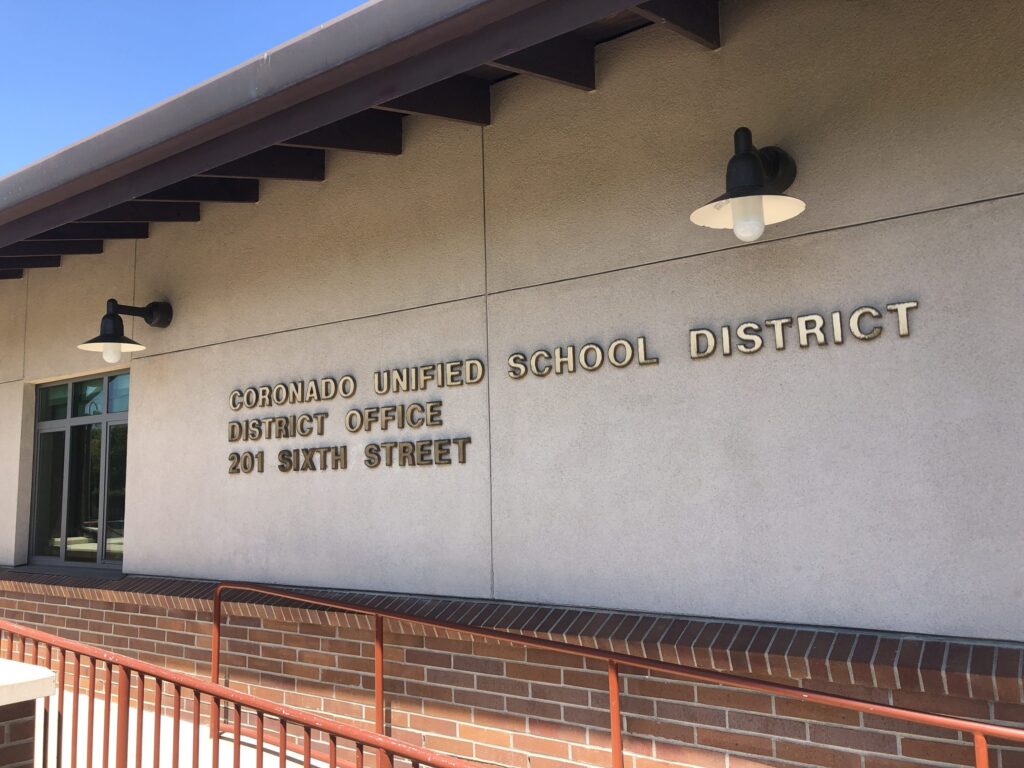
By the 2026-2027 school year, the Coronado Unified School District won’t have the amount of funding required by the state of California.
Although administrators say it’s “on track” for Basic Aid funding by the 2027-2028 school year, in the meantime, it must come up with various ways to close a $1.4 million budget gap. At the June 18 school board meeting, trustees approved a resolution to identify budget reductions or revenue enhancements, as required by the state.
But district administrators say they don’t want to cut programs. That means they will rely on restructuring positions after retirements or resignations. Financing is another option.
Donnie Salamanca, Deputy District Superintendent, said that continued declining enrollment supports a leaner staff. He says the district will likely have 200 less students in the 2026-2027 school year.
“I don’t want you to look at this cutting programs,” said Salamanca. “It makes sense that with declining enrollment, we would have less staff.”
Superintendent Karl Mueller said that the district is focusing on “absorbing and restructuring” to the best of their ability.
“A lot of factors are taken into consideration, as we try to continue offering the programs we offer across all four school sites, while being mindful of the necessity to cut spending from the district,” said Mueller.
Salamanca says the district has received significantly less applications for interdistrict transfers (IDTs), with 250 applying this year, compared to 500 last year. Traditionally, IDTs have helped bring revenue to the district as they bring in extra funding.
But when CUSD hits Basic Aid, whereby the district is funded by local property taxes, IDTs will come with very little or no funding. Mueller acknowledged that CUSD is at an “interesting time” with IDTs with future changes in the funding model.
“We are being mindful of where we are accepting IDTs, understanding that in two years we will not be receiving any revenue for those students,” said Mueller. “So it’s been a very difficult balance that we are actively working on, and some very difficult decisions or options have been taken into account.”
But he went on to say that the district will continue accepting IDTs, even once it reaches Basic Aid. This is especially true for specialized programs.
“I do not want anyone in the room to assume that once we reach Basic Aid we will no longer accept IDTs. We will,” said Mueller. “But it’s a budget formula, and the revenue that we receive from our local property taxes has to support our district.”
Several CUSD teachers spoke about how the budget woes are already affecting district arts programs. Teacher Jennifer Landry said that the district is quietly cutting various arts programs by eliminating sections. She said, for example, a full-time teacher who retired is being replaced by a part-time position.
She also said that an entire arts position was being cut, and that that teacher was blindsided.
“It’s as though the rules don’t apply anymore, but fortunately they do,” said Landry. “Our arts programs matter. The district needs to be transparent about cuts and what they are basing those cuts on.”
Arts teacher Karrie Jackson asked the trustees to consider any cuts to arts education as more than a budgetary issue, and as a decision with deep and lasting human consequences. She said that research overwhelmingly reports that teenagers in creative communities report a higher life satisfaction, reduced anxiety and stronger social bonds. In addition, she said that arts engagement can lower depression by nearly 50% and increase emotional resilience by 70%.
“Cutting arts programs is not just cutting a line item. It’s cutting a lifeline for students who need a sense of purpose, belonging and expression,” said Jackson.
In other board business, the trustees approved amendments to both Salamanca and Mueller’s employment contracts. Their employment contracts were extended through June 30, 2029, but approved 2.5% salary increases were deferred until July 1, 2027. This puts their salaries at $233,020 and $270,579, but not until July 1, 2027.
Trustee Fitz Lee thanked both Salamanca and Mueller for “making the sacrifice” and said it showed true leadership.
Additionally, the board approved a policy allowing freshmen at Coronado High School to leave campus for lunch if they choose. While CHS principal Karin Mellina wasn’t able to attend the meeting, Mueller shared that high school ASB has plans to retain freshmen on campus the first two weeks of instruction with planned activities to build community and connections. The new policy will take effect in the fall.
The next board meeting will be Thursday, Aug. 21 at 4pm, at the district office.