




The agenda for this week’s meeting of the Coronado City Council includes a proposed “Coronado” sign at Tidelands Park, considering the future of the Island Express shuttle service, the community events calendar for 2026, and more. Public comment will be heard.
The meeting is at 4 p.m. on Oct. 21 in the City Council Chamber at 1825 Strand Way, and will be broadcast here. The full agenda is here. A recording of the meeting will be posted here.
Considering a “Coronado” monument sign
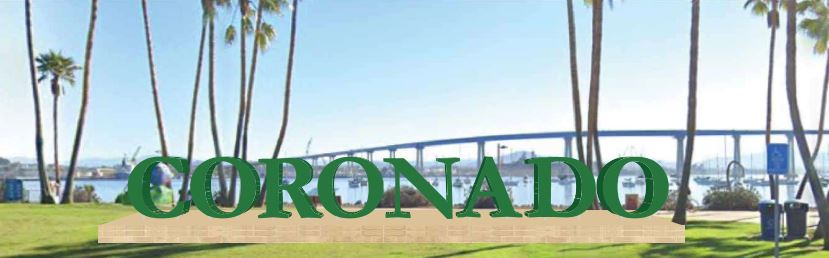
The Rotary Club of Coronado would like to gift the city a large monument sign at Tidelands Park to commemorate the club’s 100th anniversary.
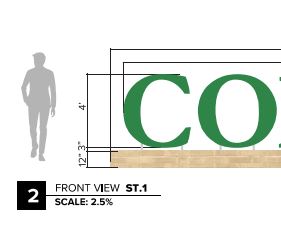
The proposed sign features letters that are four feet tall and one foot wide, stretching 30 feet across a 36-by-6-foot foundation. One foot of the base would be visible above ground to hold commemorative engraved bricks. The letters would be painted green, coated for graffiti resistance, and accompanied by a plaque or sign noting Rotary’s contribution.
If approved, the sign would be on Port of San Diego property, so Rotary is coordinating with the Port Board of Commissioners for review and approval. Before Rotary brings the project to the Port Commission, the City Council is asked to review the concept.
Rotary has long marked its milestones by giving gifts to the city, including the Rotary Clock it donated to mark Rotary International’s centennial in 2005.
The sign, if approved, would be a gift, and Rotary would fund maintenance as well, including an annual maintenance fee. The installation would be approved on a provisional three-year basis, and if the monument were later deemed inconsistent with the character of Coronado, Rotary, or the Port, it would be removed at Rotary’s expense.
The future of the Island Express shuttle
After a popular and expensive pilot of a free, door-to-door electric shuttle program, city leaders will consider how it might be made permanent.
During the first four months of the city’s Island Express program, an average of 322 passengers per day rode the Island Express in those its first four months, which cost the city just under $87,000 per month. In total, the average cost to the city was $18.43 per ride, or $9.04 per passenger.
By the end of the six-month pilot, the city had provided more than 30,000 free rides. The pilot was always meant to be a proof-of-concept, and was introduced as free to evaluate demand.
Now, the City Council will decide whether — and how — to continue the service. City staff are seeking input on program parameters before it releases a request for proposals to assess what options — and costs — exist. The initial pilot was operated by Circuit Rideshare.
Up for consideration are the following:
- Funding: Whether to make the program contingent on receiving outside grants, such as The San Diego Association of Governments (SANDAG’)s proposed Flexible Fleet Pilot Program, or to continue without grant funding. Council may also consider pursuing financial partnerships with hotels and businesses or allowing vehicle advertising as a revenue source.
- Fares: Whether rides should remain free or include modest fares, and if discounts should be offered to residents, seniors, or other groups.
- Service area: Whether to continue service to the Coronado Cays, reduce service there, or limit the program to the Village.
- Route structure: Whether to provide door-to-door, fixed-route, or hybrid, virtual stop service, in which riders meet at a designated pick-up point.
- Fleet and schedule: Whether to expand or reduce the fleet size, continue using all-electric vehicles, and operate year-round or seasonally.
- Accessibility: How to accommodate seniors and riders with mobility limitations.
- Student riders and hotel inclusion: Whether to establish minimum age requirements and whether resort properties should be served.
- Call center: Whether to maintain a staffed phone booking option, which cost $13,901 during the six-month pilot, and was used for 223 of 29,900 total rides.
After hearing the council’s thoughts on these matters, the city will solicit proposals to evaluate whether the service can continue.
Potential new guidelines for historic homes in Coronado
Part of Coronado’s charm lies in its unique, historic homes, and over the last several years, the city has grappled with the tension between historic preservation, fiscal responsibility, and property rights. An ordinance updating its historic review process for homes will be introduced at Tuesday’s meeting.
Homes designated as historic receive a property tax break under the Mills Act, but they also face restrictions to renovations or demolition.
Currently, the city uses a laborious process to assess the historical significance of a property. All homes 75 or more years old must undergo an individual historic review, which is expensive. Between 2019 and 2023, 122 properties were assessed at a cost of about $863,000. This figure underscores the third prong of the debate: fiscal responsibility.
To address this, the council in Dec. 2024 directed staff to draft an updated ordinance. The proposed plan includes an updated historic context statement (read it here) and will use survey data to exempt certain properties from individual historic review.
The survey considered observable features of homes in the Village built through 1970, evaluated them for architectural significance, and divided them into three tiers. Tier one properties are unaltered or minimally altered structures that may be eligible for historic designation and comprise 184 properties; tier two properties are somewhat altered and not currently eligible for historic designation — 140 properties; and tier three are substantially altered and not eligible for historic designation.
Under the new ordinance, 1,058 tier three properties would be exempt from the historic review process, even when they reach 75 years of age. The goal, supporters of the plan say, is to save money and time. However, this has been a much-debated topic in past years, and critics say the survey approach might miss historic properties that deserve to be preserved.
About 130 properties were not assigned a tier during the survey, either because they were not sufficiently visible from the street or because a determination could not be made. Those would be subject to the determination of historical significance process as they came of age.
The 2026 community event calendar
The City Council will consider approval of special events for 2026, including fee and alcohol waivers.
When the city grants a fee waiver, it covers or reduces costs for its services related to its events, such as police and fire staffing, street closures, and facility use.
With an alcohol waiver, the city grants permission for organizers to serve alcohol on public property during an event. Normally, the consumption of alcohol is prohibited on public streets, parks, beaches, sidewalks, and other city-owner property.
The city is expected to absorb an estimated $390,000 in fees if the calendar is approved.
The proposed event schedule follows:
Proposed 2026 Major Events
- Valentine’s Day 10K – Feb. 15
- Coronado Flower Show – Apr. 18–19 (fee + alcohol waiver)
- MotorCars on MainStreet – May 3 (fee waiver)
- Art & Wine Festival – May 9 (alcohol waiver)
- Bay Bridge Run/Walk – May 17
- Promenade Concerts – Sundays, May 24–Sept. 6 (fee + alcohol waiver)
- Fourth of July Celebration – July 4 (fee waiver)
- Bike the Bay – Aug. 23
- Coronado Island Film Festival – Nov. 4–8 (fee waiver)
- Silver Strand Half Marathon – Nov. 8
- Holiday Parade – Dec. 4 (fee waiver)
Proposed Moderate Events
- Every 15 Minutes – Mar. (TBD) (fee waiver)
- Friends of the Library Book Fair – Apr. 18 (fee waiver)
- Memorial Day Ceremony – May 25 (fee waiver)
- Low Tide Ride & Stride – July 18 (fee waiver)
- Liberty Celebration Swim – July 5 (alcohol waiver)
- CHS Homecoming Parade – Oct. (TBD) (fee waiver)
- A Taste of Coronado – Oct. 7
- LOOSEFOOT 616 Memorial Run – Oct. 17
- Swim for SOF – Sept. 19
- Crown City Open Water Classic – Sept. 26


Please run the shuttle to the Cays. We pay the same taxes, but do not get the same services.