




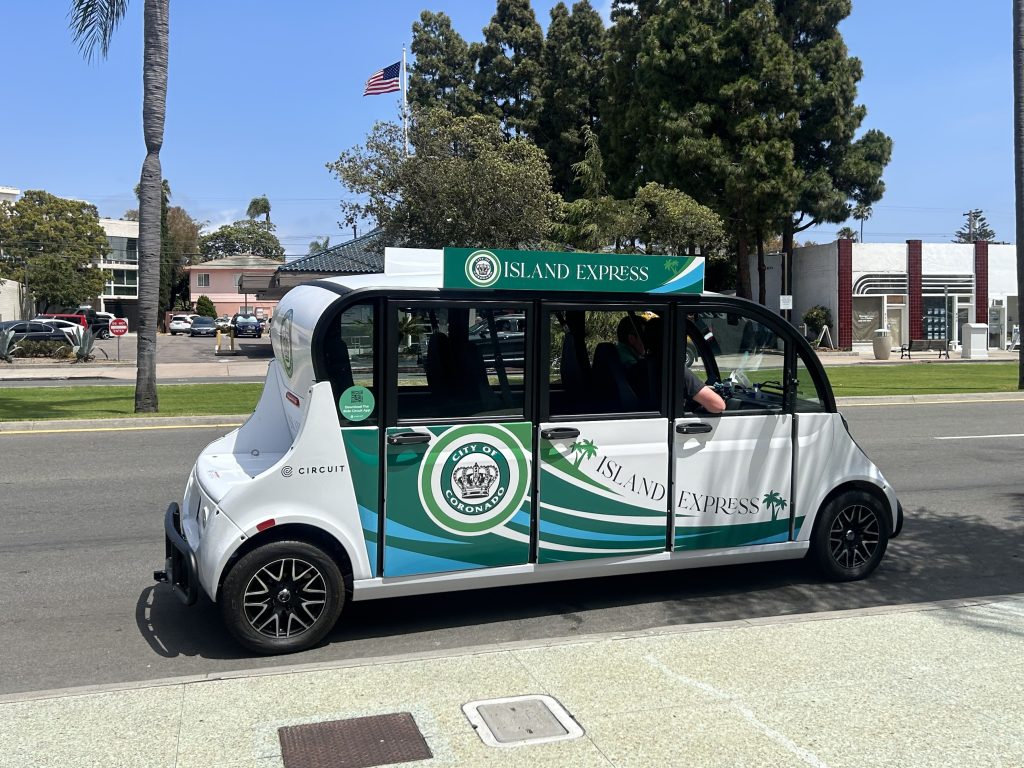
The question isn’t whether Coronado wants its electric shuttle back. It’s how much the city is willing to pay to make that happen.
Operating a door-to-door service in the Coronado Village, with fixed routes in the Cays, would cost about $1.22 million annually after startup costs. The city could offset costs by charging a fare, selling ads, or asking hotels to chip in.
With so many questions lingering, the City Council on Oct. 20 voted unanimously to hold off on a contract for an all-electric, on-demand shuttle, the would-be successor to the city’s popular but pricey 2024 Island Express pilot.
The council will direct its questions to city staff within 30 days, and the matter is expected to return to the council for discussion early next year.
The Island Express pilot ran from June to December 2024, operated by Circuit and free to riders. The six-month pilot cost the city $561,509 and carried 58,596 passengers: 52,945 in the Village and 5,651 in the Cays. Cays service was by far the most expensive piece, averaging $29 per passenger compared to about $7 in the Village.
To complicate the matter, the city is currently evaluating its related free summer shuttle, a fixed-route MTS bus the city has funded since 2013. Ridership peaked in 2019 before the service was canceled in 2020 and cut back in 2021 during the pandemic. A 2023 bus workers’ strike pushed ridership down to 34,248. In 2024, the council shortened the season and gave the shuttle another chance, later calling 2025 its last try.
That gamble paid off. In 2025, the shuttle averaged 1,123 riders per day, its highest since the pandemic and the third highest in the program’s history. It cost about $2.01 per rider. Council members have questioned in past meetings whether running both a routed summer shuttle and an on-demand service is redundant. The summer shuttle ran again this year from June 7 to Sept. 7.
Council members said they did not want to make a decision about an electric shuttle without first reviewing the free summer shuttle’s 2026 ridership. Senior Planner Tricia Olson said staff recently received those numbers, and they are expected to be presented at the council’s next meeting.
“I guess I’m just not feeling like I can make a decision when I have all these questions,” Councilmember Amy Steward said.
The economic puzzle
Although the Island Express was free to use during its pilot, the plan was always to explore cost offsets through fares, ads, or grants. The reasoning was to offer the service for free to gauge interest, a model other cities have used as well.
But why offer a shuttle to begin with? The city in 2022 passed its Climate Action Plan (CAP), which aims to cut the city’s emissions 40 percent below its 2016 levels by 2030. Most of those reductions depend on state actions, but 26 percent rely on the city’s own measures.
While the CAP doesn’t explicitly mandate a shuttle program, it identifies transportation as the city’s largest source of greenhouse gas emissions and includes several initiatives to reduce vehicle miles driven in Coronado.
Climate goals aside, parking in the Village remains a battle, and fewer cars on the road would alleviate the strain.
Last October, the council authorized staff to seek proposals for a permanent service. At the time, councilmembers signaled support for a fare, with $5 per ride suggested, along with year-round service, an all-electric fleet, and cost-sharing with hotels.
After exploring multiple options, city staff recommended authorizing the city manager to negotiate a contract with Via, through Crosby Street Transit LLC. A selection committee unanimously scored Via’s proposal highest among the bids it received. Via already runs microtransit services in El Cajon and San Diego, and staff from those programs spoke highly of it, Olson said.
Via proposed year-round, on-demand service in the Village. The council could pick an electric van fleet or the golf-cart-style Polaris GEMs that became the face of the Island Express, with a wheelchair-accessible vehicle in either lineup.
A newly available solar-assisted GEM could stretch the carts’ range between charges, though Olson noted that the notoriously gray skies of May and June would cut into the benefit.
Because the GEMs can’t legally drive on State Route 75, the Cays would get its own optional service: two wheelchair-accessible vans running a five-stop fixed route every 30 minutes.
The Village service would cost about $980,000 in the first year, which includes branding and startup costs, and $860,000 a year after that. The Cays service would cost $455,000 the first year and $360,000 a year after. Those figures do not account for fares or advertising revenue.
Via offered several ways to offset the cost:
- Fares: Options include flat fares, a fare equal to 50 percent of the average cost of a ride, and reduced fares for residents, seniors, or students. The estimates assume some riders will drop off once the service is no longer free.
- Advertising: In-app, in-vehicle screen, and rooftop ads are available. The city would keep 100 percent of the revenue, and alcohol and cannabis ads are prohibited. Via told the city that ad revenue in other cities has reached up to $170,000 a year, though Olson said it’s unclear what Coronado would see.
- Grants: Coronado applied for the San Diego Association of Governments’s Flexible Fleets program, but the SANDAG transportation committee earlier this month did not recommend the city’s program for funding. The SANDAG board has not made a final decision.
- Discover Coronado: The tourism marketing district has set aside $300,000 from its reserves for community projects, which the council could put toward the shuttle.
How much is the city willing to spend?
Mayor John Duncan said the threshold question is how much the city should spend on the program beyond what it recovers from riders.
Fares or advertising aside, the Village and Cays services together would cost about $1.22 million in the second year. Even if riders covered half, the city would be spending more than $600,000 a year that it would not get back.
“My goal is to create a program that is not going to fail,” Duncan said.
Duncan said that in hindsight, the pilot should have started in the Village alone and expanded only after proving the concept. He also floated subsidizing Uber or Lyft rides as a possible alternative, and asked staff to look at the Coronado Community Foundation’s free rides to medical appointments for seniors. He said he wants to hear from the public on whether the program is worth $600,000 to $800,000 a year in taxpayer money.
Councilmember Carrie Downey came with a framework of her own, saying the council had given staff direction about a year ago but did not get a staff recommendation back.
“I thought we gave pretty good direction, but apparently we didn’t,” Downey said.
Her proposal:
- Year-round service. Pilot ridership did not drop off after summer as expected, she said.
- Door-to-door service in the Village using three golf-cart-style electric vehicles, one of them wheelchair accessible.
- Four set pickup points in the Cays, such as Cays Park and the Coronado Cays Yacht Club, served by rotating vans. Riders could bike to those spots and lock up.
- Riders pay 50 percent of the cost of their trip, in both the Village and the Cays.
- A $1 discount for Coronado residents, with hotels free to give guests coupons.
- Service until 11 p.m. on Fridays and Saturdays.
Downey said charging riders gives them “skin in the game,” which could cut down on last-minute cancellations that slowed the pilot. She also reminded residents that the service is shared.
“This is not a door-to-door limousine service,” Downey said. “It’s a rideshare.”
The question of the Cays
Councilmember Kelly Purvis noted that Cays rides cost about $29 per passenger during the pilot. At 50 percent, a Cays resident would pay roughly $14.50 each way, which could add up quickly for a family of four. Downey acknowledged that at that price, a cab might be cheaper, but said she didn’t know another way to fund the service.
Purvis also pointed out that Via’s 50 percent fare estimate was based only on the average cost of a Village ride, and asked for a Cays figure. She said she would like the Cays HOA and its leaders to weigh in on where pickup spots should go.
Councilmember Mark Fleming said his rough math showed about 31 Cays riders per day during the pilot, when the service was free, and he wondered how much that would drop once riders had to pay. He said he was cautious coming into the meeting, and appreciated the council’s consensus to take a pause.
Hotels and ferries
Steward asked whether the Hotel del Coronado and the Coronado Island Marriott Resort & Spa, which were among the top pickup and drop-off spots during the pilot, would help pay for the service. City Manager Tina Friend said staff has not yet approached the hotels but could, along with asking Discover Coronado whether it would contribute more than $300,000.
Steward also asked whether money from the city’s subsidized ferry service could be shifted to the shuttle. Friend said the ferry is funded with state pass-through transit dollars that carry restrictions, and the city is about two years into a three-year ferry contract.
Answering another of Steward’s questions, Friend pointed to a city survey from the pilot in which 535 of 695 respondents, about 77 percent, said they would pay a small fee.
Steward said golf carts feel “more Coronado” and are easier to get in and out of than vans. For the Cays, she suggested a “last mile” shuttle that would pick residents up at their doors in the Cays and connect them to the MTS Route 901 bus, which travels up Silver Strand Boulevard to the Village.
What’s next
Council members will send questions to the city manager ahead of their self-imposed, 30-day deadline. Staff will then work with Via on cost modeling and approach the hotels and Discover Coronado about contributions.
Rather than a single proposal, Friend suggested returning with a range of options, each showing its estimated cost to the city budget. She also offered to release the information publicly before it goes on an agenda, or to hold a study session first so residents can weigh in before the council takes action.