




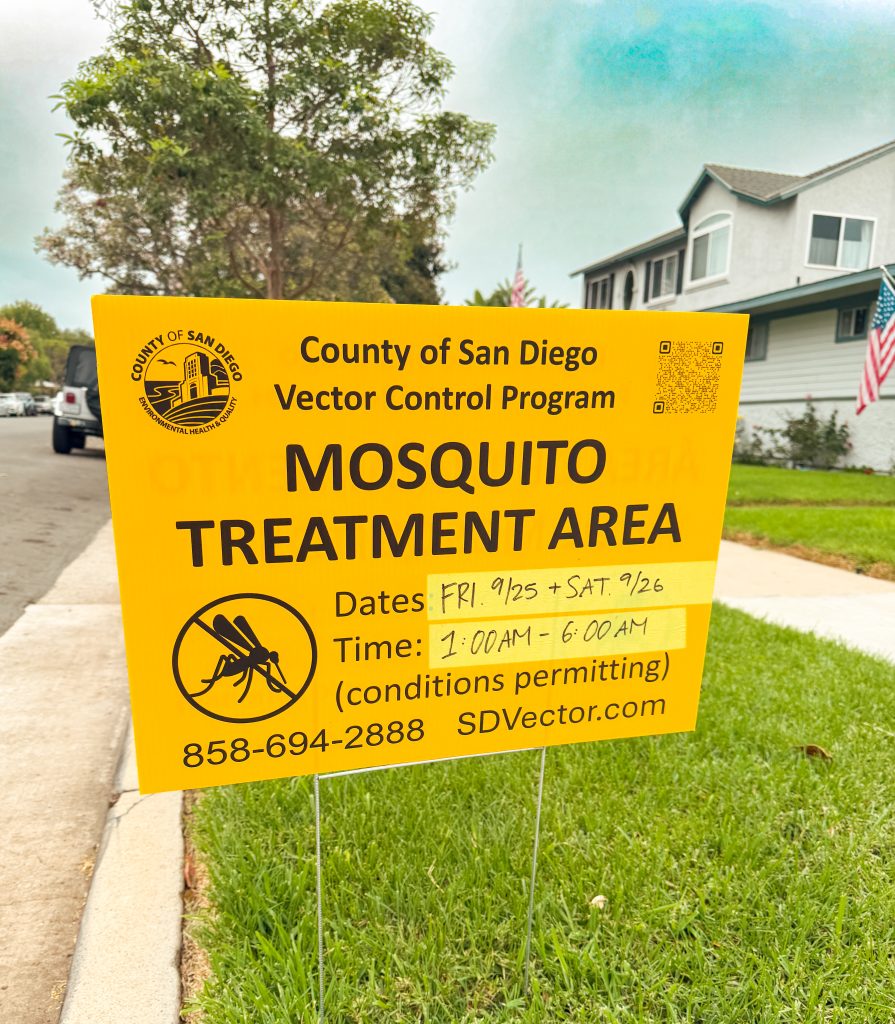
Coronado residents may want to consider taking precautions before the planned spray of pesticide mist treatments to combat the mosquito-transmitted West Nile virus. The treatments are scheduled to take place from 1 a.m. to 6 a.m. on Friday, Sept. 25 and from 1 a.m. to 6 a.m. on Saturday, Sept. 26, according to the county.
The area being treated includes from 2nd Street in the north to Ocean Boulevard in the south, F Avenue in the west, and Glorietta Boulevard to the east.
“Adult mosquito control works very quickly to reduce the numbers of adult mosquitoes in a localized area,” said Donna Durckel, communications officer with the county. “This can provide immediate relief from mosquitoes and help prevent the spread of disease.”
She said the areas being sprayed are where the West Nile virus positive mosquitos have been found. But areas outside of the treatment area will likely see an overall decrease in mosquito activity as well.
The products used in adult mosquito treatments have been evaluated by the Environmental Protection Agency for safety and will not harm people or pets, according to the county. The pesticide used is called AquaDuet, which mimics natural insecticides found in chrysanthemum flowers.
How does it work? Depending on the situation, these products may be applied with hand-held, backpack, portable, and/or truck-mounted equipment by vector control technicians certified by the California Department of Public Health. The pesticide is applied into the air as fine mist that kills adult mosquitoes upon contact and then rapidly disappears — often, within minutes.
The county says it is not necessary to stay inside or close doors and windows during the treatment, but residents may feel more comfortable doing so. When applied as an ultra-low volume spray, the droplets will disappear quickly and should be gone within 30 minutes.
Residents with outdoor fishponds or bee hives should cover them during the treatment.
Additional optional precautions may include:
- Keep pets indoors during spraying. Wash any pet food and water bowls that were left outside during the treatment
- Wash homegrown fruits and vegetables with water as you would typically do before cooking or eating them
- Wait 30 minutes after the treatment before going outside
- Wipe down or cover outdoor items such as toys and barbecue grills
Additional treatments may also be applied the following week, depending on conditions.
But some residents don’t think spraying the area with pesticides is such a good idea. Animal advocate and environmental law expert Christine Mott says the pesticide indiscriminately kills all insects like bees, butterflies, and other pollinators. It can also harm animals that eat those insects like birds, bats, and fish.
“The spray is not harmless and the risks have not been properly disclosed to residents,” she wrote in an online community forum. “There are other ways of controlling mosquito populations and protecting people from West Nile. Blanket poisoning is not the answer.”
Mott urged residents with concerns to call the county at 858-694-2888.
Emily Jones, a Coronado resident and wildlife biologist, says she is torn because she wants to reduce the mosquito population, but she’s worried about the effects of the pesticides, especially on her fruit bearing trees.
And she says the pesticide is definitely toxic to other bugs, insects, and fish.
“I absolutely do not like that it is killing butterflies, caterpillars, moths, ladybugs and other beneficial insects,” she wrote in a community forum.
But Durckel says that the impact to other insects is minimal.
“Although some other insects could be affected, we minimize these effects by our strategies such as treating at night to avoid bees and other insects that are active during the day, using products at their label rate, and informing residents to cover any hives or other insect habitats that they want to protect,” she said.
Meanwhile, to avoid mosquito bites, doctors suggest residents to cover themselves with clothing, spray their bodies and clothing with a DEET spray, and avoid being outside at dawn and dusk, when mosquitos are most active.
While West Nile virus can be deadly, 80% of all infections don’t present with symptoms, according to Dr. William Bianchi, director of the emergency room at Coronado Sharp Hospital. He acknowledged that it’s very likely that many people in Coronado are walking around with the West Nile virus and don’t even know it.
About 20% of people who contract West Nile get a fever. Less than 1% of those infections progress to something called neuroinvasive disease, or a brain infection.
“Those are the ones that I get really worried about,” said Dr. Bianchi. “So when we look at risk factors for people that might get severe disease, age is certainly a risk factor.”
If residents experience symptoms (mild illness such as headache, fever, nausea, fatigue, skin rash or swollen glands) after getting bit by a mosquito, he says its important to stay hydrated, drink fluids, and self-manage with Tylenol or ibuprofen.
Only a blood test can confirm if you truly have West Nile virus, and there is no cure.
“It’s essentially an untreatable viral infection,” he said. “But if people get really severe symptoms, if they aren’t able to eat or drink because of it, or their headache is really severe, they should go to the hospital for supportive care.”
This could include intravenous fluids, breathing support and careful medical monitoring.
“If there is ever any concern, we’re always happy to see anybody in San Diego,” said Dr. Bianchi. “The Sharp Coronado Emergency Room is open 24/7, 365 days a year.”
RELATED, Sept. 22, 2026:
Three Coronado residents have West Nile Virus; County to conduct pesticide spray