




By Abby Berk, Ph.D.
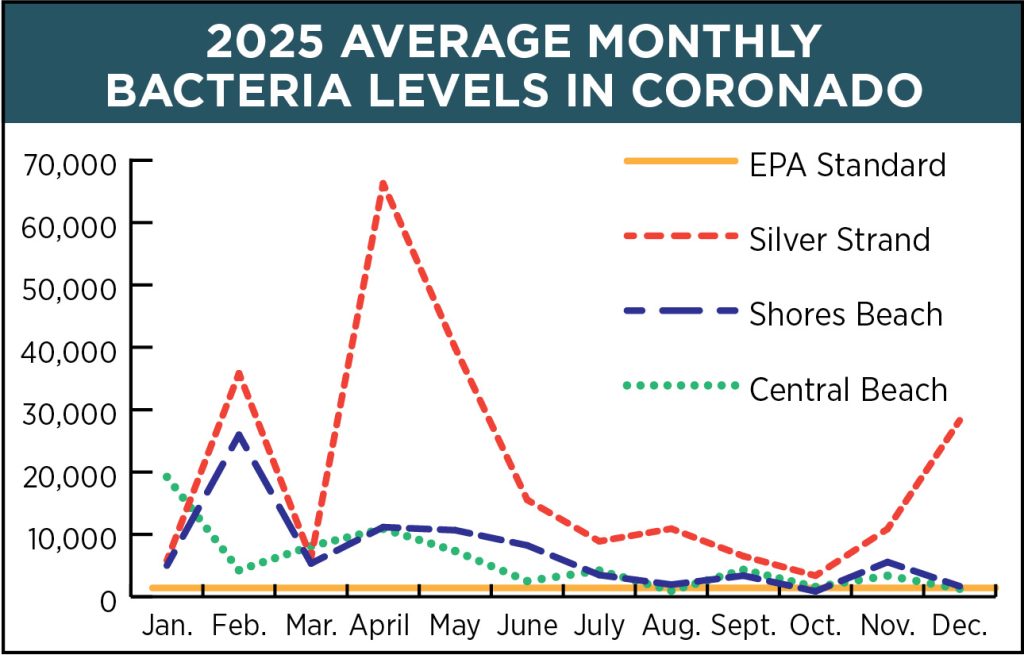
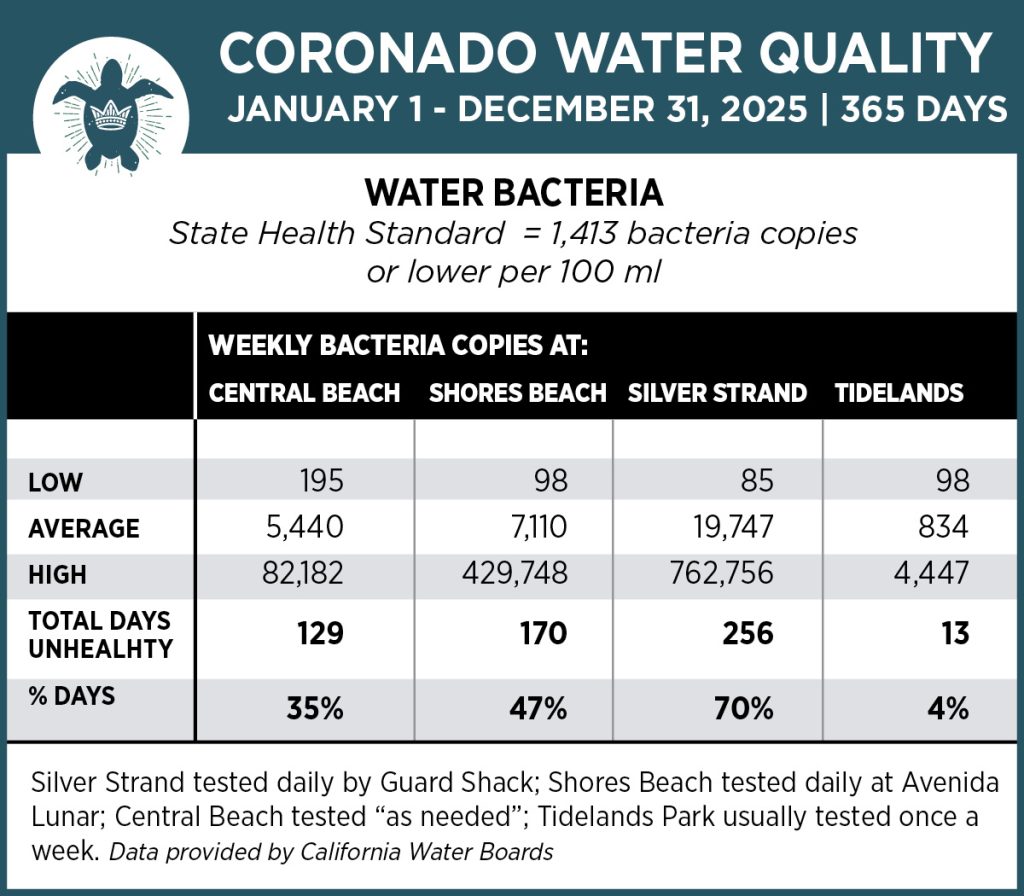
The ongoing sewage crisis dominated Coronado news in 2025. Beyond the headlines, Emerald Keepers analyzed the County of San Diego’s ocean water quality test results in Coronado to document the true extent of the contamination. In 2025, Coronado had unsafe water quality 256 days out of the year and during 50 out of the 52 weeks. At its peak, bacteria levels in Coronado waters were more than 500 times above safe levels.
TESTING
The San Diego County Department of Environmental Health and Quality samples, tests, and reports on water quality from over 120 locations around San Diego County, including four stations in Coronado and four along the Silver Strand. Using the EPA-approved digital droplet polymerase chain reaction (ddPCR), technicians count enterococci bacteria in the water samples as an indicator of fecal contamination. California water standards establish a high risk for illness when water samples exceed 1,413 copies of the enterococci bacteria per 100 milliliters.
LOCAL BACTERIA LEVELS
In 2025, the average across Coronado beaches was over 5,000 copies of bacteria per 100 ml of water — nearly four times the safe threshold. Significant bacteria spikes along the Coronado shoreline include:
- Central Beach: 82,182 bacteria copies on May 6, 2025.
- Shores Beach: 429,748 bacteria copies on Feb. 7, 2025.
- Silver Strand Guard Shack: 762,756 bacteria copies on April 13, 2025.
While October 2025 offered the best conditions of the year, the monthly average bacteria count of 2,055 was still above the safe limit. The peak tourist months of June, July, and August had more than 80% of days with unhealthy bacteria levels in at least one Coronado location.
 TESTING SCHEDULE
The Department of Environmental Health and Quality collects water samples around 8 a.m. daily (including holidays) for processing. Preliminary results are typically available by 5 p.m. that day and are posted on the County website sdbeachinfo.com. The Shores and Silver Strand at the guard shack are scheduled to be tested daily. Central Beach is tested on an “as needed basis” — usually dependent on the Shores results from the previous day.
One exception to the testing schedule is after rainfall. If precipitation exceeds 0.2 inches, the County stops testing and issues an automatic advisory, assuming high bacteria levels due to runoff.
For example, water testing was suspended for eight days after heavy rainfall on Nov. 15, 2025. When sampling resumed on Nov. 24, bacteria levels were still above the health standard. This means actual annual bacteria averages are likely much higher than the reported data suggests, as the most contaminated days are often excluded from official counts.
HOLIDAY TESTING
Inconsistent testing left beachgoers at risk during major holidays. Because Central Beach is not tested daily, data and advisories can be outdated:
- Fourth of July: No tests were conducted July 1–3. Based on June 30 data, the water was labeled safe throughout the holiday. When testing resumed the morning of July 4, bacteria levels were 14,137 (10x the limit). The advisory wasn’t issued until 5 p.m. on the holiday, after thousands had already been in the water.
- Labor Day: Central Beach was not tested for five days leading up to the holiday weekend. When testing resumed on Monday, Sept. 1, the results showed levels were at 11,423 (8x the limit) — too late for the holiday crowds.
Local and federal governments are focused on long-term infrastructure repairs to the sewage source. However, the immediate need is for greater transparency on water quality. Frequent, consistent testing — especially leading up to holidays — is essential for the public to make informed decisions about their health before entering the water.
Abby Berk is an Emerald Keepers board member.


This has been a problem for years and millions of dollars provided to fix it but obviously nothing worth noting has been done!!!!!! My question is when or is this sewage problem ever going to be resolved???? I have been sick off and on for the past few years and am demanding true accountability and solutions!!!!