




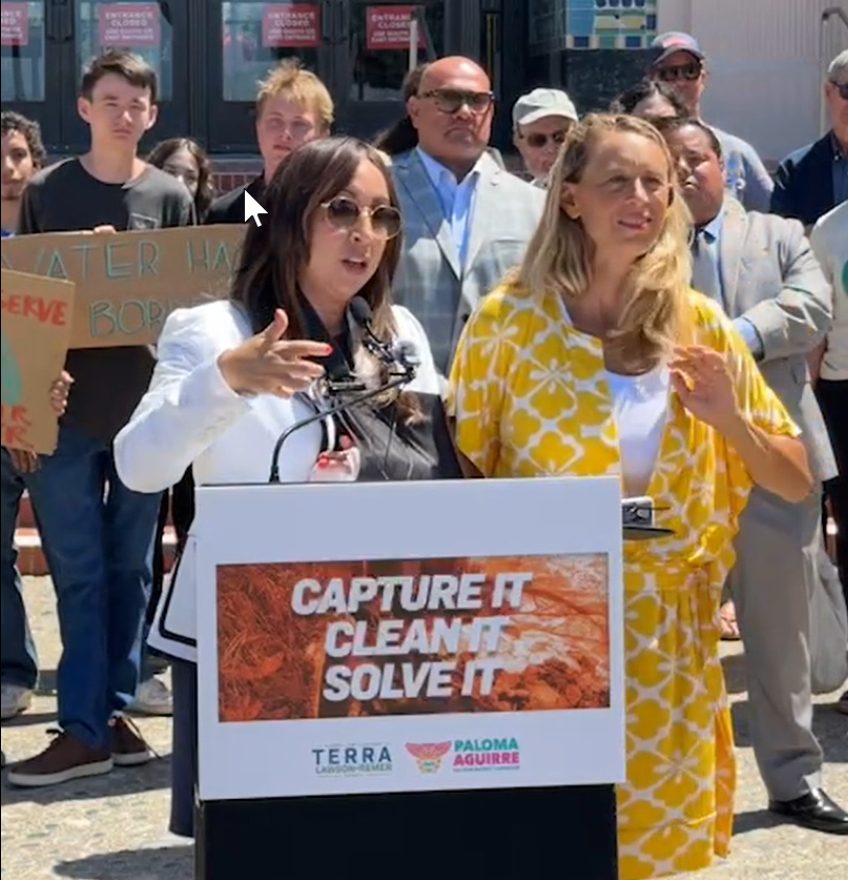
After years of being told to wait on Mexico and the federal government, two San Diego County supervisors announced Monday that they will request $5.8 million of the county’s own money to start planning sewage treatment infrastructure on U.S. soil.
The infrastructure would address the ongoing Tijuana sewage crisis, which for decades has polluted air and beaches in the South Bay and beyond.
Supervisors Terra Lawson-Remer and Paloma Aguirre will request an immediate $5.8 million in county funds through a board letter presented at the Sept. 1 meeting of the San Diego County Board of Supervisors.
Of that $5.8 million, $4 million would fund design of a permanent box culvert fix at Saturn Boulevard, running alongside a $2.5 million interim pipe extension the county already has underway there.
The remaining $1.8 million would pay for engineering work on a capture and cleanup system that Aguirre described as the first infrastructure the county would build to capture and treat river flows directly, on U.S. soil, rather than waiting on action from federal agencies or on Mexico.
“The South Bay has heard 60 years of promises,” Aguirre said. “This one comes with a budget.”
Currently, the International Boundary and Water Commission (IBWC) overseas sewage infrastructure in San Diego County that treats wastewater piped in from Tijuana. It does not currently treat water that has entered the U.S. through the Tijuana River. The U.S. section of the IBWC is in the midst of several infrastructure projects to address the sewage, the largest of them being the rehabilitation and expansion of the South Bay International Wastewater Treatment Plant.
What Lawson-Remer and Aguirre are proposing is that San Diego County build infrastructure of its own.
If approved, the board letter would also convert the board’s ad hoc Tijuana River subcommittee into a standing committee, which supervisors said is meant to keep the effort accountable to the public as it moves through future phases.
Most who live in the area have heard the numbers: the millions gallons of untreated sewage that flows through the Tijuana River daily, the hydrogen sulfide in the air in South Bay that measures 16 times the state standard, the region’s beaches, some of which have been closed for more than 1,400 consecutive days.
But those numbers have a human impact.
Twice, Virginia Castellanos has watched her daughter battle bouts of pneumonia, both following severe asthma flare-ups. Her family’s doctors believe the incidents were triggered by the air quality in their Imperial Beach neighborhood.
As a nurse for the South Bay Union School District, Castellanos said asthma is the most common chronic condition she treats in students, some of whom arrive at the nurse’s office with headaches, nausea and burning eyes on the days the smell from the Tijuana River is worst.
“There is nothing more frightening than watching your child struggle to breathe and wondering whether the air around them is contributing to their symptoms,” Castellanos said Monday, standing behind two San Diego County supervisors at a press conference.
UCSD Scripps researchers attributed roughly 34,000 illnesses annually to water pollution in Imperial Beach, according to the board letter.
Ash Israni, owner of the Pier South Hotel in Imperial Beach, said the smell has driven away guests and businesses along Imperial Beach Boulevard for years.
“We have people check in for a week, and they’ll stay two days,” Israni said. “They say, ‘We can’t get in the water, the water smells,’ and they leave. This is a disgrace for a country like the U.S., the richest country in the world.”
Lawson-Remer recalled being unable to swim in San Diego’s beaches as a child. Now her own daughter also cannot swim there.
“Families across San Diego County, and especially in South County, have been forced to bear the worst of this crisis: polluted beaches, toxic air, and health risks that are absolutely unacceptable,” she said. “This is an environmental injustice. When one community is forced to bear the cost of pollution, that is a problem for all of us.”
How the county could pay for it
Lawson-Remer said the county’s long-term plan hinges on the same financing model used for large public infrastructure elsewhere. For example, the $900 million Terminal 2 expansion at the San Diego International Airport was financed in part by bonding against future airport revenue. (It was also funded by airport cash reserves, FAA grants, and passenger use fees.)
Lawson-Remer said if the county secured about $80 million a year in guaranteed revenue, it could bond against it to raise close to $1 billion for treatment infrastructure.
Of course, the revenue would have to exist. One potential source is a countywide ballot measure this November that would raise the sales tax by a half-cent. It’s coined the San Diego County Health and Safety Act, and revenues from it could be used for matters of public health — including mitigating the ongoing sewage from Tijuana. Supporters project the measure would generate roughly $360 million a year, with 22 percent, or about $80 million annually, dedicated to Tijuana River pollution solutions if voters approve it.
Both supervisors said they were not taking a position on the measure and are pursuing state and federal funding regardless of its outcome. Lawson-Remer pointed to the county’s $100 million Behavioral Health Hub as a precedent for designing a project before its full funding is secured.
“It’s very hard to raise money for a project that you don’t have a design for,” Lawson-Remer said. In the case of the Behavioral Health Hub, the county self-funded design before seeking funding for the construction itself.
If approved, over the next 18 months, county staff would work through engineering, technology, site permitting and financing options, which Lawson-Remer said include diverting river flows, annexing or expanding the existing South Bay International Wastewater Treatment Plant, retrofitting other existing infrastructure, or building a new treatment plant.
Aguirre said any facility the county builds or operates would fall under the Clean Water Act and be regulated by the San Diego Regional Water Quality Control Board, and that governance would likely require a joint-powers agreement with other agencies, including the International Boundary and Water Commission, which holds federal jurisdiction over the area.
Councilmember Matthew Leyba-Gonzalez of Imperial Beach, San Ysidro School District board member Antonio Martinez, South Bay Union School District trustee Jose Lopez, and former Imperial Beach Mayor Serge Dedina attended the press conference in support.
“We’re not waiting anymore. We’re not passing the buck,” Aguirre said. “Not on our watch.”
The Board of Supervisors is scheduled to take up the board letter at its meeting on Sept. 1.


Supervisors Lawson-Remer and Aguirre should go back to the 1985 President Reagan and President Madrid agreement to keep treated and unreated Tijuana sewage south of the border and south of Tijuana and out of the Tijuana River. The U.S. committment, in return, was Colorado River water for Tijuana. Tijuana is still receiving Colorado River water in 2026. The Presidential successors to Reagan and Madrid did not enforce their 1985 deal about Tijuana sewage.
Blame the U.S.
The U.S. made a poor decision to import Tijuana sewage in the 1990s. That action continues to harm public health in the South Bay every day and has sent Tijuana sewage onto U.S. beaches since 1998. No Environmental Impact Report. No nearby public hearings.
There was hope in Trump 1.0.
Trump had hired Arcadis Engineers to analyze border sewage problems. Tijuana sewage was being sent south of Tijuana by new and larger sewage pumps. The changed sewage pumps that sent Tijuana sewage south had yielded 4 months of clear South Bay waters in 2019 until the pumps were stopped. The California Governor had signed a bill that would send Tij more and more Tijuana sewage north for partial treatment and into the ocean off Imperial Beach. Why didn’t anyone tell us who swim and live here?
Beaches would have been open now.
Arcadis – of Trump 1.0 – had also mentioned a solution to keep Tijuana sewage waters off U.S. beaches. Send Tijuana sewage waters to the Point Loma Ocean Outfall from the South Bay Sewage (partial) Treatment Plant.
Northbound Tijuana sewage hurts the U.S.
Tijuana sewage impacts have accelerated downhill since the 4 months of clear waters seven years ago. Worse, the minds of local to State to Federal officials have been made-up since 2019. The Mayor of Coronado is critical of social media sewage discussions that do not want to increase sewage treatment for Tijuana sewage. “Lets Talk Sewer” and “C4” – Citizens for Coastal Conservancy – and Coronado sites are the only places where residents can ask and answer questions on sewage matters.
Sewage impact testimony ignored.
A Coronado Shores Association spokesman and longtime Shores residents spoke about beach sewage impacts at a recent Coronado City Council meeting. A map of the Coronado Littoral Current – that carries the U.S.- released sewage to our beaches – was projected for all to see by a speaker for C4. There was no mention of either event in two Coronado print newspapers.
No direct feedback allowed.
Constituent phone calls to elected officials about sewage remedies are cut short and letters are not read. A flyer to open local beaches was met with laughter by environmental advocates. Why?
The impacts of a 2019 California law.
Many of us have just learned why our elected officials do not want to hear our opinions. Our elected officials are not open to Tijuana sewage solutions because they made up their minds to treat Tijuana sewage in the U.S. “from now on” in 2019. Many voters upset by sewage still do not know why our representatives have deaf ears. I was one. It did not hit me until 2 weeks ago – at the Coronado City Council meeting. It was clear that Coronado had made up its mind years ago to import Tijuana sewage. No wonder sewage problems and sewage solutions are left out of Press coverage of the Council meeting in Coronado.
U.S. Sewage problem #1:
Why does the Coronado Times not mention in its sewage summaries that it is U.S. actions that close U.S. beaches. And that the U.S. can fix that.
Tijuana doesn’t have a sewage problem.
South San Diego has a sewage problem.
South Bay San Diego communities are now Tijuana’s Sewage Annex in the United States. What a great deal for Tijuana!
Sewage Problem #2:
The U.S. did not repair the storm-damaged channel of the Tijuana River in the Tijuana River Valley after two big storms since 2000. The U.S. cannot blame that on Tijuana. The breaks in the channel have led to a slower river on a different course. The curved, slowed, river now flows by homes and drops sewage and pollutants in the Valley to accumulate (!) year after year.
The President is right.
President Trump believes that other countries take advantage of the U.S. I think that some unknowns in Baja have counted on the arrogant U.S. attitude that has lead San Diego to volunteer to treat Tijuana sewage. I have been told by many that “Tijuana doesn’t know how to run a sewage treatment plant.” Balderdash. Yet Tijuana can build a modern airport that is the busiest in Mexico, impressive new highways and buildings? The U.S. is gullible.
There is a border sewage remedy.
Enforce the agreement made by President Reagan and President Madrid in 1985. The successors to both Presidents did not enforce their agreement. President Trump may be our only opportunity to reverse the present U.S. Tijuana sewage policy. President Trump has the gumption to meet with President Sheinbaum to enforce the 1985 actions to provide Colorado-River-water-for-Tijuana in exchange for Keeping-all-Tijuana-sewage-south-of-the-border. AND for Tijuana to keep untreated sewage out of the Tijuana River. What better time than now. Colorado River waters are low, the USMCA (US-Mexico-Canada) is undergoing change.
Two Supervisors can do it.
The plan of two San Diego County Supervisors’ to process the untreated Tijuana sewage in the river will not open beaches and will not “stop the stink” in the River Valley. Instead, why not go for the whole package that both Supervisors must want. Enforce the 1985 President Reagan – President Madrid Agreement.
Tijuana Sewage will be treated south of Tijuana and untreated Tijauana sewage will be kept out of the Tijuana River in Tijuana. In return Tijuana will continue to receive water from the Colorado River.
Sounds like the beginning of another CA high speed train. Over 50 years this has been happening and the population of Tijuana is booming creating even more sewage for us to swim in. Someone has to have the courage to own this problem. Do something. Do not allow any Tijuana officials access to the USA. If they have property here, seize it. Do something other than put signs up showing the water is polluted. This is beyond ridiculous. That money should go to a study to show how it has poisoned our beautiful beaches. I finally quit walking on the beach without any shoes on because I know it cannot be healthy to grind my toes into human waste.
What a joke! $5M won’t accomplish anything.
Totally agree on that comment. $5MM?? It will pay for another study or go into the pockets of Mexican officials. Thank goodness I didn’t buy in Coronado!