




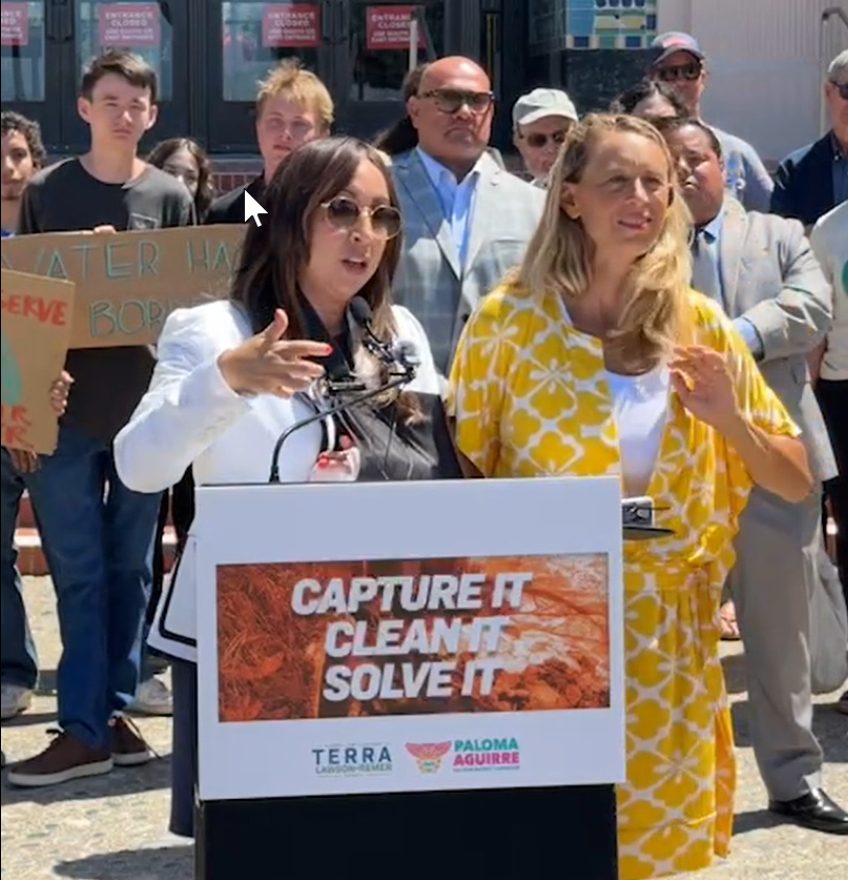
After years of being told to wait on Mexico and the federal government, two San Diego County supervisors announced Monday that they will request $5.8 million of the county’s own money to start planning sewage treatment infrastructure on U.S. soil.
The infrastructure would address the ongoing Tijuana sewage crisis, which for decades has polluted air and beaches in the South Bay and beyond.
Supervisors Terra Lawson-Remer and Paloma Aguirre will request an immediate $5.8 million in county funds through a board letter presented at the Sept. 1 meeting of the San Diego County Board of Supervisors.
Of that $5.8 million, $4 million would fund design of a permanent box culvert fix at Saturn Boulevard, running alongside a $2.5 million interim pipe extension the county already has underway there.
The remaining $1.8 million would pay for engineering work on a capture and cleanup system that Aguirre described as the first infrastructure the county would build to capture and treat river flows directly, on U.S. soil, rather than waiting on action from federal agencies or on Mexico.
“The South Bay has heard 60 years of promises,” Aguirre said. “This one comes with a budget.”
Currently, the International Boundary and Water Commission (IBWC) overseas sewage infrastructure in San Diego County that treats wastewater piped in from Tijuana. It does not currently treat water that has entered the U.S. through the Tijuana River. The U.S. section of the IBWC is in the midst of several infrastructure projects to address the sewage, the largest of them being the rehabilitation and expansion of the South Bay International Wastewater Treatment Plant.
What Lawson-Remer and Aguirre are proposing is that San Diego County build infrastructure of its own.
If approved, the board letter would also convert the board’s ad hoc Tijuana River subcommittee into a standing committee, which supervisors said is meant to keep the effort accountable to the public as it moves through future phases.
Most who live in the area have heard the numbers: the millions gallons of untreated sewage that flows through the Tijuana River daily, the hydrogen sulfide in the air in South Bay that measures 16 times the state standard, the region’s beaches, some of which have been closed for more than 1,400 consecutive days.
But those numbers have a human impact.
Twice, Virginia Castellanos has watched her daughter battle bouts of pneumonia, both following severe asthma flare-ups. Her family’s doctors believe the incidents were triggered by the air quality in their Imperial Beach neighborhood.
As a nurse for the South Bay Union School District, Castellanos said asthma is the most common chronic condition she treats in students, some of whom arrive at the nurse’s office with headaches, nausea and burning eyes on the days the smell from the Tijuana River is worst.
“There is nothing more frightening than watching your child struggle to breathe and wondering whether the air around them is contributing to their symptoms,” Castellanos said Monday, standing behind two San Diego County supervisors at a press conference.
UCSD Scripps researchers attributed roughly 34,000 illnesses annually to water pollution in Imperial Beach, according to the board letter.
Ash Israni, owner of the Pier South Hotel in Imperial Beach, said the smell has driven away guests and businesses along Imperial Beach Boulevard for years.
“We have people check in for a week, and they’ll stay two days,” Israni said. “They say, ‘We can’t get in the water, the water smells,’ and they leave. This is a disgrace for a country like the U.S., the richest country in the world.”
Lawson-Remer recalled being unable to swim in San Diego’s beaches as a child. Now her own daughter also cannot swim there.
Families across San Diego County, and especially in South County, have been forced to bear the worst of this crisis: polluted beaches, toxic air, and health risks that are absolutely unacceptable,” she said. “This is an environmental injustice. When one community is forced to bear the cost of pollution, that is a problem for all of us.”
How the county could pay for it
Lawson-Remer said the county’s long-term plan hinges on the same financing model used for large public infrastructure elsewhere. For example, the $900 million Terminal 2 expansion at the San Diego International Airport was financed in part by bonding against future airport revenue. (It was also funded by airport cash reserves, FAA grants, and passenger use fees.)
Lawson-Remer said if the county secured about $80 million a year in guaranteed revenue, it could bond against it to raise close to $1 billion for treatment infrastructure.
Of course, the revenue would have to exist. One potential source is a countywide ballot measure this November that would raise the sales tax by a half-cent. It’s coined the San Diego County Health and Safety Act, and revenues from it could be used for matters of public health – including mitigating the ongoing sewage from Tijuana. Supporters project the measure would generate roughly $360 million a year, with 22 percent, or about $80 million annually, dedicated to Tijuana River pollution solutions if voters approve it.
Both supervisors said they were not taking a position on the measure and are pursuing state and federal funding regardless of its outcome. Lawson-Remer pointed to the county’s $100 million Behavioral Health Hub as a precedent for designing a project before its full funding is secured.
“It’s very hard to raise money for a project that you don’t have a design for,” Lawson-Remer said. In the case of the Behavioral Health Hub, the county self-funded design before seeking funding for the construction itself.
If approved, over the next 18 months, county staff would work through engineering, technology, site permitting and financing options, which Lawson-Remer said include diverting river flows, annexing or expanding the existing South Bay International Wastewater Treatment Plant, retrofitting other existing infrastructure, or building a new treatment plant.
Aguirre said any facility the county builds or operates would fall under the Clean Water Act and be regulated by the San Diego Regional Water Quality Control Board, and that governance would likely require a joint-powers agreement with other agencies, including the International Boundary and Water Commission, which holds federal jurisdiction over the area.
Councilmember Matthew Leyba-Gonzalez of Imperial Beach, San Ysidro School District board member Antonio Martinez, South Bay Union School District trustee Jose Lopez and former Imperial Beach Mayor Serge Dedina attended the press conference in support.
“We’re not waiting anymore. We’re not passing the buck,” Aguirre said. “Not on our watch.”
The Board of Supervisors is scheduled to take up the board letter at its meeting on Sept. 1.